Tags
Just as the birth of the Marvel in 1956 marked the beginning of a long line of Suwa-conceived models that was to define the main navigational course of Seiko’s development as one of the most important watchmakers in the world, so the Cronos two years later marked the beginning of its own parallel dynasty that would sire the King Seiko line of succession as well as some of the most creative output through this most vibrant period in Seiko’s history. The Cronos was conceived as a thinner, higher-performance alternative to the Marvel and represented the first three-hander with a centre seconds hand produced by the Daini Seikosha division.
The earliest examples of the Marvel featured no shock protection at all but subsequent iterations initially sported an ‘anti-shock’ moniker on the dial with the shock protection provided by an adaptation of the Swiss Incabloc system. That evolved into an early incarnation of the now familiar three-pointed Diashock spring, its three prongs engaging and disengaging from the setting beneath by rotation of the spring. By 1958, the matured design of the proprietary Seiko antishock system had emerged but it is a little difficult to unpick exactly at what point the term Diashock was being used in reference to adaptations of the Incabloc system or to Seiko’s own system. The reason for my uncertainty in the timeline will become apparent shortly in our exploration of a 1958 example of the Seiko Cronos J14013.
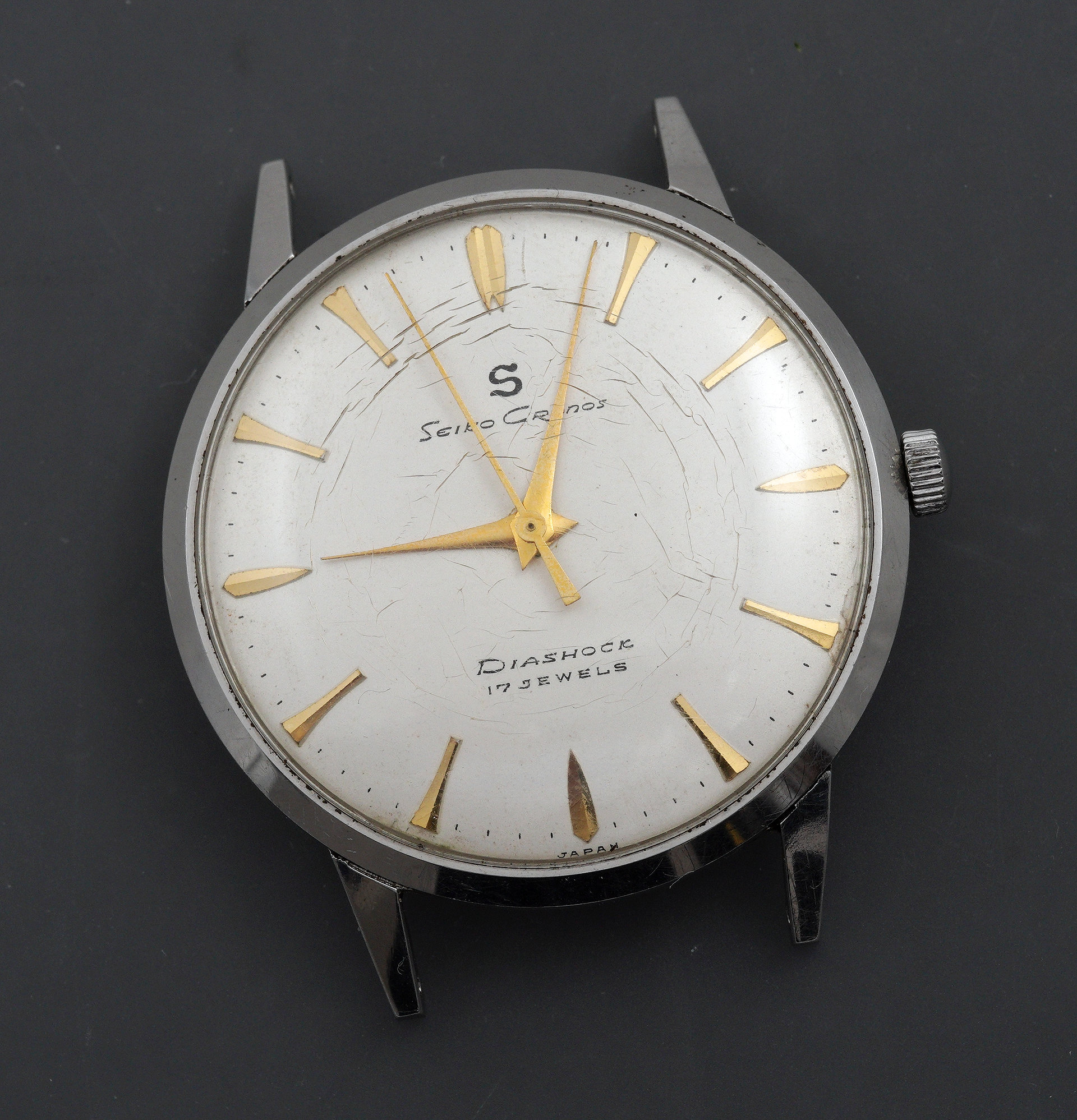
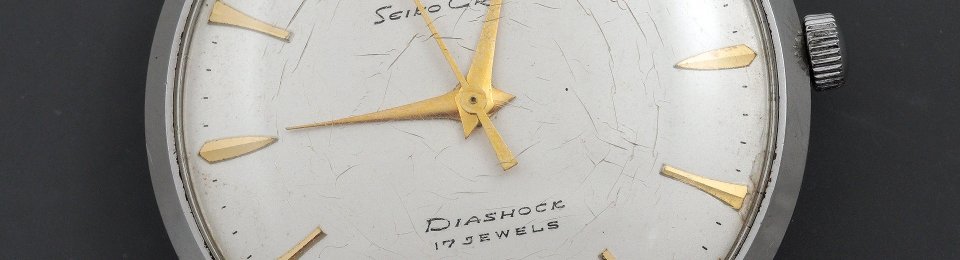
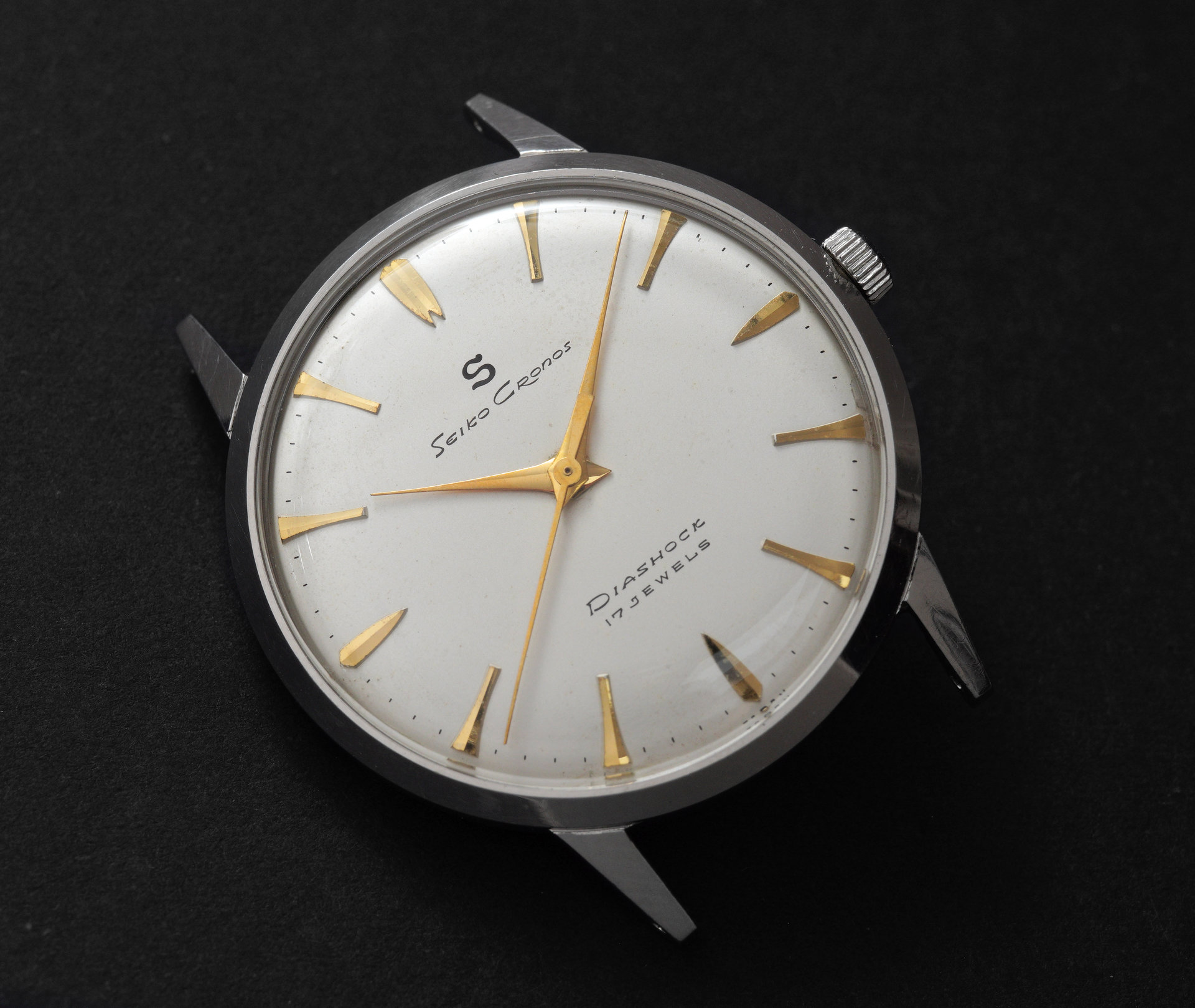
The pairing of a stainless steel case with a dial with gold accents was a common combination in late-1950s Seiko watches and so questions of either dial or case substitutions having occurred in the intervening 68 years can be dismissed. Externally, this watch presents very nicely indeed, aside from the crazing of the acrylic crystal. The case back interior, however, reveals evidence of water intrusion at some point.
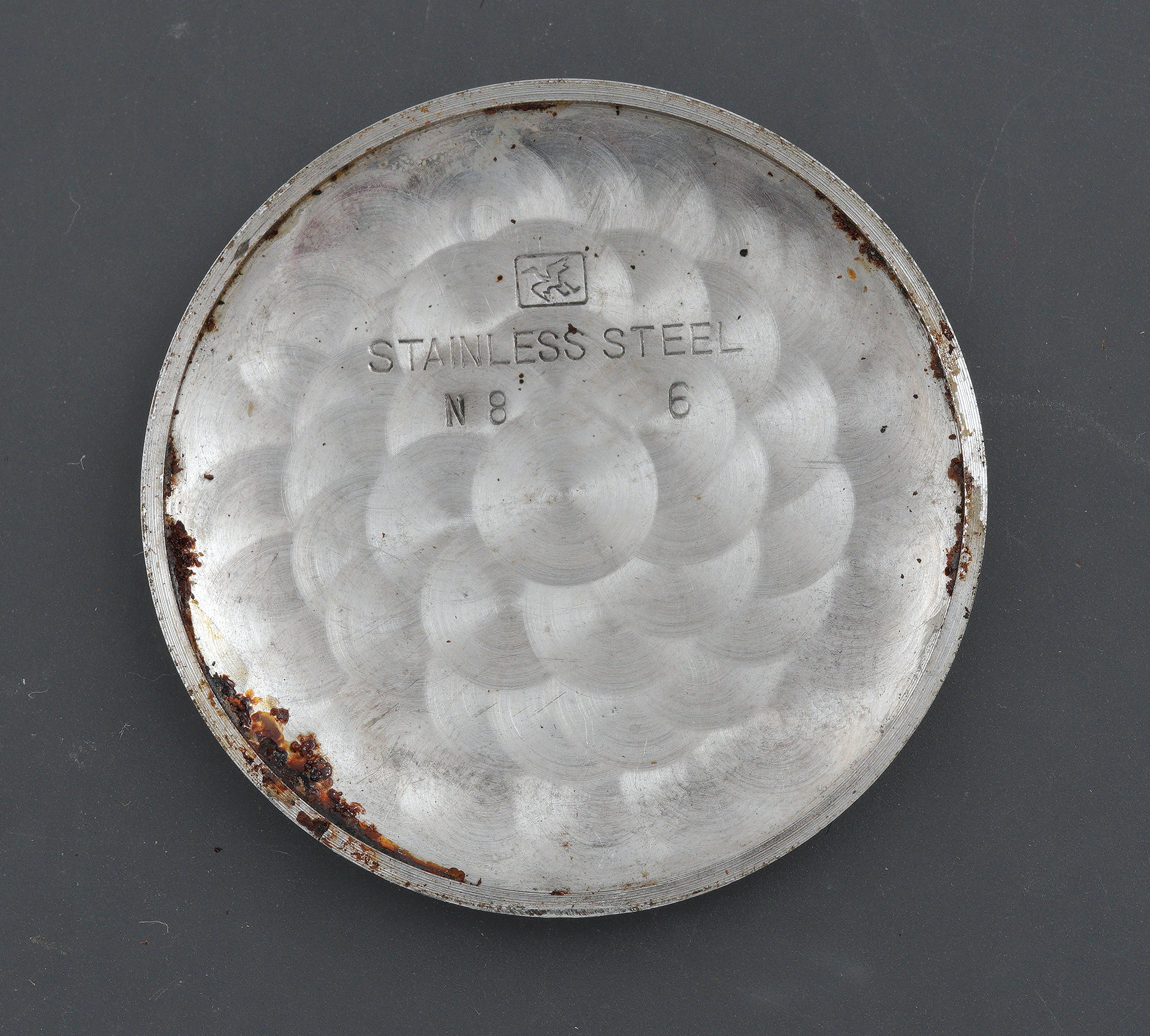
The imprinted crane symbol signifies that this watch is a product of Daini Seikosha factory in Tokyo. Notice also that in 1958, the month symbol in the serial number precedes the year, that order reversing within a year or two to the familiar dating system used by Seiko to the present day. The rust encircling the case back is duplicated in patches around the periphery of the mid-case.
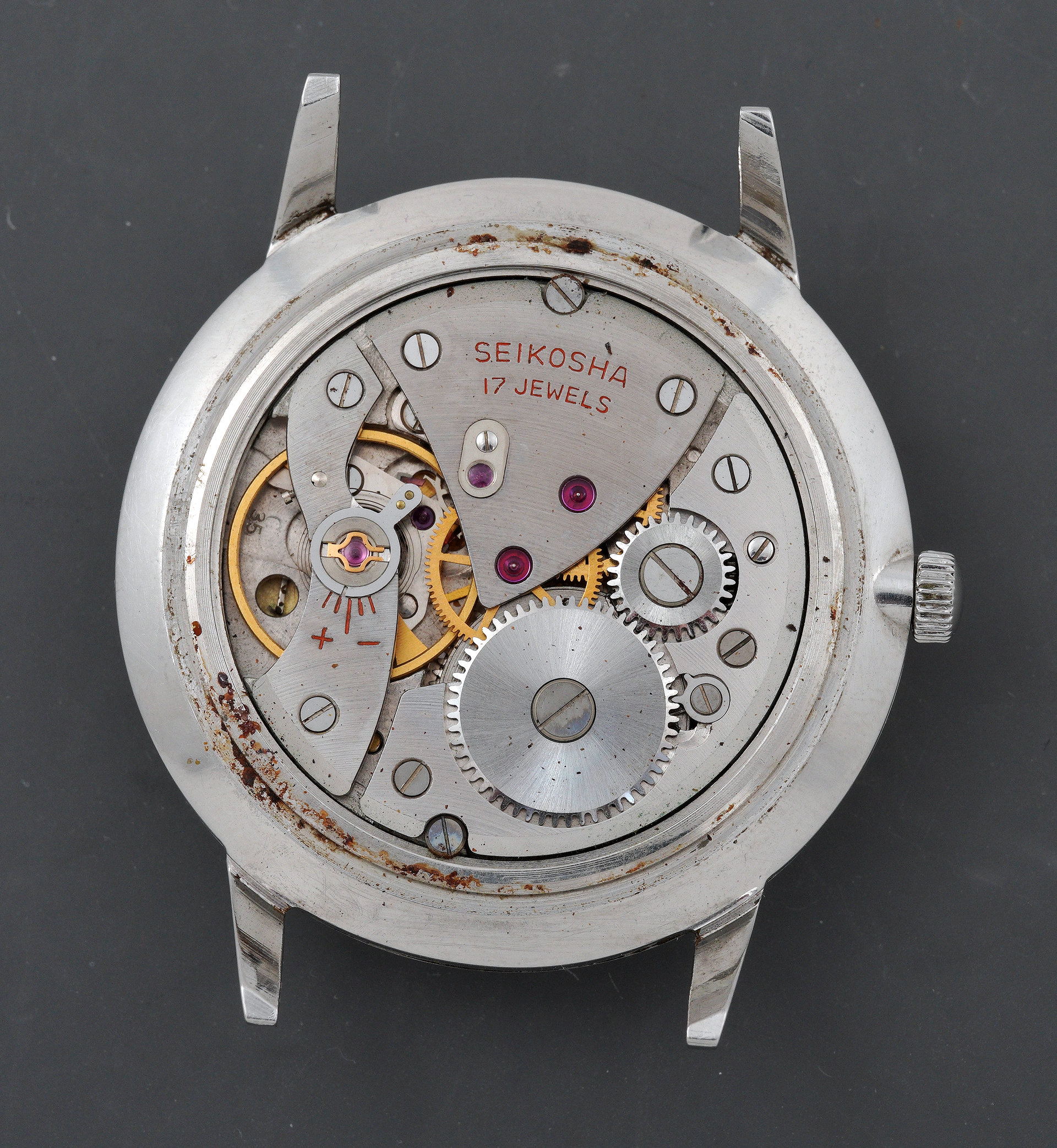
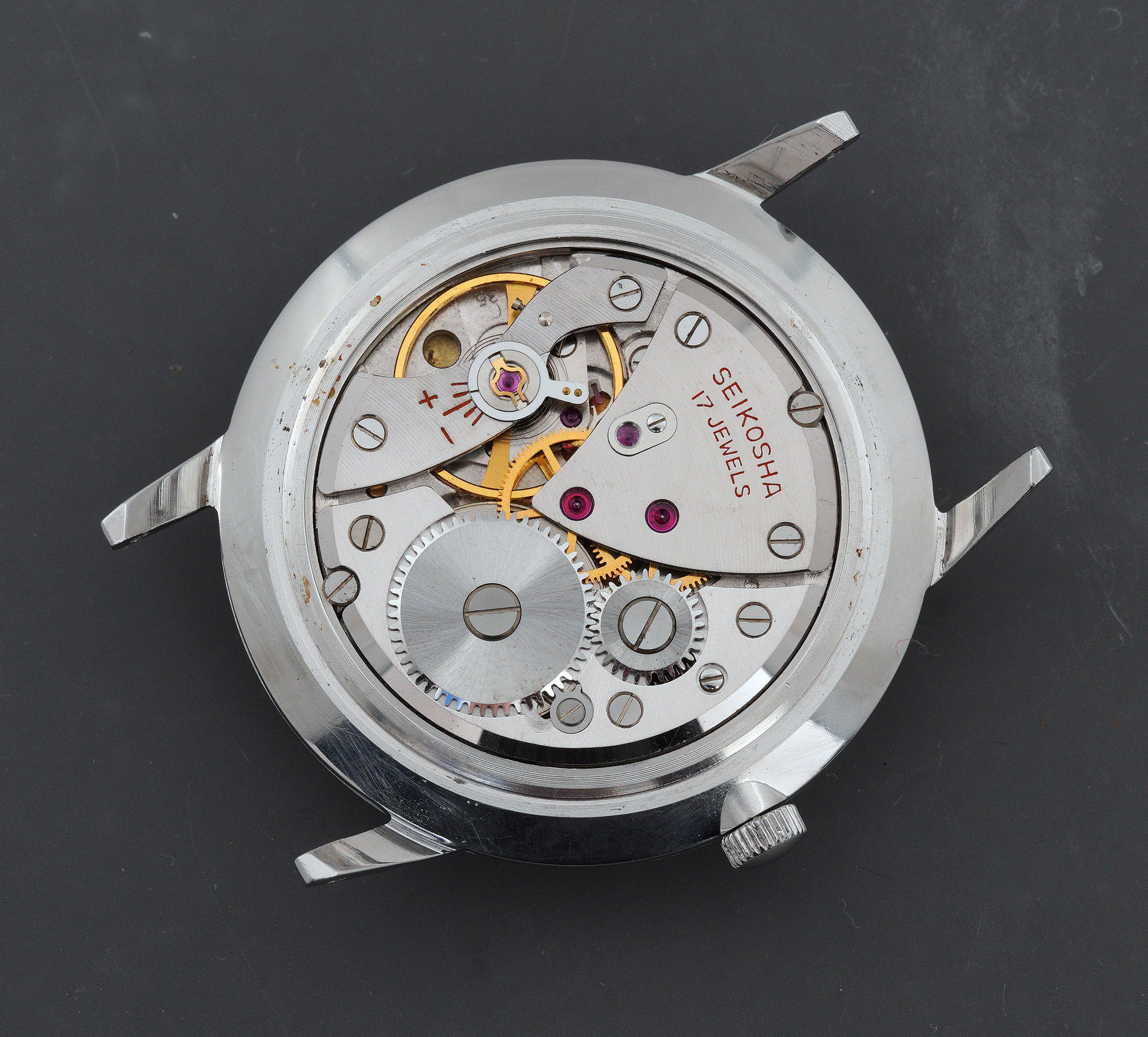
This perspective more importantly provides us with nice view of the familiar Cronos movement design, one which was to cross-pollinate to the Champion sub-brand as well as evolve into the King Seiko. The most intriguing element of the movement for me is the presence of what appears to be an adaptation of the Incabloc shock-protection system on the balance in a watch advertising Diashock on its dial. 1956 is noted by Seiko as the year of the birth of Diashock and yet this late 1958 watch uses the Swiss system. Further insights from readers welcome on this point. One other issue that the owner of this watch had wanted correcting was the downward attitude of the lower right lug, the victim presumably of an impact most likely under the influence of gravity. You may be able to see the extent to which the lug shown in the upper right of the photo above is not aligned with its partner on the left.
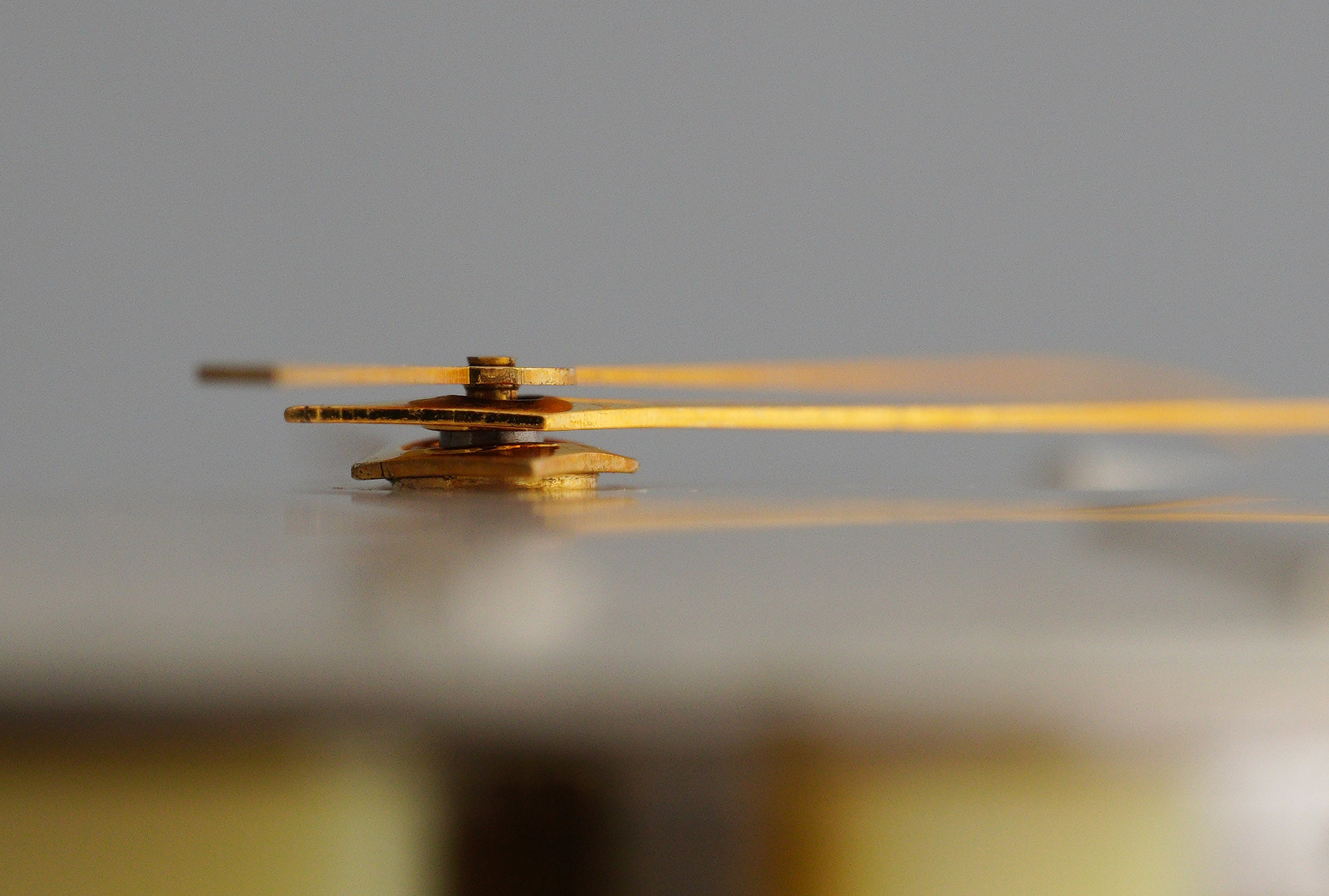
This being the familiar three-part case used in most Seiko watches until water-proofing became a consideration, the movement is removed from the top which requires first that we remove the bezel and crystal as a single unit. The hands are removed at this point to avoid snagging them while manoeuvring the movement out of the case but in mulling the logistics, I noticed that the sharp, downwards curving edges of the base of the dauphine hour hand had been touching the dial, gouging a circular groove around the centre hole.
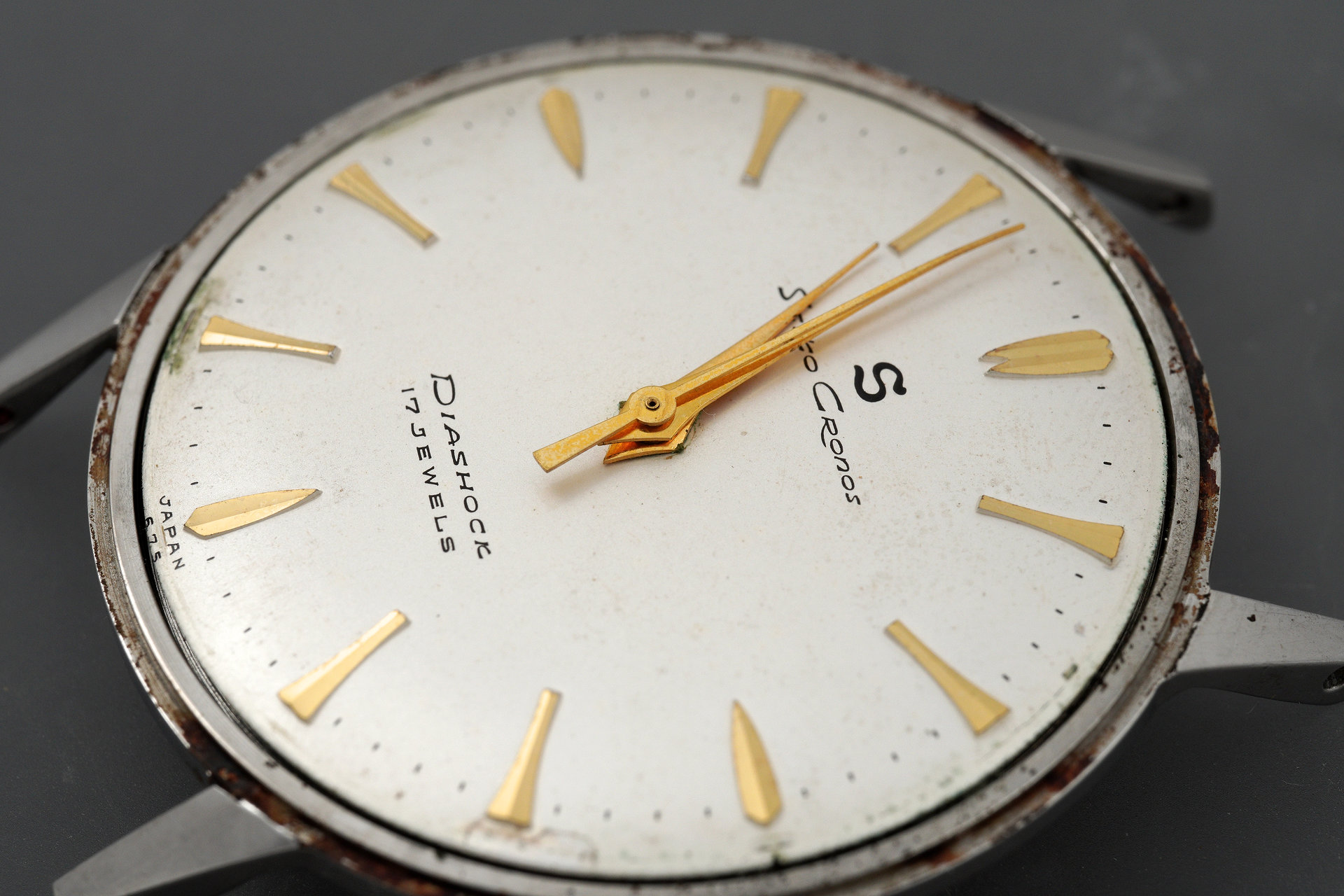
To avoid inflicting further damage and to aid in providing a little clearance for my hand levers, I slid in a Bergeon dial protector with the slot orientated parallel with the line connecting the two apexes of the hour hand.
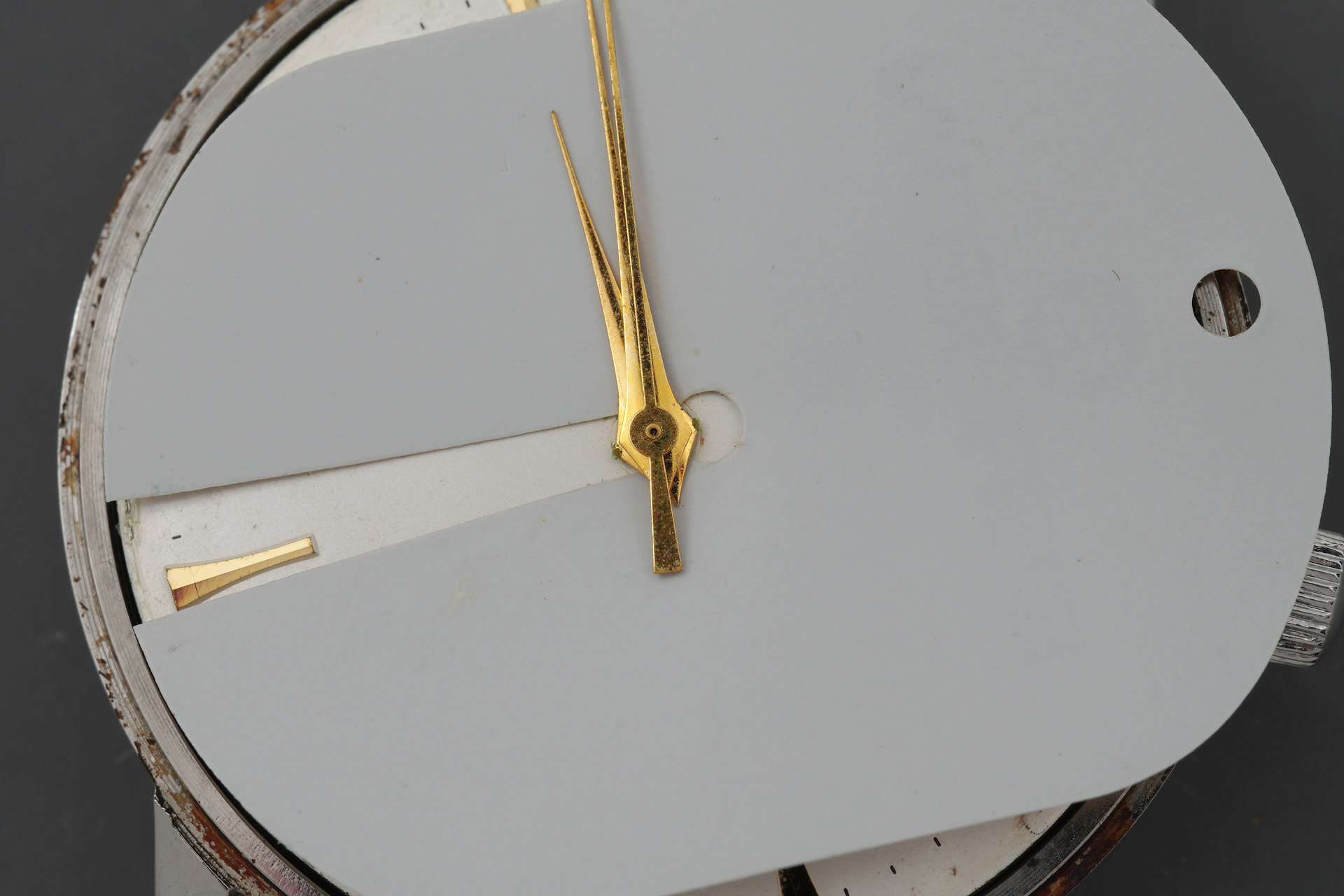
This cleared a safe passage for the levers, and the hands popped off their posts without protest.
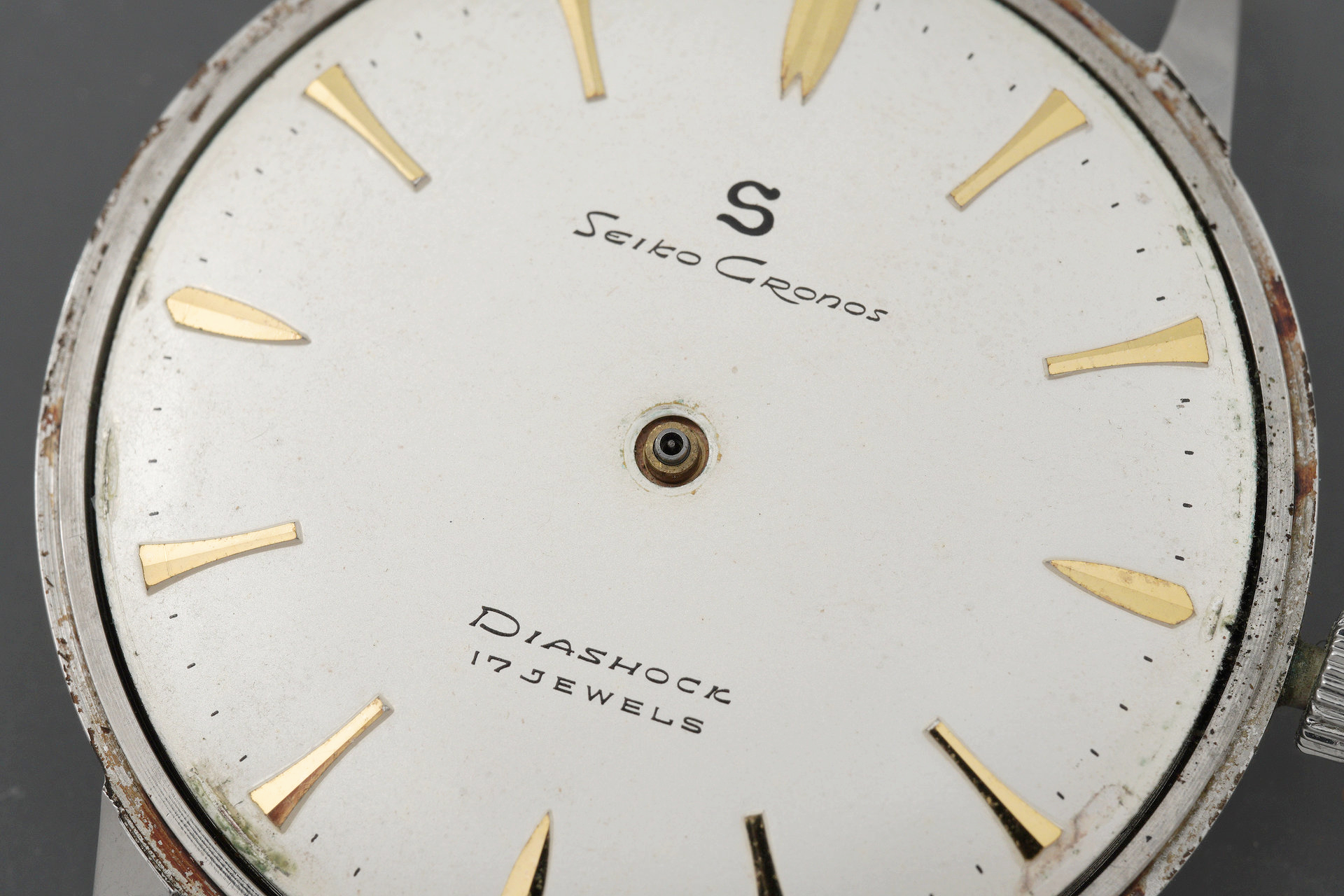
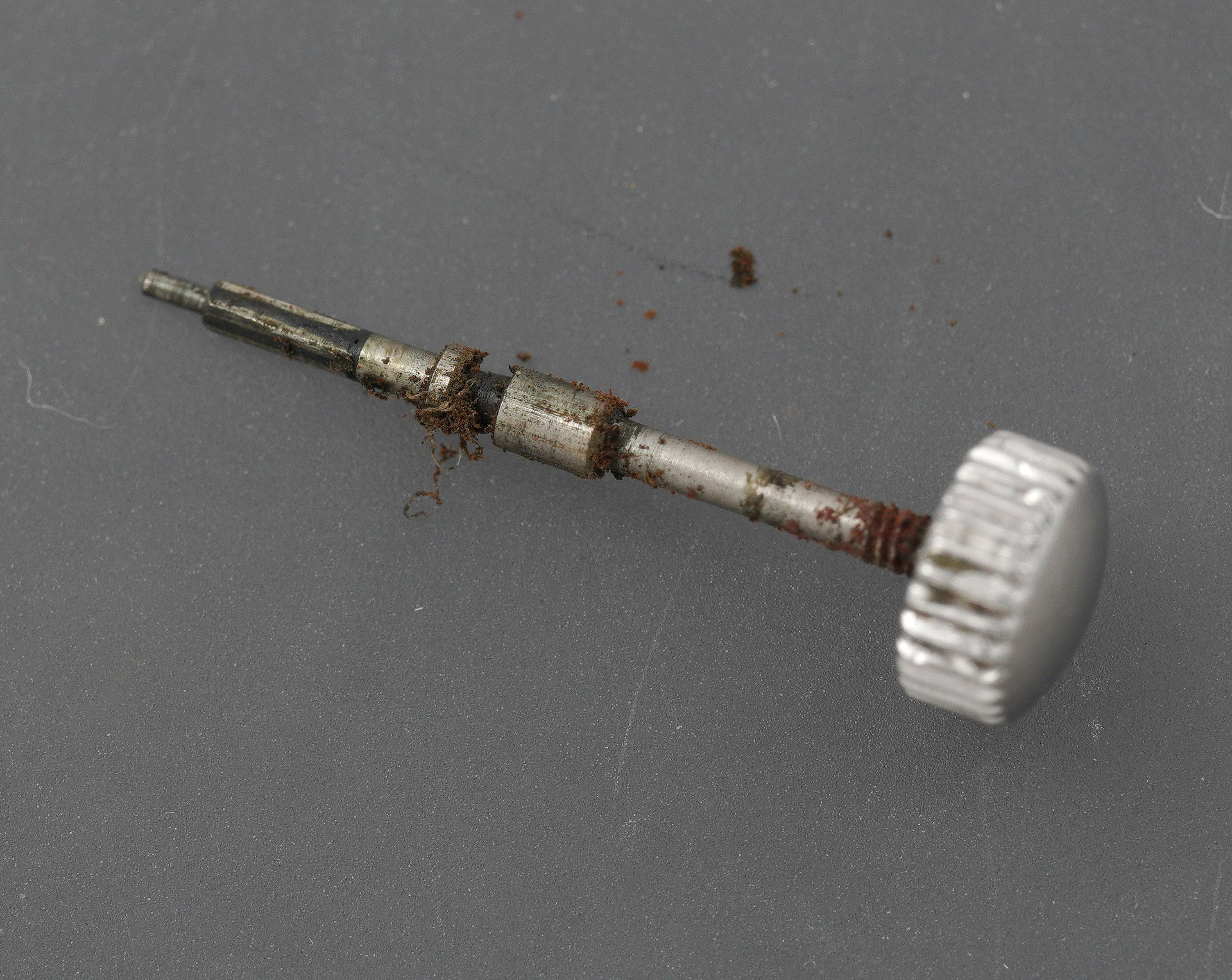
In order for the movement to be lifted away from the case, the movement retaining screws must be removed from the rear and the crown and stem extracted. The condition of the latter provides evidence of a second route for water to have made its way into the case.
With the movement extracted from the case, the dial can be removed, exposing the dial side of the movement.
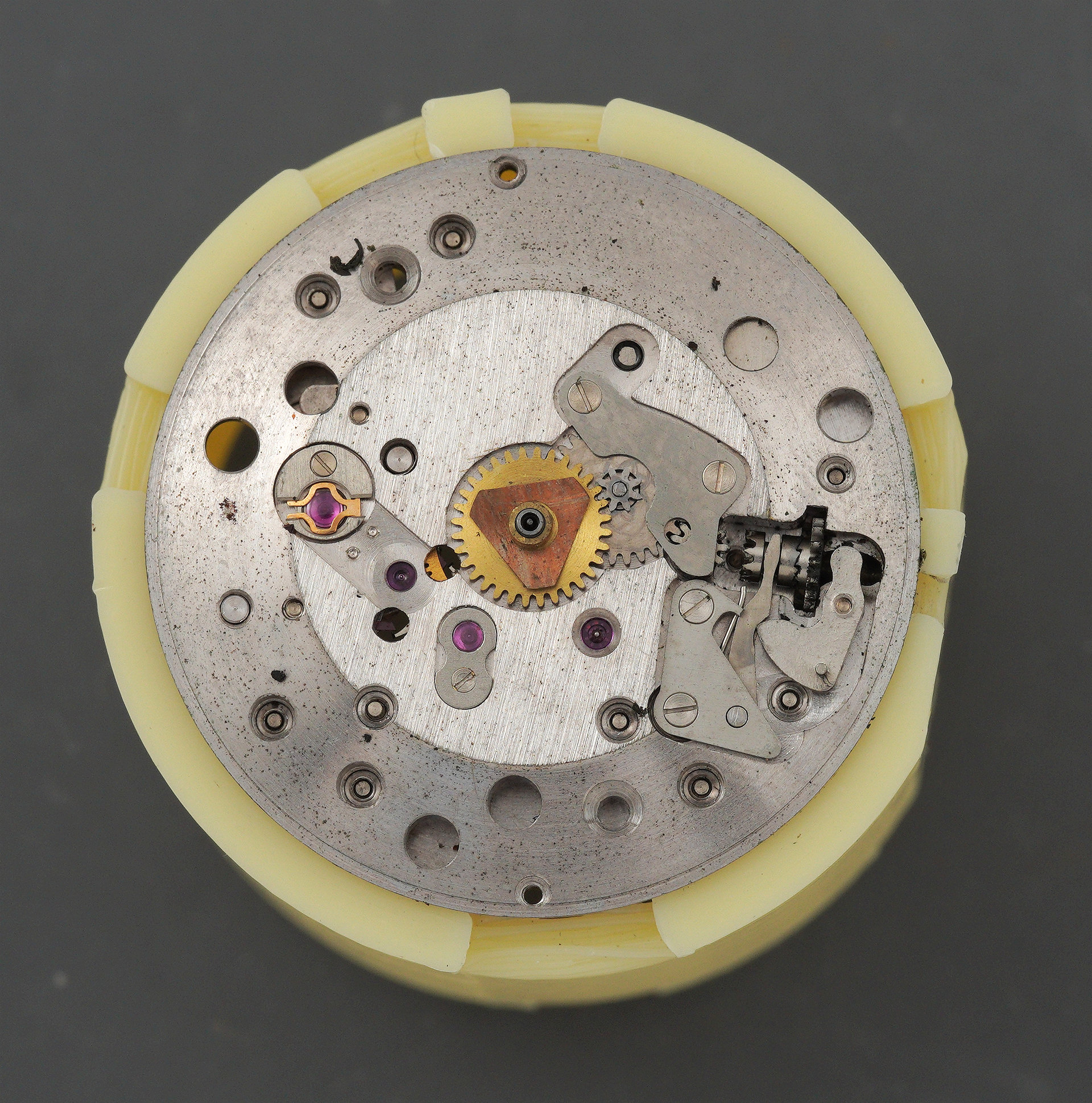
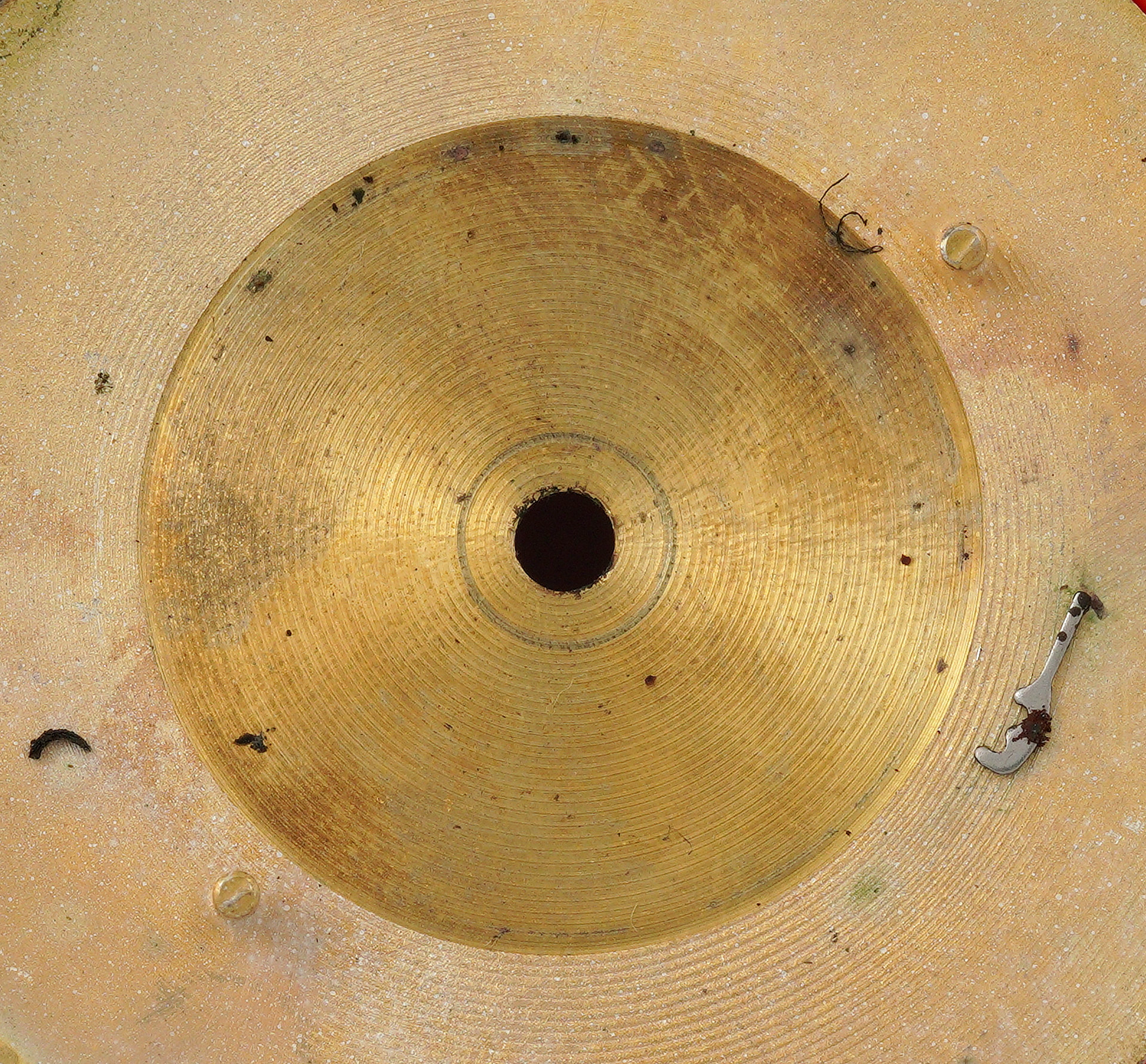
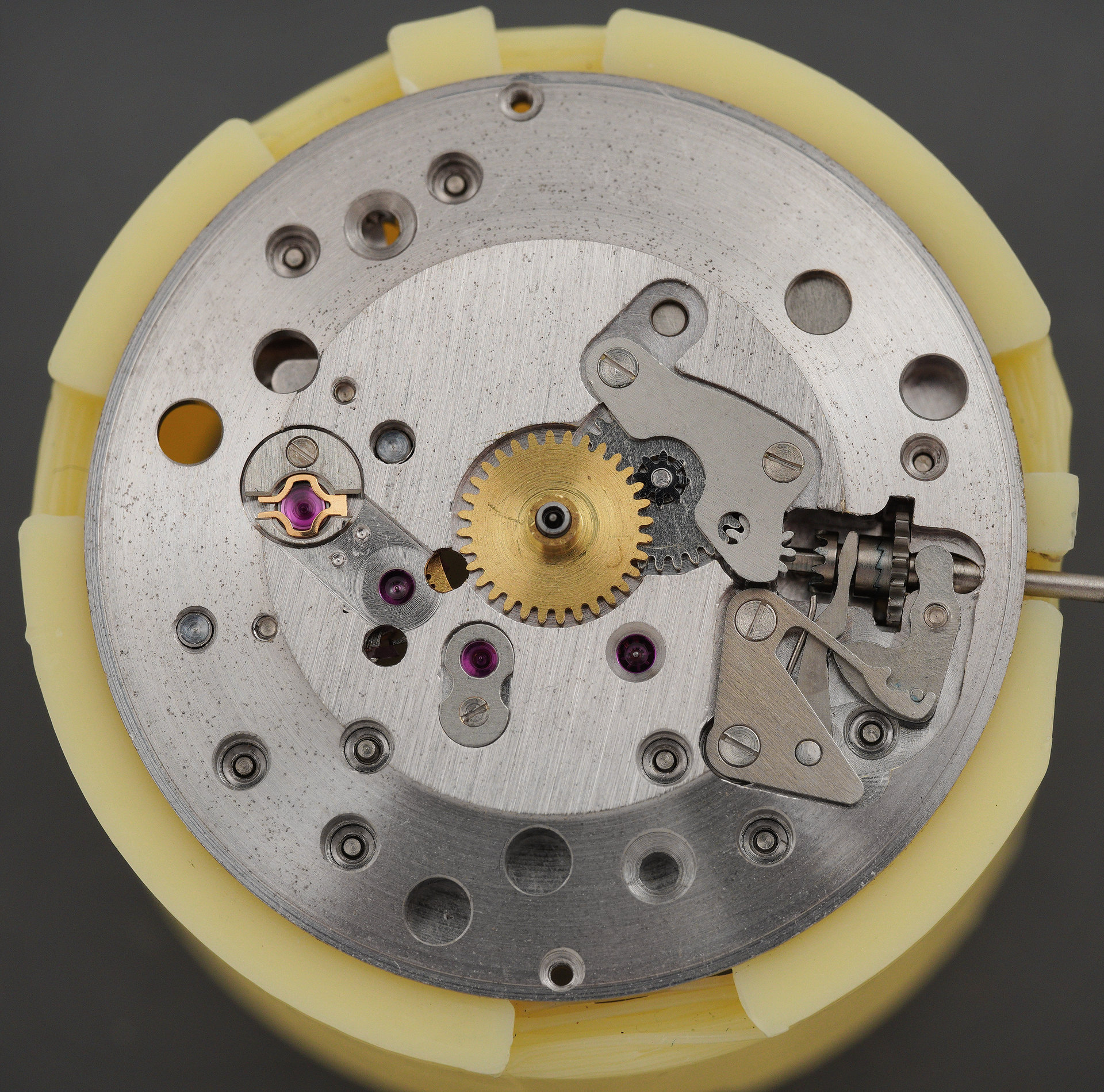
The most obvious and seemingly ubiquitous Cronos gremlin in evidence here is the broken setting lever spring. This is a failure that I’ve encountered in several other Cronos and early King Seiko movements, a vulnerability likely caused by the stresses of too many turns of the setting lever screw during previous stem removals. Those of you familiar with this family of movements will notice too that the design of the setting lever spring is different to that of later examples of the Cronos and its relations in that it does not have the second arm extending to protect the winding pinion. When seeing a fracture such as this, one might reasonably speculate about the location of the partner fragment. In this case, I located it adhered to the rear of the dial.
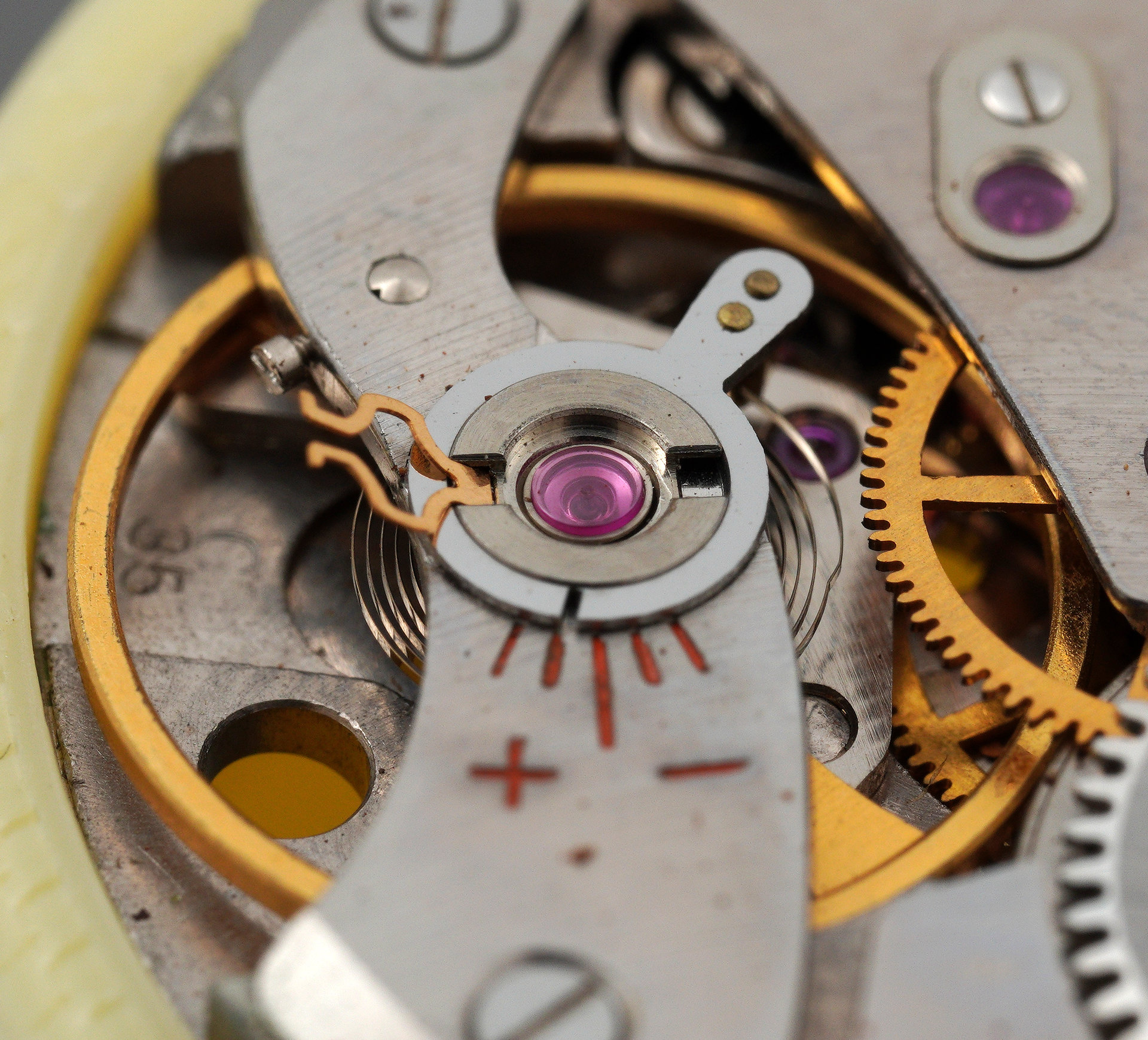
The other noteworthy aspect of the dial side of the movement is the duplication of the Incabloc-style shock protection.
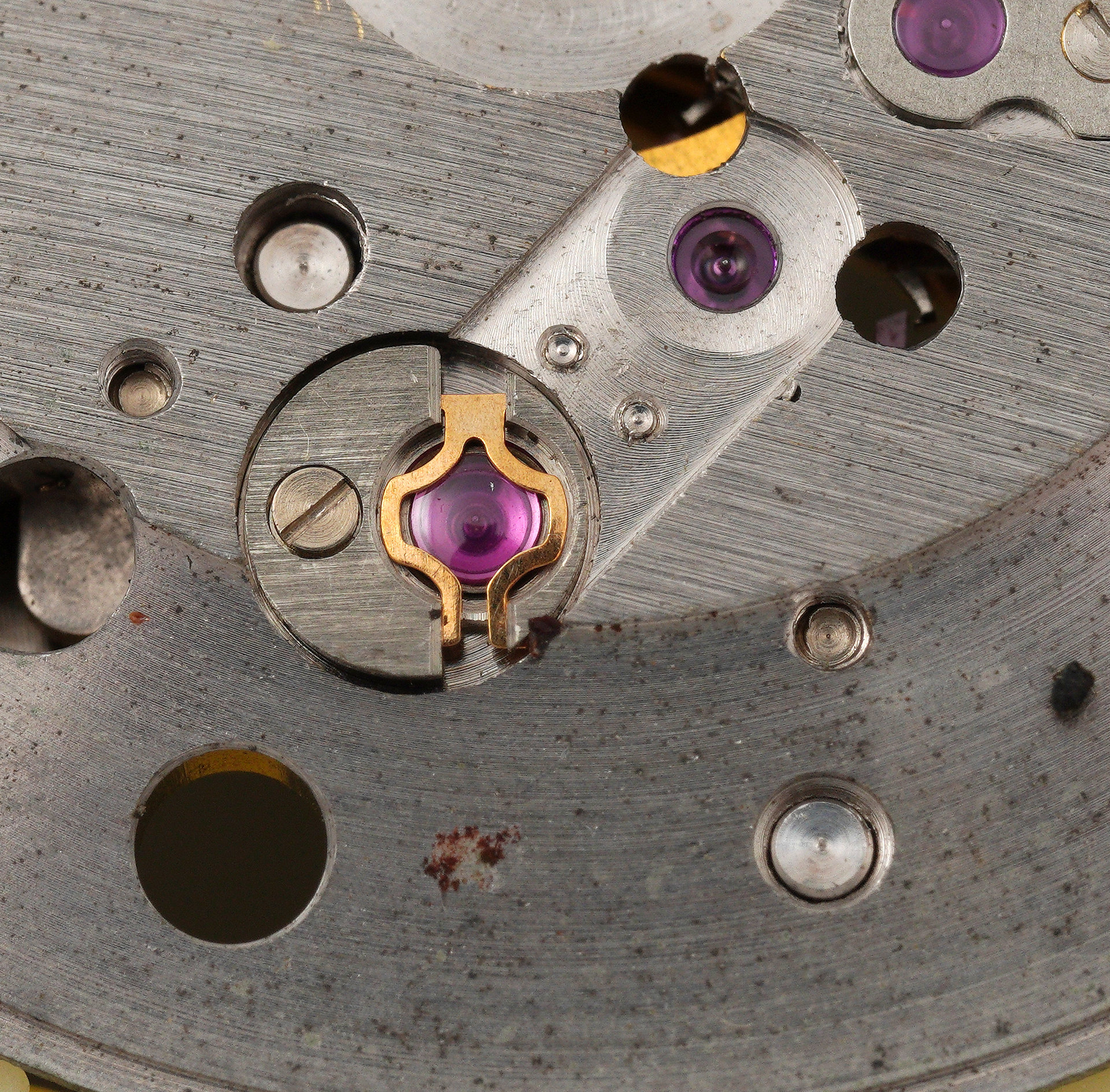
The seamless integration of the design with the main plate makes it clear that this design of shock protection is original to the movement and therefore broadens at least my understanding of what Seiko defined as a Diashock setting, although in this incarnation, its description as proprietary is, perhaps, stretching the definition of that word a little.
When I received this watch, it was not running and failed to respond to any encouragement to do so. As I was dismantling the movement, the cause of this became clear. The centre wheel pinion had become gummed up with fragments of corrosion, preventing the wheel from turning and leaving all that pent-up frustrated potential energy contained in the mainspring.
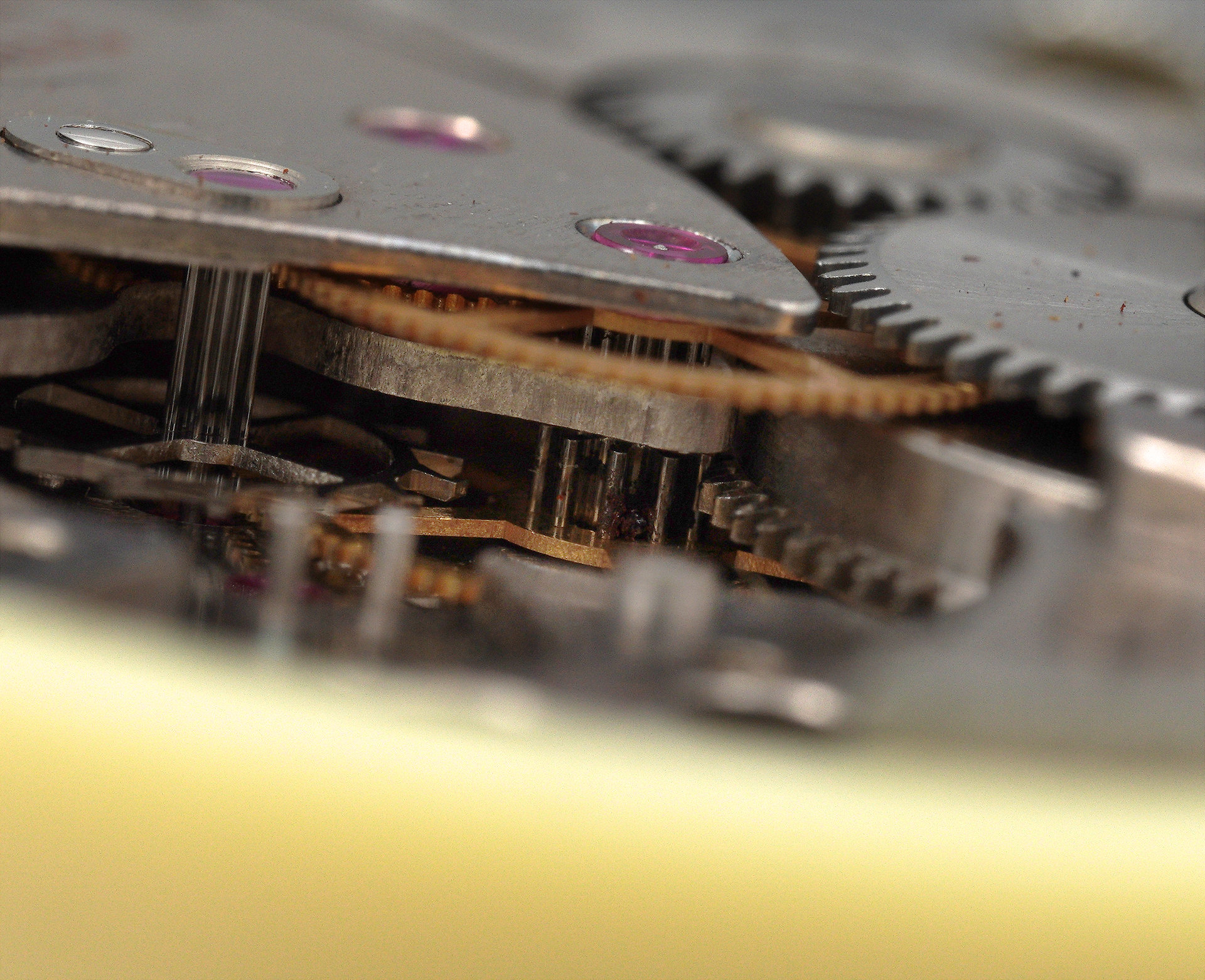
Before removing the balance, we need first remove the shock protection and in doing so in this case, can reveal the nature of the design used here.
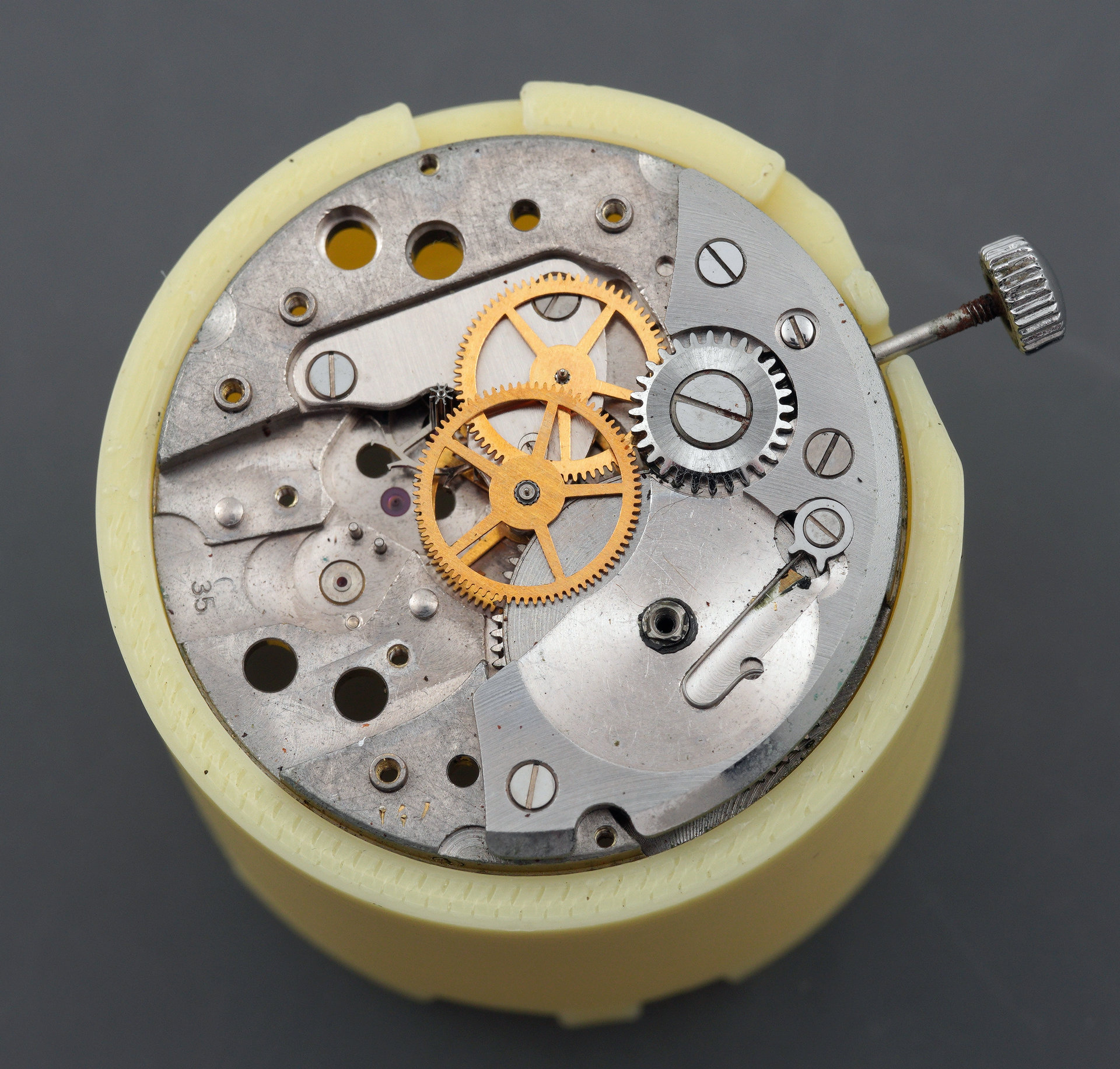
The deconstruction of this movement family being an oft-trod path in these here parts, I will skip through, pausing only to air a view of the partially stripped movement.
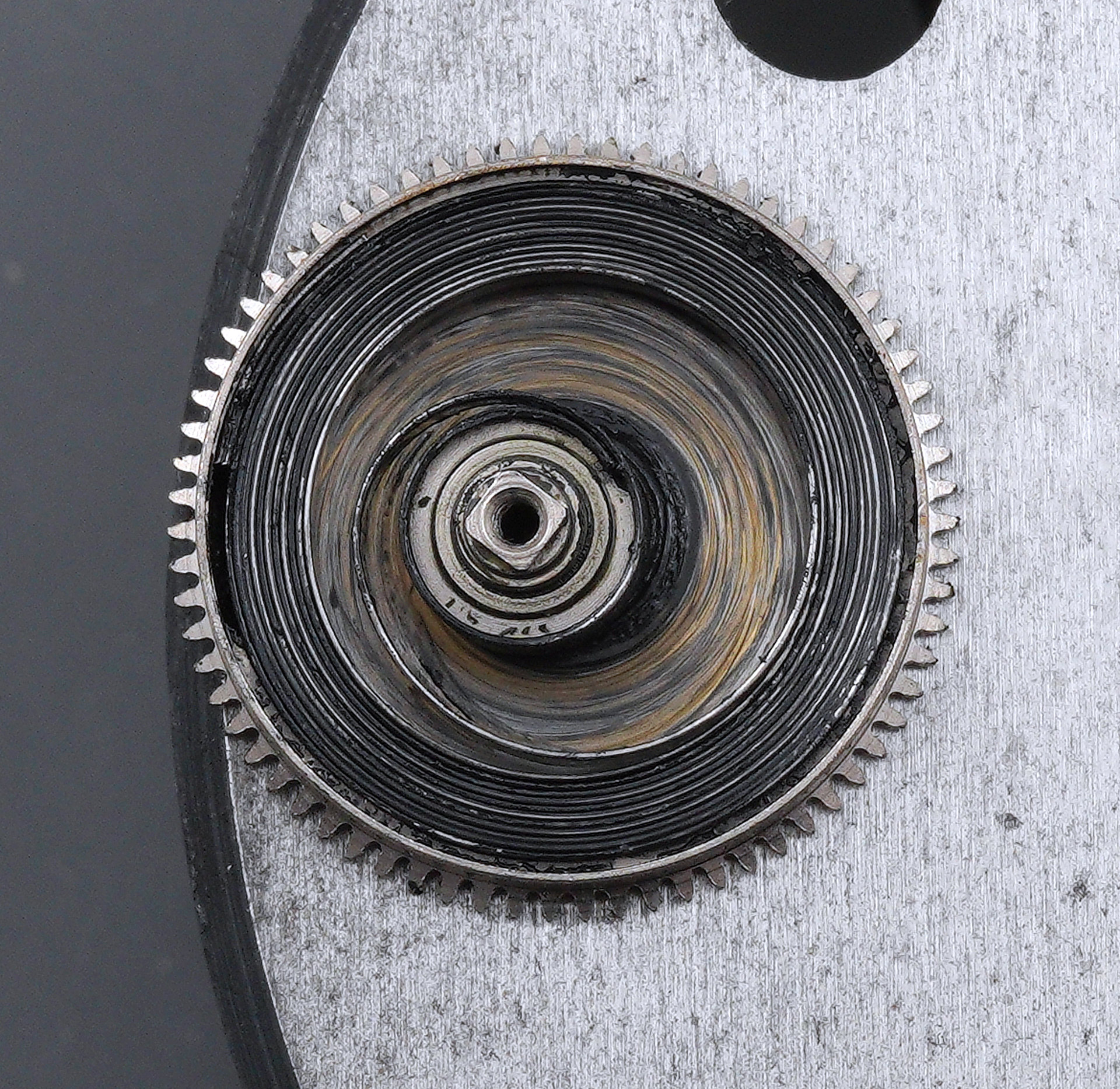
The original mainspring looked to be in very good condition, albeit slathered in goodly amounts of molybdenum grease.
Following cleaning, the movement reassembly begins. Here we are with the setting components partially assembled, and with the gear train fully assembled but awaiting the escapement.
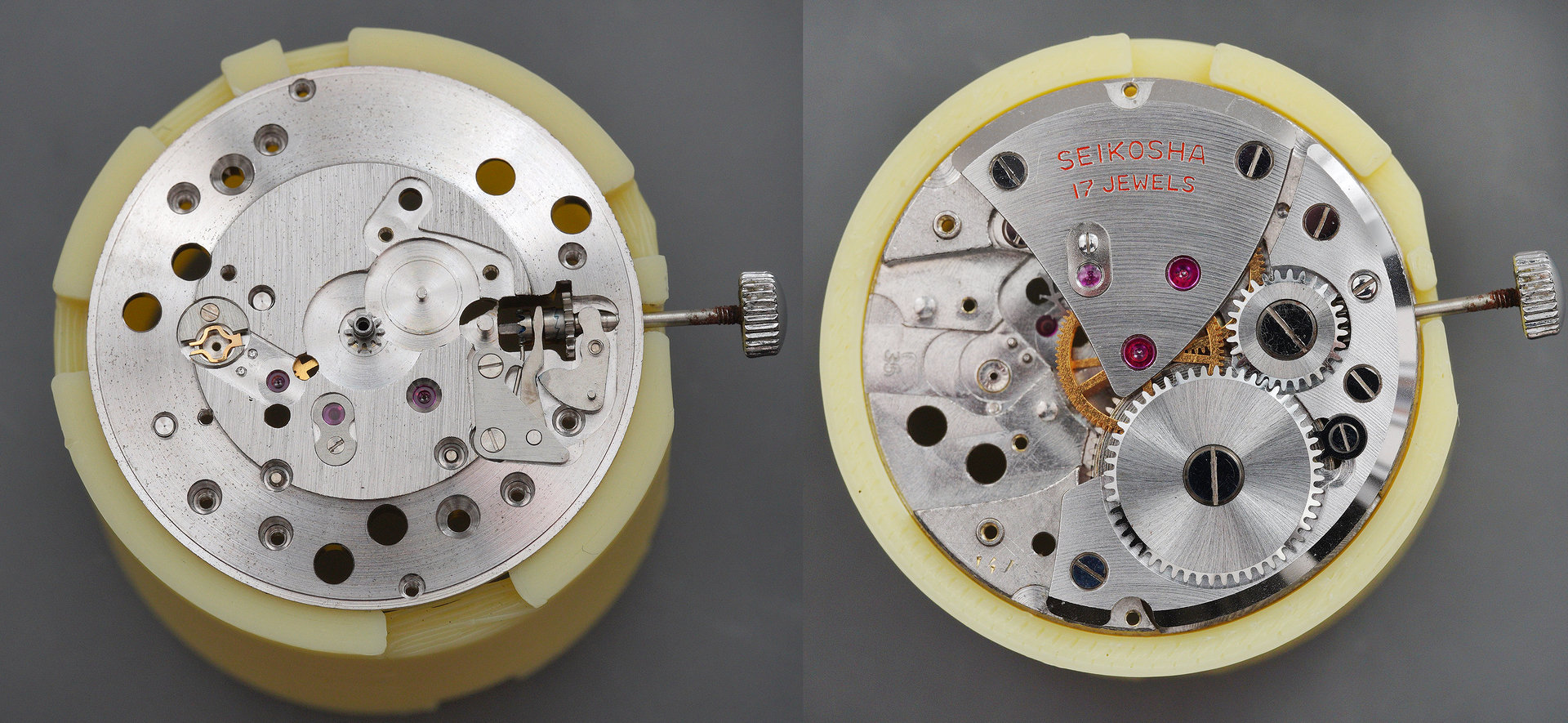
You will notice that I have refitted the broken setting lever spring. I’ve done that as a stop gap while I awaited the arrival of a replacement, secured via a circuitous route to a blocked Yahoo Japan auction. This particular flavour of Cronos setting lever spring is extremely elusive, its part number even now still unclear to me although the one that I ended up finding was advertised as 388541. That part number is also used to label one of the later versions with the extra arm so who knows. It took several weeks and one false start to secure the correct part at which point, proceedings could resume. Here is the replacement part in position, with much of the rest of the movement now complete.
With all impediments to free running eliminated, the movement jumped to action with a full wind under its belt.
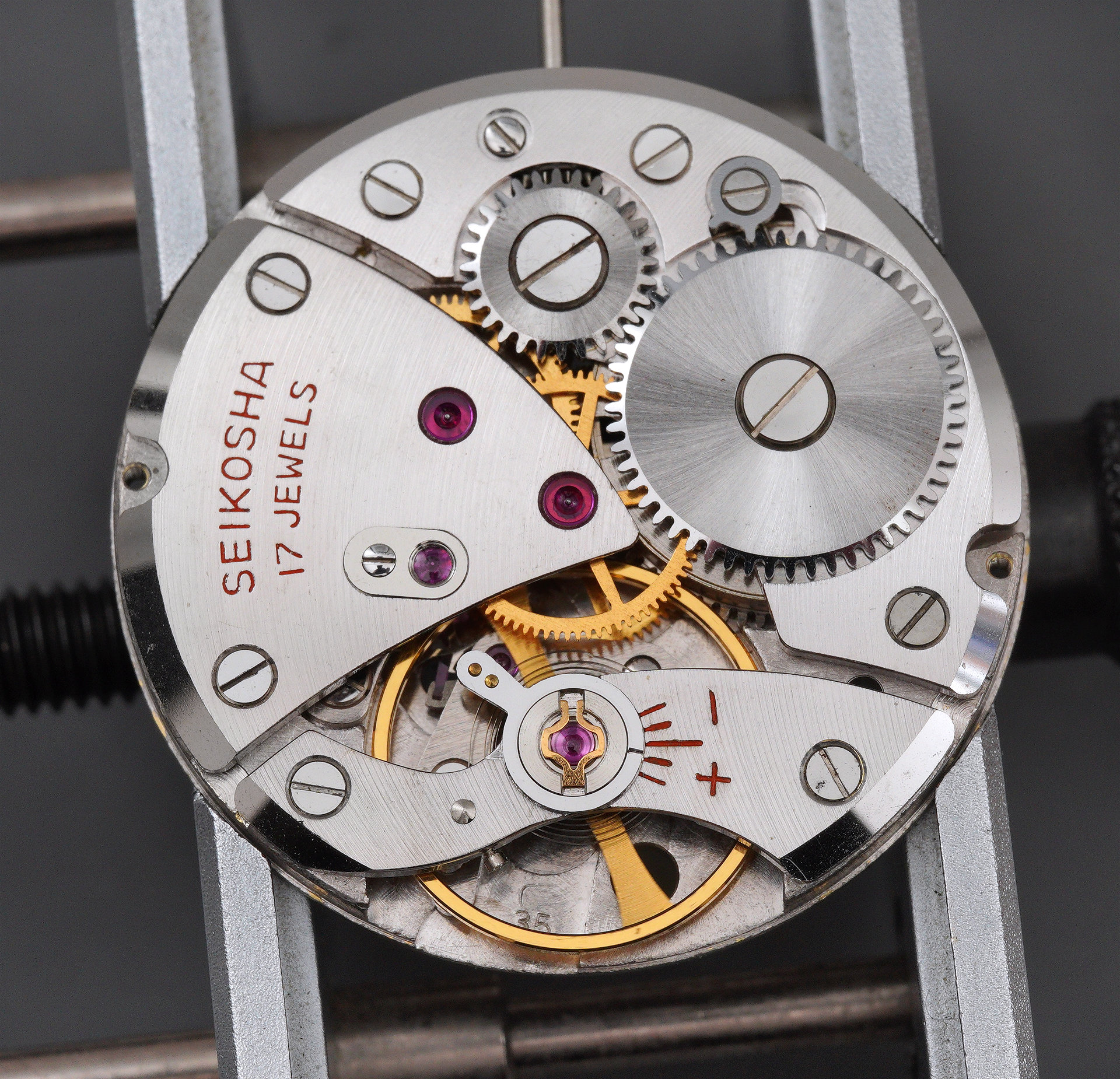
You will notice that the Cronos movement lacks a moveable stud. A timegrapher measurement at this point revealed a beat error of 1.2 ms and so I braced myself for the ordeal of multiple cycles of balance wheel removal and collet adjustments but fortunately, some careful planning resulted in only a single adjustment to all but eliminate the beat error (averaging 0.1 ms over four positions).
The last remaining hurdle on the movement side was to correct the negligible hand clearance that had caused the damage to the dial. This required a combination of some adjustment to the hands themselves and very carefully regulated force applied to the hands during the fitting process.
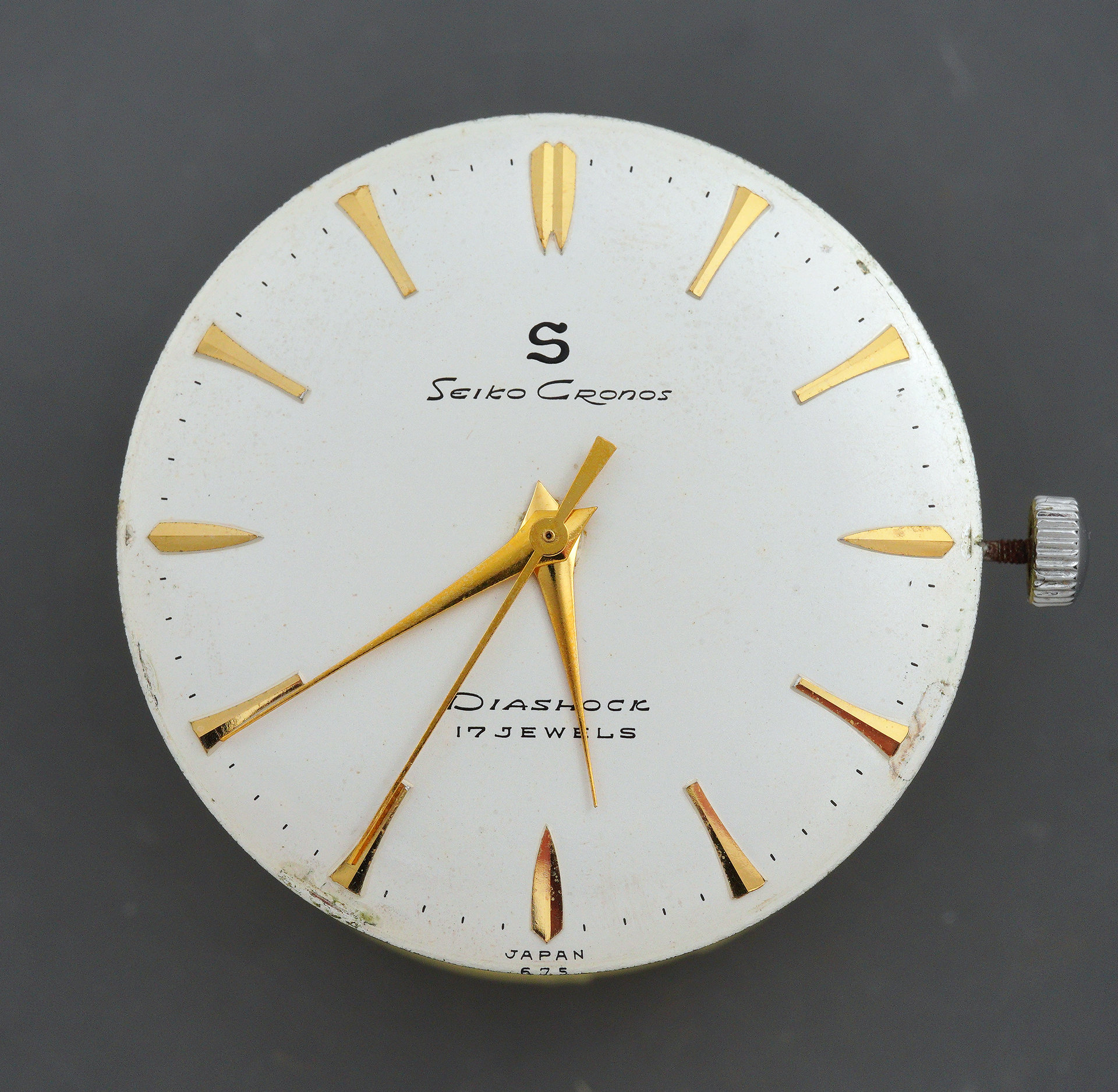
These properly lovely hands complement the dial beautifully.
The case cleaned up very nicely, the lower right lug position adjusted without disaster, and a fresh gasket installed in the cleaned crown. Here we are once again with the movement installed.
And a parting shot from the front, a fresh crystal providing an unobstructed view of the face of the original ancestor of so many distinguished offspring to follow.
 Adventures in Amateur Watch Fettling
Lovely work.
What crystal did you use? I’ve got a couple of Cronos’ in my to-do pile, and want to find crystals that will preserve the original thin profile.
That’s a good question! I experimented with Sternkreuz M which has a lovely parabolic curve but it would not clear the hands. In the end I used a 31.6mm Sternkreuz N.
Bello, mi piace;
complimenti come sempre per il bel lavoro. Saluti
Grazie mille!