I have written on several occasions about the Seiko 62MAS and explored to some extent its place in the iconography of early Seiko dive watches. In spite of its position as the original ISO-certified Seiko diver’s watch, it played second fiddle for some time in the consciousness of Seiko enthusiasts to the more celebrated third-generation cushion-cased Seiko 6105-8110, which had gained notoriety for having featured conspicuously on the wrist of Martin Sheen in Francis Ford Coppola’s Apocalypse Now.

The 62MAS appeared in two subtly different incarnations, the original small-crown 6217-8000 being produced for just two months from April 1965, with the larger-crowned 6217-8001 taking over from July 1965 and sustaining until early 1968 when it was replaced by the Seiko 6105-8000. I have owned three examples of the 62MAS, one of which I still have, and in the past year have acquired a fourth, a very early example of a 6217-8000 that I plan to feature here at some point soon (how we define soon in this instance remains to be seen). In the meantime, I thought I might sake my (and perhaps your) thirst for a bit of wabi sabi Seiko dive watch action by writing briefly about a late example of the 6217-8001 that passed through my hands earlier this year.
The owner asked if I might be able to sort a number of problems with his example dating from April 1967.

The watch looked tidy enough in the owner’s photo shown above but there is plenty to suggest that this is a watch that has been well-used. Cosmetics aside, the owner reported that it had been serviced 6-7 months previously but that there were still a number of issues affecting the watch. These included: a seized bezel; a very stiff crown action; slipping quickset and time-setting; and a loose movement in the case. On the plus side, he reported good time-keeping. I agreed to take a look and report back and a few days later I was able to diagnose the reported faults with the watch in hand.
First up: the reason for the seized bezel.

This is one extremely dirty watch, the years of accumulated grime having glued the turning ring to the mid-case. The original bezel retaining spring looks in good condition and so I was confident that this problem would be resolved with a thorough clean.
The loose movement was due to the absence of both casing screws with the result that the movement was almost entirely unrestrained in the case, only being held in position by the presence of the crown and stem, the case back acting on the movement ring but not the detached movement. The straightforward solution was to source and fit two replacement casing screws.
At this point, I removed the autowinding mechanism, wound a full wind into the mainspring, and performed a timing measurement.

On the plus side, the amplitude is semi-respectable, but on the downside, the beat error is catastrophically bad and the timing trace wondering all over the place. This does rather prompt a question or two related to its recent history but it is what it is and so let’s move on.
A slipping quickset and time-setting are a common problem with all 62-series movement and usually the result of a worn clutch and/or setting wheel lever. The solution will be to replace either or both as part of the service. And finally, the very stiff time-setting is likely to be due to an over-tightened cannon pinion, again, something that can be addressed easily enough.
Before continuing, it’s worth noting the very nicely preserved dolphin embossing on the case back.

62MAS case backs are frequently worn smooth – indeed none of the examples that I have owned have been as nicely preserved as this one. Unfortunately, the back has also been quite badly scarred by historic case back-opener slippages.
With the autowinding mechanism already removed, we can take a look at the movement in situ.

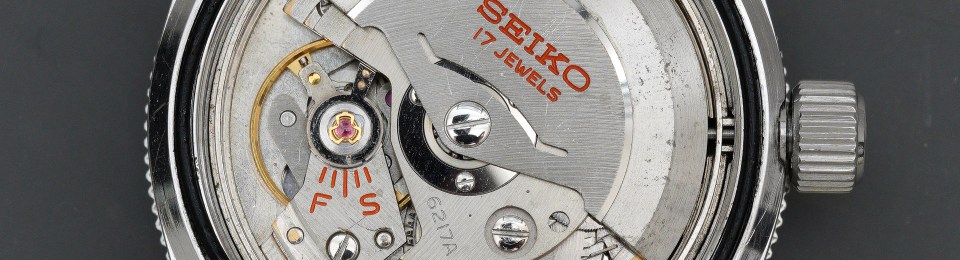
This is pretty typical of a well-used base-spec 17 jewel 62-series movement, the most obvious signs of wear being the loss off plating around the edges of the barrel and train bridge due to contact from the rotor (note that this photo was taken after I’d sourced a pair of casing screws).
With the movement released from its confines, we can take a closer look at the dial and hands.

The lume on all of the markers and hands is showing consistent signs of encroachment around the peripheries but there is nothing really objectionable. It just lends the watch a proper sense of its age and experience and I see no reason to interfere. The dial is dirty however and could benefit from a clean, which I will do when reassembling the watch later on.
Removing the dial and hands reveals the calendar side of the movement.

I have to say that this does not look like a movement that has recently been treated to a day at the spa. In particular, note the heavy patina on the hour wheel.
There are numerous examples of 62-series breakdowns on the blog and so I’ll just skip through, pausing to make any noteable observations. The first of these is the condition of the barrel arbor hole in the barrel and train wheel bridge.

A previous watchmaker has presumably noted wear to the barrel arbor hole and has meted out some punishment in an attempt to return the hole closer to circularity. This looks (and is) crudely executed but judging from the relative lack of side shake and the smooth rotation of the barrel, it looks to have had the desired effect. You might also note that the region around the hole is swimming in oil. So too is the underside.

The trail continues onto the layer beneath.

The vandalism inflicted upon the barrel and train bridge has been duplicated around the arbor hole in the main plate.

The constituent parts of the movement are treated to a manual cleaning with pegwood, Rodico and lighter fluid-infused kitchen roll to remove as much of the ingrained dirt as possible before the second and third cleaning stages in the ultrasonic bath and then watch cleaning machine.

While the movement parts are stewing, I can turn my attention to the case, expending in full my day’s supply of elbow grease. The case back gasket was rock hard and flattened and had to be excavated piecemeal, exposing eventually a gasket groove in good condition but with quite a lot of surface corrosion.

The crystal was in reasonable condition but the polished tension ring pitted and upsetting the view from head-on.

The final and most labour-intensive part of the casing work was to rebuild the crown. This involves removing the retaining washer using an approach that does not involve gasket-stuffing, extracting the rock hard original gasket, removing the gasket spacer, cleaning the whole lot, refitting a fresh gasket and then staking the original retaining washer back into place.

The reassembly begins with the setting parts, a replacement clutch and setting wheel lever resolving the previous issue with slipping time- and quick-setting and a replacement cannon pinion solving the very stiff time-setting action.

Rebuilding the movement from here proceeded straightforwardly. Note in the picture bottom left below, the vastly improved appearance of the hour wheel. I did nothing special here other than subject it to the usual cleaning process along with the other movement parts.

The final step is to reassemble and fit the autowinding mechanism.

By this point I had checked the timekeeping and was satisfied that the movement was performing strongly and so proceeded to refit the dial and hands.

The casing parts were cleaned and primed for reunification with the cleaned and polished crystal and the now fully assembled movement.

The icing on the movement, now nestled back into its home, is the winding weight.

A measure of how well the movement is performing at this point can be gleaned from a snapshot timegrapher reading, dial up on a full wind, having had time to settle for a few minutes.

The positional consistency was good and given the life experience of this watch and that the only movement parts that I’d replaced were the clutch, setting wheel lever and cannon pinion, I was very pleased with this level of performance.
When Seiko conceived and realised the 62MAS, a dynasty of mid-market mechanical diver’s watches was born, one that worked its way through five distinct generations before the development of this corner of the market started to stagnate in the late 1980s. It may not be the most iconic of those watches, that laurel arguably awarded to the 6105-8110 or 6309-7040, but it is perhaps the sweet spot of the range.

The market appears to recognise its historical importance as values for decent original watches have inflated by at least an order of magnitude beyond its original market position.

The fact that this watch is not perfect, that it displays a good deal of patina associated with a life well-lived, makes it a watch that I hope the owner feels free to use without impediment. I certainly enjoyed my brief time putting it through its paces.

If you have a watch needing attention, feel free to get in touch here. You can also read more about the development of the blog, a little about me and how things have changed a little around here since the beginning of 2025 by clicking here.
 Adventures in Amateur Watch Fettling
OK, I’ll bite – how did you remove the crown gasket without gasket stuffing?
A drilled out Allen bolt screwed into the crown. The threads push the inner part of the washer out as the bolt is turned clockwise.
Very ingenious!
What’s the allen bolt thread size?
It’s M3.
Hi Martin. May I request that you return to using arrows and text in your images to point out some of the important bits for us noobs? Thanks!
Hi Tom,
I confess to having got out of the habit but you may have noticed in the very recent post on the Citizen hummer movement, I made plenty of use of text and arrows. This latest post on the 62mas was intended as a lighter touch account and I’ve clearly not spent as long annotating everything that I might. I’ll keep your request in mind when writing future posts. Thanks for the feedback!
Martin
Ah yes, I do recall that. Thanks for the consideration. It’s also nice to see you using your skills in retirement.
Cheers
Tom
I’d love a 62MAS and maybe one day I’ll find one, but sadly I think I missed the boat on prices that I think are reasonable. But the thrill is in the chase, and when one does come up I’ll be all over your posts as always Martin!
Yes, prices are generally high, almost seemingly regardless of condition but I do still see the occasional honest example selling for sensible money (by which I mean closer to £1k than £2k+). Keep looking!