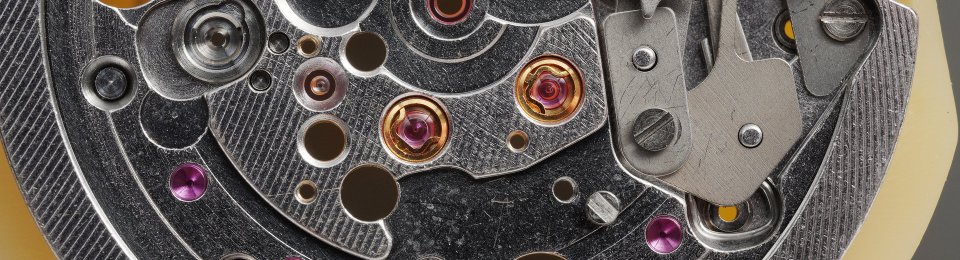
The term ‘Trigger’s broom’ gained its place in the British vernacular following an episode of the sit-com Only Fool’s and Horses in which one of the characters, Trigger, a road sweep, earns a medal from the local council for saving it money through his careful twenty-year maintenance of his original broom. He insists his broom is wholly original in spite of it having had seventeen new heads and fourteen new handles. This is an extreme example of the question of identity that can raise its head when servicing and repairing any tool or device but in particular, or at least most pertinent to the subject matter of this blog, when repairing old wristwatches.
A single service of a mechanical wristwatch might require only the replacement of a gasket or two but commonly, the replacement of the mainspring or a worn gear, a lost spring or broken screw will be a routine requirement. As watches age, so more parts may need replacing – the crystal, a bezel insert, a crown tube, the crown. If water has made its way into the watch, then a dial and hands may need replacing and in extremis, perhaps the entire movement. At that point, the only original parts that remain may be the mid case, case back and bezel. But even those might need replacing where a case has sustained damage from a severe impact. If all of these changes have occurred over an extended period of time, then the identity of what you have at the end of the process may still connect compellingly with what you had at the beginning and in your mind it is the same watch. The truth though is that whatever it was originally is really only part of what remains in spirit.
I have quite regularly ruminated over this question but it occurred to me again recently while I was girding my loins to begin work on the Grand Seiko project that has been the subject of recent posts here and on Instagram. As I prepared the ground for that, my attention was distracted by a loose thread that presented itself as I rummaged through some of my off-cut parts boxes. This is what caught my attention:

This is one of two Seikomatic 6216-9000 cases that I had leftover from two previous projects: one of the two original watches provided the innards of what turned into the very beautiful ‘Grand Seiko in all but name’ featured here; the second was bought to provide a donor movement for a hot-rod 62MAS project described here. That latter donor-watch I judged as unsalvageable as a going project because the dial was irredeemably compromised as a result of historic water damage.

The dial and hands from this watch were consigned to a life of confinement within the quarters of a box assigned to the housing of off-cast 62-series movement and casing parts. The two cases were in perfectly sound – indeed very decent – condition but their potential for reinstatement to their former purpose was dependent on my sourcing one or more suitable dials. The obstacle to the latter was that this case was designed for a convex dial and pretty much all 62-series Seikomatic dials are flat. The only realistic prospect of finding a 6216 Seikomatic dial would be to source another 6216-9000 and that would defeat the purpose of attempting to re-purpose one of the spare cases. As I mulled this over, I thought I should take another look at the dial.

In its current state, this was a no go. The lacquer was lifting around the entirety of the periphery and the dial beneath oxidised beyond salvation. The applied markers were pitted but the hands looked a deal better. At this point, a little light bulb illuminated and a cunning plan was hatched.
How easily could those applied markers be removed from the dial? With the aid of a pristine, flat-edged scalpel, quite easily, as it turned out.

The frame around the calendar hole also came free without too much protest which left just the Seiko logo. Before tackling that, I immersed the dial in some nail polish remover to soften the lacquer and any glue holding the logo in place.

I was able to prise off the logo using a more nuanced variation of the approach taken with the markers and calendar frame, and the dial was naked. Time to see what potential it might offer as the platform for a reinvention of the watch to which it previously belonged. I started by cleaning the dial with kitchen towel soaked in naphtha and then nail varnish remover and then progressed to Cape Cod polishing clothes. Gradually the dial was transformed from a dog-eared impression of its former self into a pristine new identity, albeit now free from any dial markings, including the minute markers.

I took care not to over-polish the dial for fear that I would work through the plating, exposing the more golden hue of the brass beneath. The end-result is rather pleasing, particularly given the complete preservation of the original sunburst finish. The next task was to clean, polish and refit all eleven hour markers (remembering that the calendar frame serves as the effective 3 o’clock marker).

The markers are refitted simply by aligning the pins with the holes in the dial, and carefully pressing home. The Seiko logo and calendar frame would wait their turn until after I’d dealt with the question of what movement to use. I should add at this point that it was my intention to complete this project without spending a penny on additional parts. The challenge was to rely entirely on what I could scavenge from what was in stock, so to speak.
Moving on to the movement options: given that I had already made use of the two original 6216A movements, my choices were limited to the next best higher-tier 62-series components available to me. Two candidates emerged: an incomplete spare-parts 6218C and the hybrid 395/6218 movement that I had used in an earlier incarnation of the hot-rod 62MAS.

Two details of what remains of the 6218C, lower left above, need noting: firstly, and most obviously, the micro-adjustor wheel that is supposed to mesh with the regulator on the balance cock is missing. It had previously been sacrificed to the cause of the high-beat Lord Marvel project described here and its absence now prompted a shufti through my supply of 5740C movements that I seem to have acquired since completing that Lord Marvel project; the second issue related to a bent-out-of-shape balance hair spring sitting alarmingly askew. You will notice that the hole in the stud lever is triangular in shape but all potential alternate donor balance springs are equipped with cylindrical studs. Thus, in order to progress, I would need to replace the stud holder, the balance wheel and fit the replacement micro-adjustor. Here is the balance cock with the replacement stud holder and micro-adjustor fitted.

With that done, I dismantled what remained of both movements, anticipating that between them I would have a sufficiency of parts to assemble one complete movement.

These passed through the usual sequence of cleaning cycles, emerging as a collection of pristine parts from which the construction of a complete movement could begin. As is typically the case, that process begins with the four Diafix settings, two of which shown below adjacent to the reassembled setting parts.

I was planning on reusing the barrel from the 395/6218 hybrid but I chose to remove the mainspring and reclean it and the barrel before reassembling with Seiko S3 mainspring grease freshly applied to the barrel walls. The process continued in the usual order, beginning with the centre wheel and its bridge, followed by barrel and gear train installation, barrel and train bridge, the escapement, the dial-side Diashock setting and finally the balance and its shock protection.

The movement sprang into life without much encouragement and with a little light regulation, I left it to its own devices while refocussing my attention on the dial.

A key difference between the 6216A and the lesser 6218 is that the day and date disks sit on two different planes in the latter movement, where in the former, they sit at the same level. As a consequence, the date window in the calendar frame is more recessed in 6218 dials than the day window whereas in the 6216, the base of the two windows sit at the same level (the photo below taken from the older post on the Seikomatic 6216-9000).

This wouldn’t necessarily be a problem here if the 6216 date disk that I had had been in decent condition. But unfortunately, even though there is going to be plenty of patina on display with this watch, the date disk was a little too far gone.

I made the decision therefore to use a much cleaner 6218 date disk but that would necessitate substituting the original 6216 calendar frame with one farmed from a sacrificial 6218 dial (don’t worry, that dial was otherwise toast and so not really a sacrifice – just an organ donor).

The lower of the two frames shown in the photo above will be taking the place of the upper frame but there is a snag. The aperture in the dial is too small to accommodate the slightly taller recess in the 6218 frame and so I had to remove some material from the frame to get it to fit. The photo below shows the initial, rather crude opening stages of that process.

Eventually, I was able to modify the frame to fit the aperture snugly and after a quick check that everything was properly aligned, I secured it into position with the aid of a little clear lacquer acting as glue. With that final wrinkle navigated, I was able to complete the calendar side of the movement.

The day jumper comes next followed by the day disk. In the photo below, you should be able to see clearly that the day and date disks sit at different elevations.

The convex shape of the dial requires a supporting dial spacer to ensure that the calendar disks don’t foul on the underside of the dial.

With that all complete, we can fit the dial and make an initial judgement about whether or not this transformation is going to work.

You will make your own minds up I am sure but for me, I am pretty happy with how it’s looking so far. I had two cases to choose from and opted for the one with the sharpest-looking haunches.

The case cleaned up nicely and with my last 320W04AN retrieved from stock, I fitted the crystal and pressed home the securing bezel.

With the hands cleaned and fitted, the movement slots into the case and I complete the deal by fitting the autowinding mechanism and then the rotor.

A fresh caseback gasket (the crown gasket replaced just prior to refitting the movement), and this one is just about wrapped up. All that remains is to fit a strap and pronounce “It’s alive!”.

The conversion of a collection of condemned parts into a useful, beautiful something is extremely satisfying, not least because it is a product of an ingrained parsimony that has developed in me from having lived in Yorkshire (and previously Scotland!) for the past 32 years. The Seikomatic is also a particular favourite of mine and it is always grounding to cleanse the palate with something familiar and comforting.

This particular watch may no longer be what it was, but it has transformed into something unique, with an identity all of its own. Here’s to the Seiko 6218-9000, a watch that never existed (but does now).
 Adventures in Amateur Watch Fettling
that must have been an extremely satisfying exercise.
the philosophical ramifications of time being measured and passing while the watch gradually morphs, like Trigger’s Broom, are quite extensive!
It was fun too! Thanks for the comment!
Bravo! I know that feeling of satisfaction all too well since i love cobbling together watches from leftover projects as well! In case you find that the finish on the bare dial dulling after a while, a fine misting of gloss clear after a light polish would work. I use Tamiya acrylic clear cans but I’ve read Humbrol works well too.
Jay
Yes, I did consider doing that but the tricky part is achieving a finish that doesn’t detract. I will see how it ages and if it does start to change in a way that displeases, then I will give that a try.
Your opening discussion of Trigger’s broom reminded me of Ship Of Theseus, e.g. https://en.wikipedia.org/wiki/Ship_of_Theseus
Ah, yes, and I note that Trigger’s broom is cited as one of the alternative forms in the footnotes.
it’s like a nicely de badged Nissan GTR. 😎
GENIO!!!!