Tags
The first automatic Grand Seiko was fitted with a refined evolution of the 603 calibre, first introduced with the Seikomatic sub-brand in 1960. The 603, later renamed to 6201, was an automatic adaptation of the 3140 hand-wind movement fitted to the Liner series, with the automatic function provided by a separate autowinding module, featuring Seiko’s proprietary bi-directional magic pawl lever mechanism. In piggy-backing this separate module onto a hand-wind movement in those early Seikomatics, the hand-wind facility was sacrificed in the name of achieving a low-profile case design with the crown tucked away at the 4 o-clock position, flush with the lines of the case. By the time of the release of the Grand Seiko 6245-9001 in 1966, the 62-series had been refined to a high-level that included stop-seconds and quickset date complications, but in essence it retained the fundamentally simple design philosophy of the 603.

The replacement to the 62-series Grand Seiko employed a new high-beat movement, the 6145, running at 36000 bph, but this too was a simple, rather unsophisticated design whose base calibre was to power a wide range of product lines from 1968 through to the late 1970s. These movements came in flavours that included the rudimentary 17 jewel hand-wind 61A, the 6105A and B automatic variants fitted to the iconic 150m 6105 divers watches, the 6106 and 6119 day/date automatics fitted to numerous mainstream Seiko and Seiko5 models, the 6117 GMT and notably the 6139 and 6138 automatic chronographs.

The 61GS line encompassed a diverse range of case styles and sustained from 1968 until 1975. However, from 1971 the 61-series Grand Seikos were being phased out as a new line of Grand Seiko high-beat automatics emerged. This new GS model line was fitted with a refinement of the 56-series automatic movement that had been used in low-beat form in the successful Lord Matic sub-brand and in high-beat form in the automatic King Seiko line, both lines introduced in 1968.

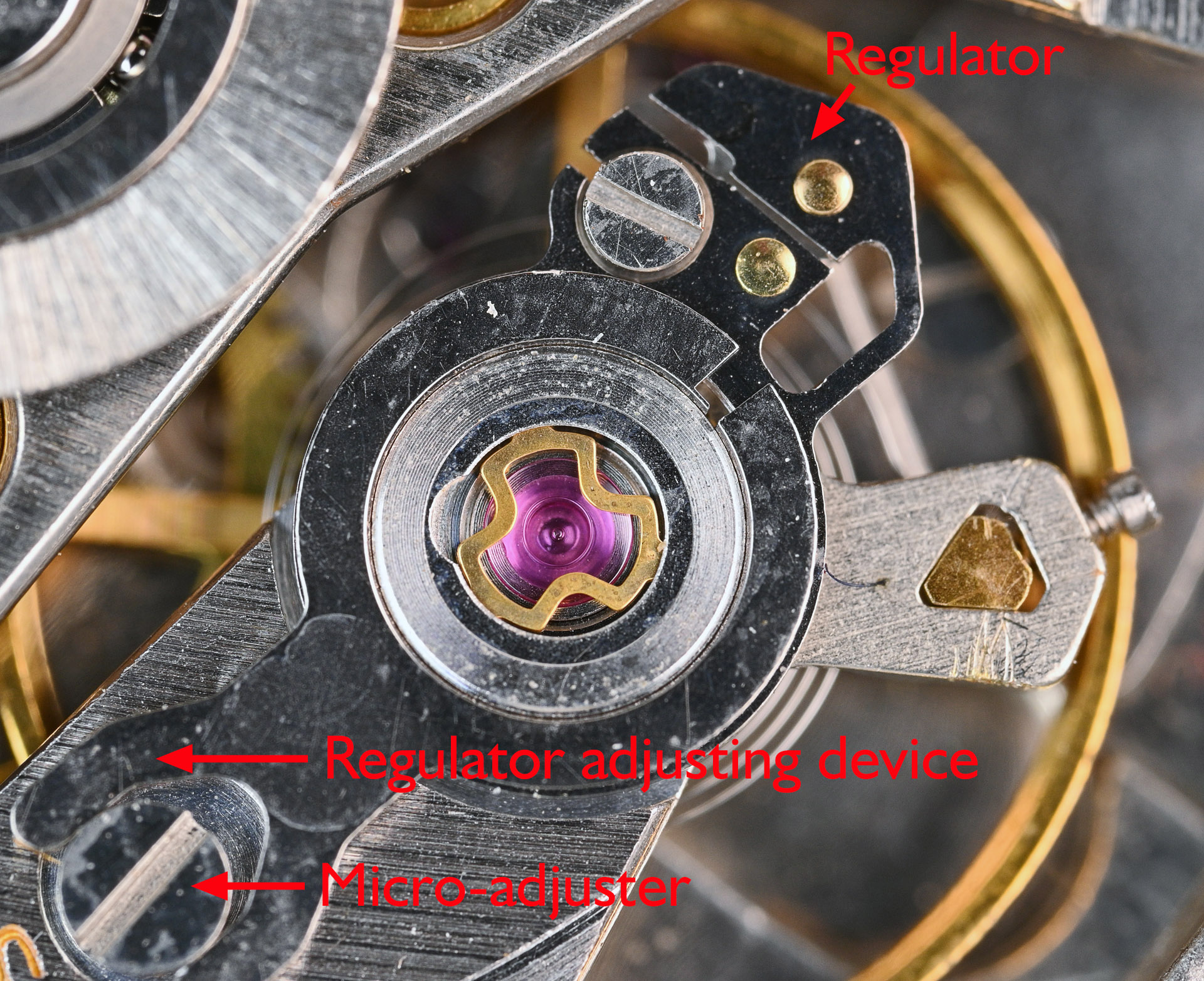
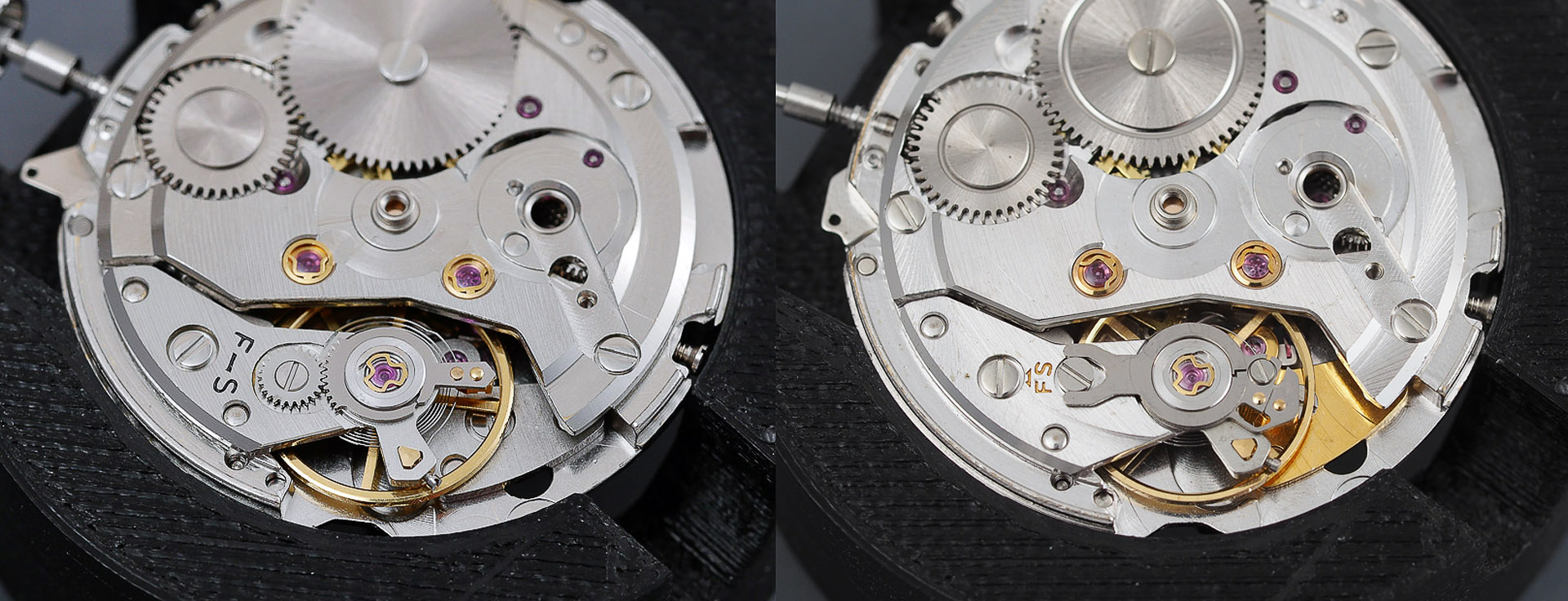
The 56-series is distinguished from the earlier magic lever automatics by its integrated autowinding mechanism sitting at the same level as the gear train and the altogether much more modern design philosophy compared to the legacy approach taken with the first- and second-generation automatic Grand Seikos. The main distinguishing features that separate the KS and GS 56-series variants from the LM are the higher beat rate (28800 plays 21600 bph) and slightly higher jewel counts (25 plays 23 jewels). Additionally, both the (later) KS and GS provide greater latitude for fine regulation thanks to the more sophisticated design of the regulator that provides adjustment to the gap between the index pin and the boot.
We shall see in due course the extent to which the GS variant distinguishes itself further from the almost identical KS variants.
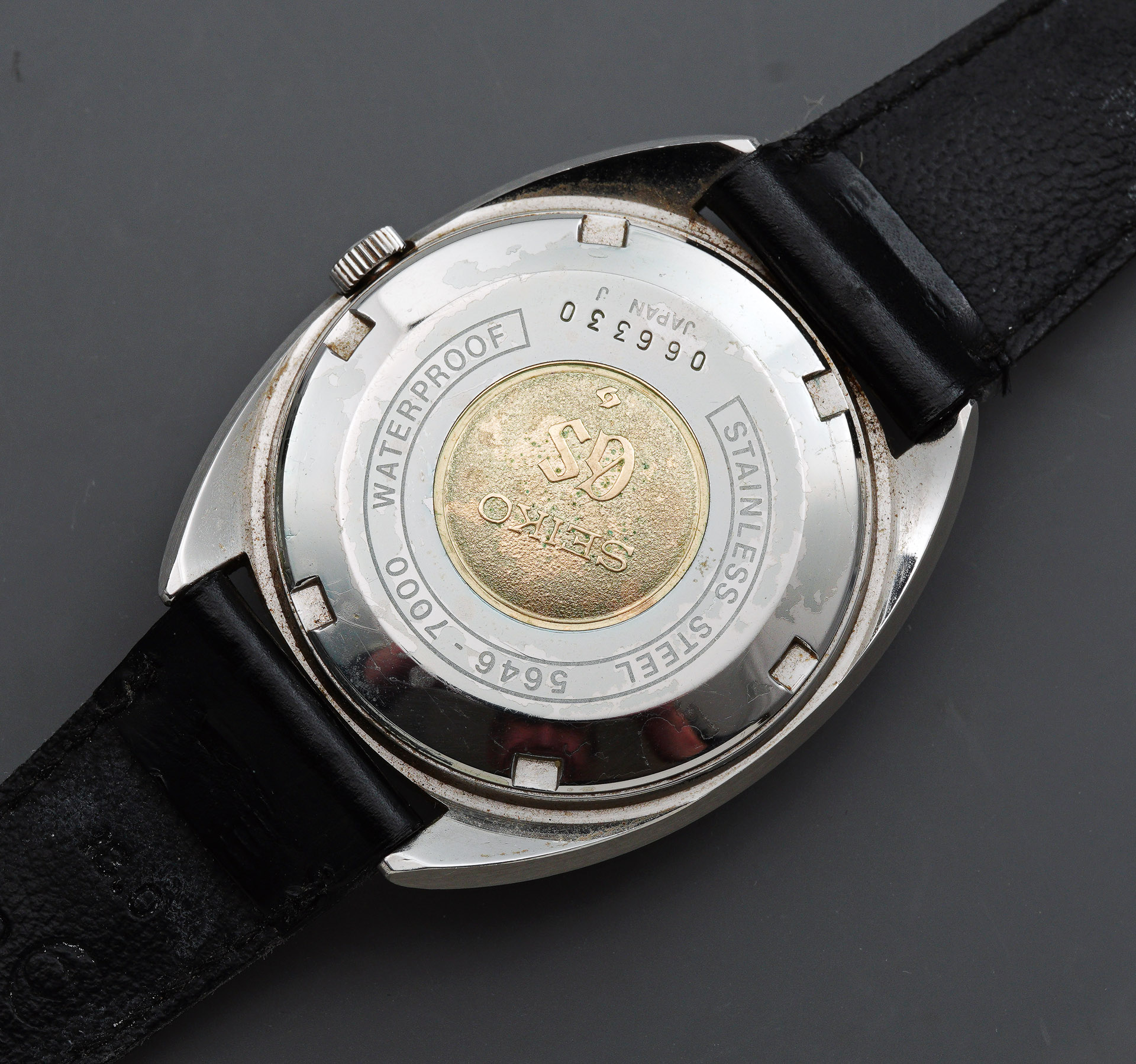
This brings us nicely to the point at which we can introduce the protagonist of this story: a Grand Seiko 5646-7000 dating from June 1970.

Externally, this is a watch for which the only real signs that it has been worn at all are the accumulation of a certain amount of dirt but otherwise the case is crisp, largely unmarked and the caseback retains most of its original protective film.
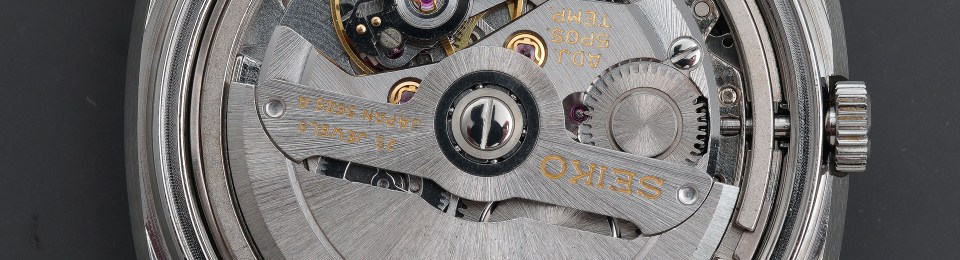
Opening it up reveals a patinated but very clean-looking 5646A, complete with trick regulator arm with its additional microadjuster screw.

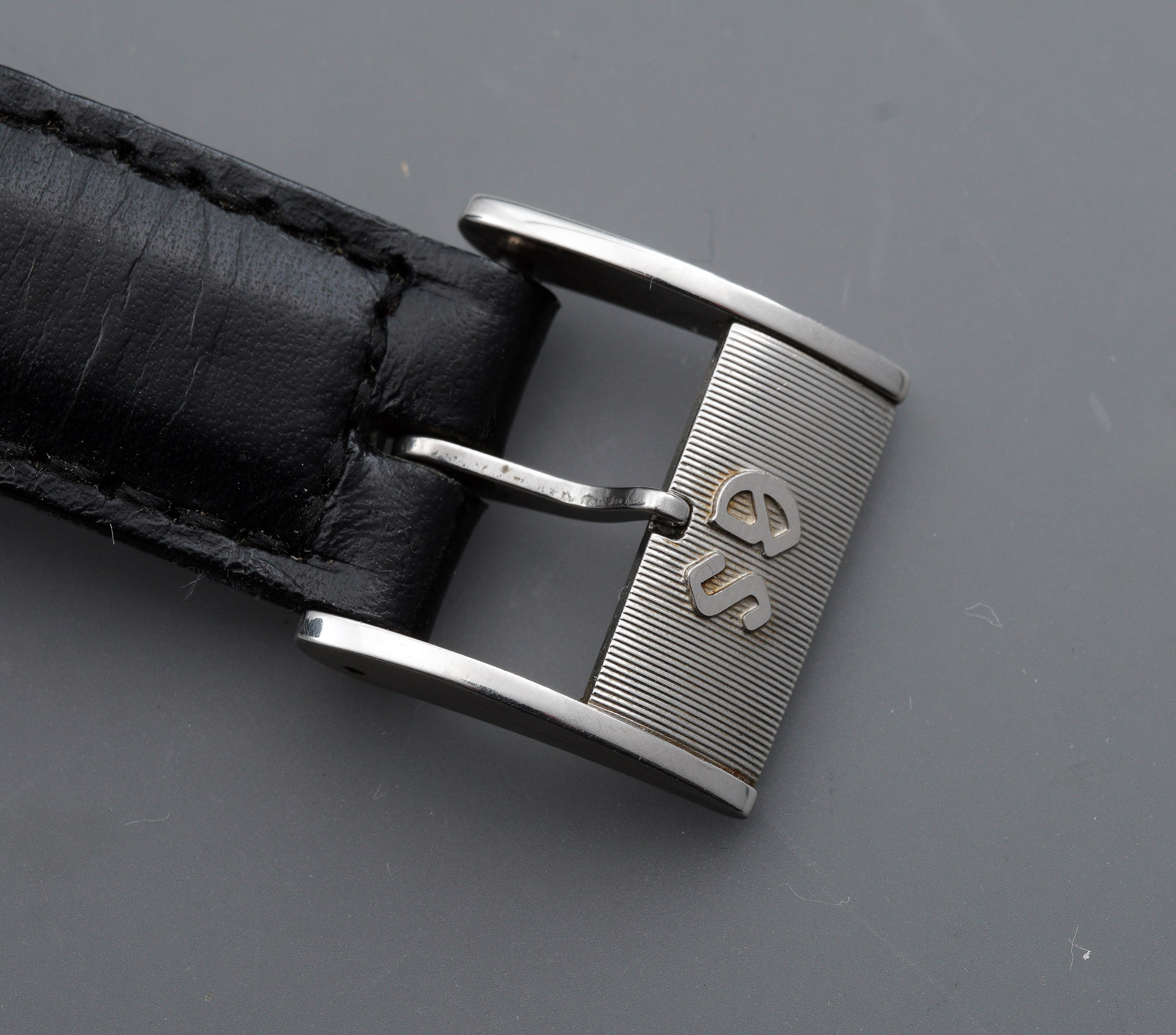
I note that the aftermarket strap is fitted with the original GS-branded buckle. Nice.
Removing the movement from the case provides an opportunity to scrutinise properly the condition of the dial and hands.

Both appear to be in excellent condition with the only signs at all of its advanced age being some some light marks beneath the lacquer, between the 11 and 3 o’clock positions that are strangely reminiscent of belly stretch marks. Beautiful. You will notice that I’ve positioned the hands at a quarter past three in order to facilitate their removal, following which we can survey the dial side of the movement.
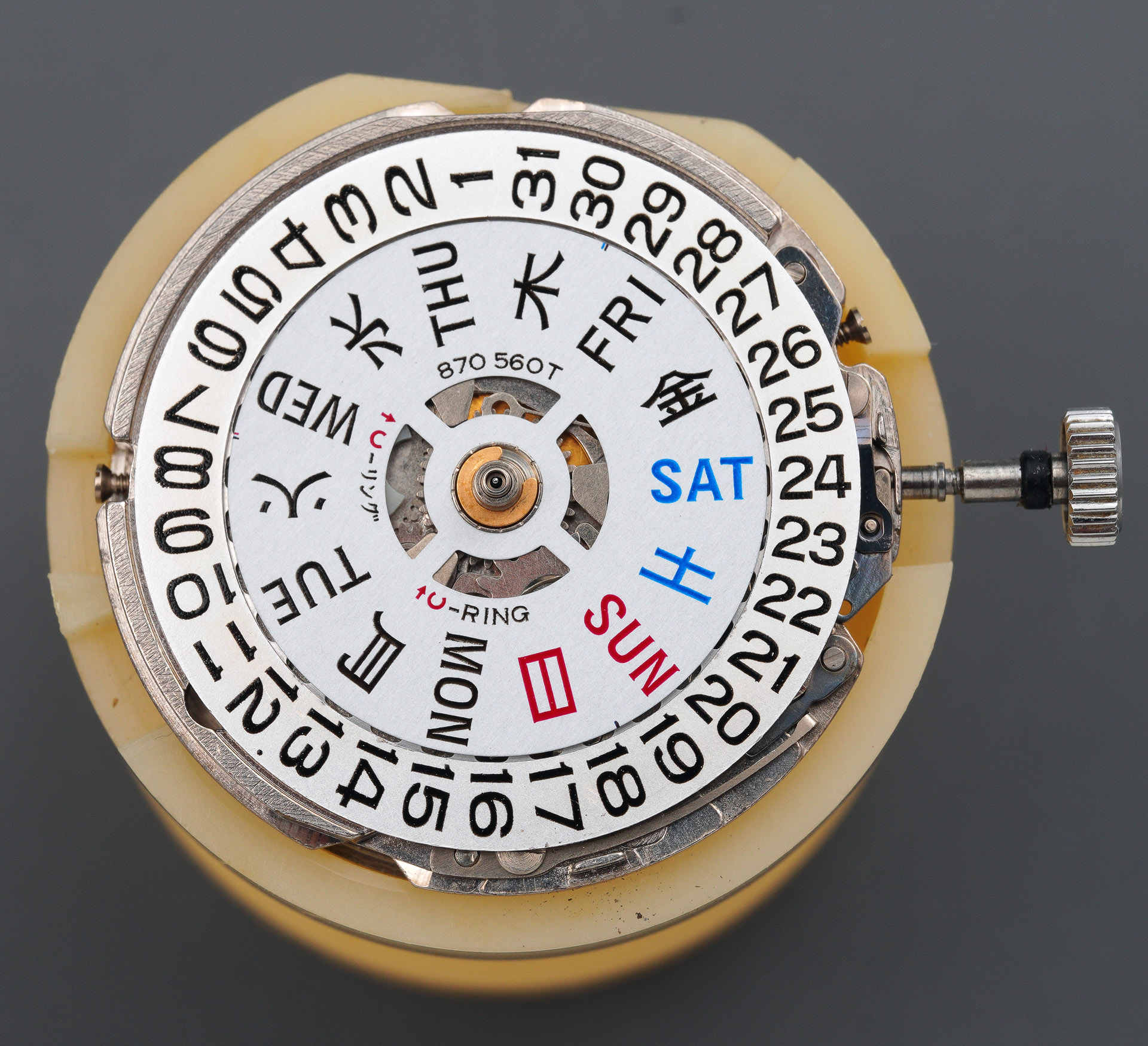
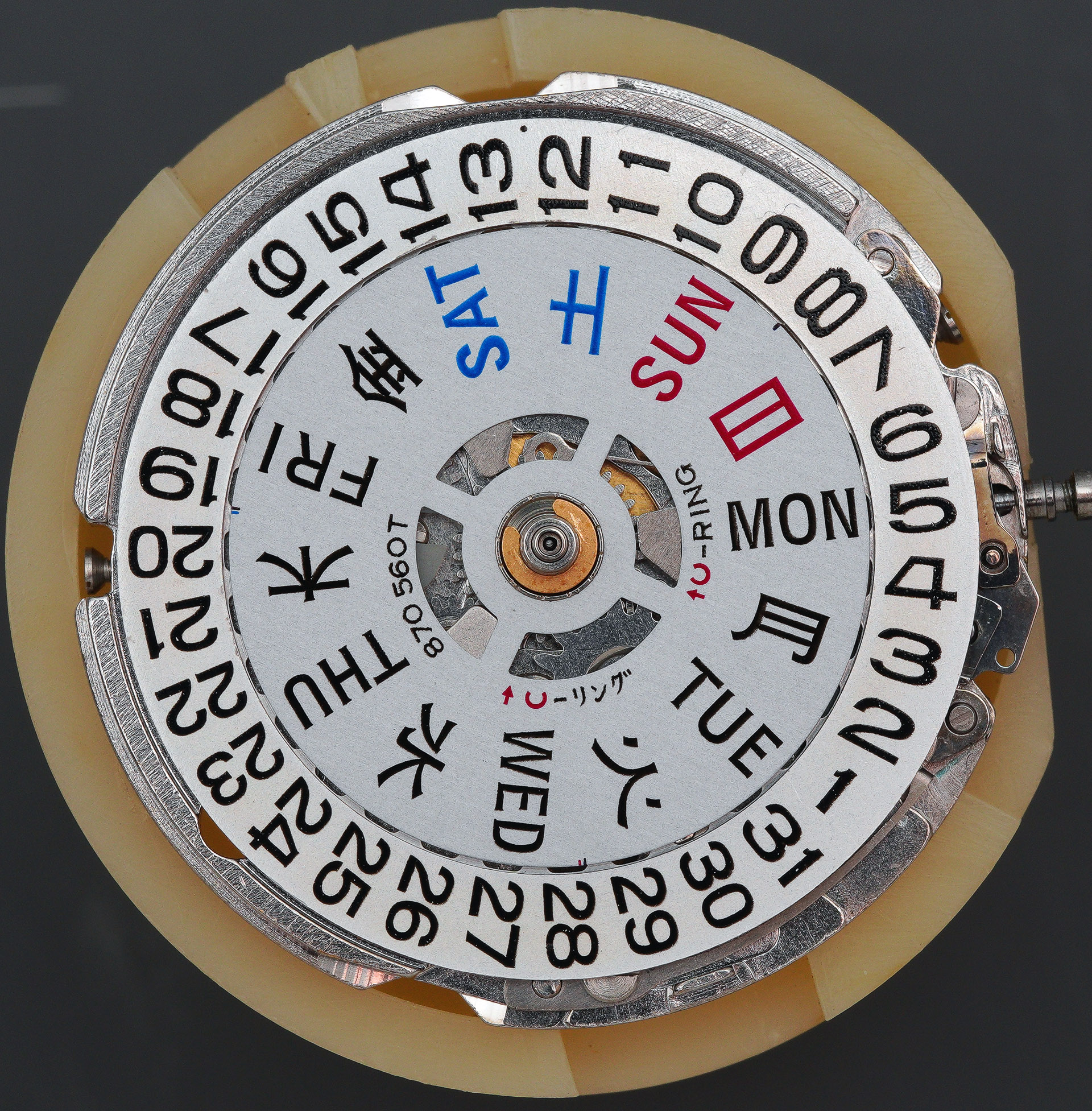
This being a Japan Domestic model, the dual language day wheel includes English and Kanji options for the wearer. The day disk is retained in position using a circlip and with the latter removed, we can lift the disk away.

This view of the dial side of the mainplate provides the answer to where the additional two jewels are located in the KS/GS variants of the 56-series compared to those fitted to the Lord Matics: the upper and lower barrel bushings in the KS/GS are jewelled whereas those in the LMs are steel. I’ve not yet made mention of any faults that I noticed upon receipt of the watch. I should have mentioned that it ran, as you can probably tell from the different positions of the seconds hand, pre-hand-removal, but I haven’t mentioned that the quickset function was inoperable. This is a condition that is more likely than not to afflict any 56-series watch, regardless of the product line to which it belongs. In this example, the reason for the non-functional quickset is quickly identified:
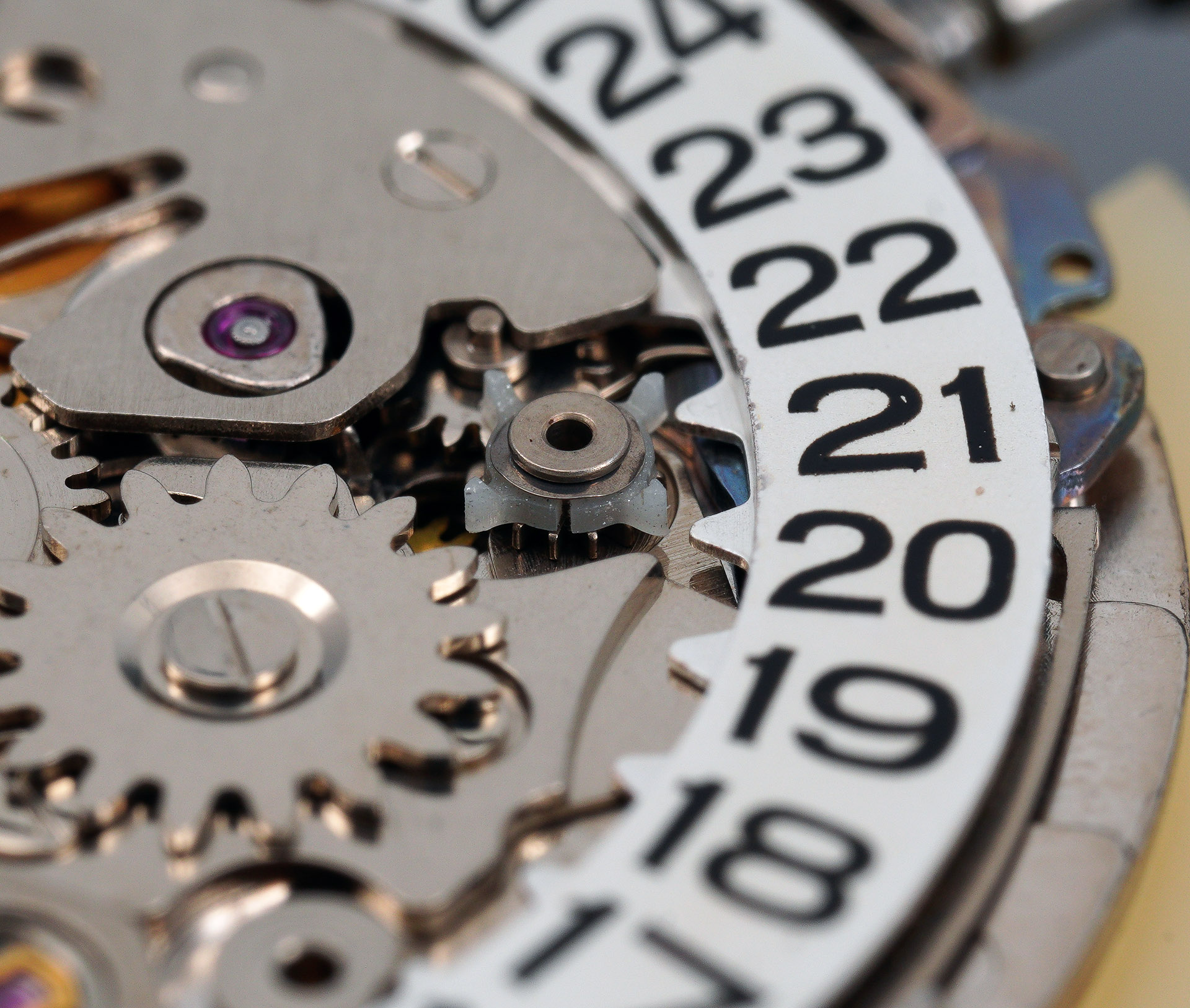
The day-date corrector wheel is made of plastic in this example and predictably, it has failed. The split you can see in the image above means that the wheel slips on its axis when called into action and no quick-settery results.
Deconstruction continues on this side of the movement until the setting parts are exposed but with the minute and calendar wheels still in place.

I like how the movement looks from this perspective with the brass barrel showing through. Next, we turn the movement over and contemplate the train side.
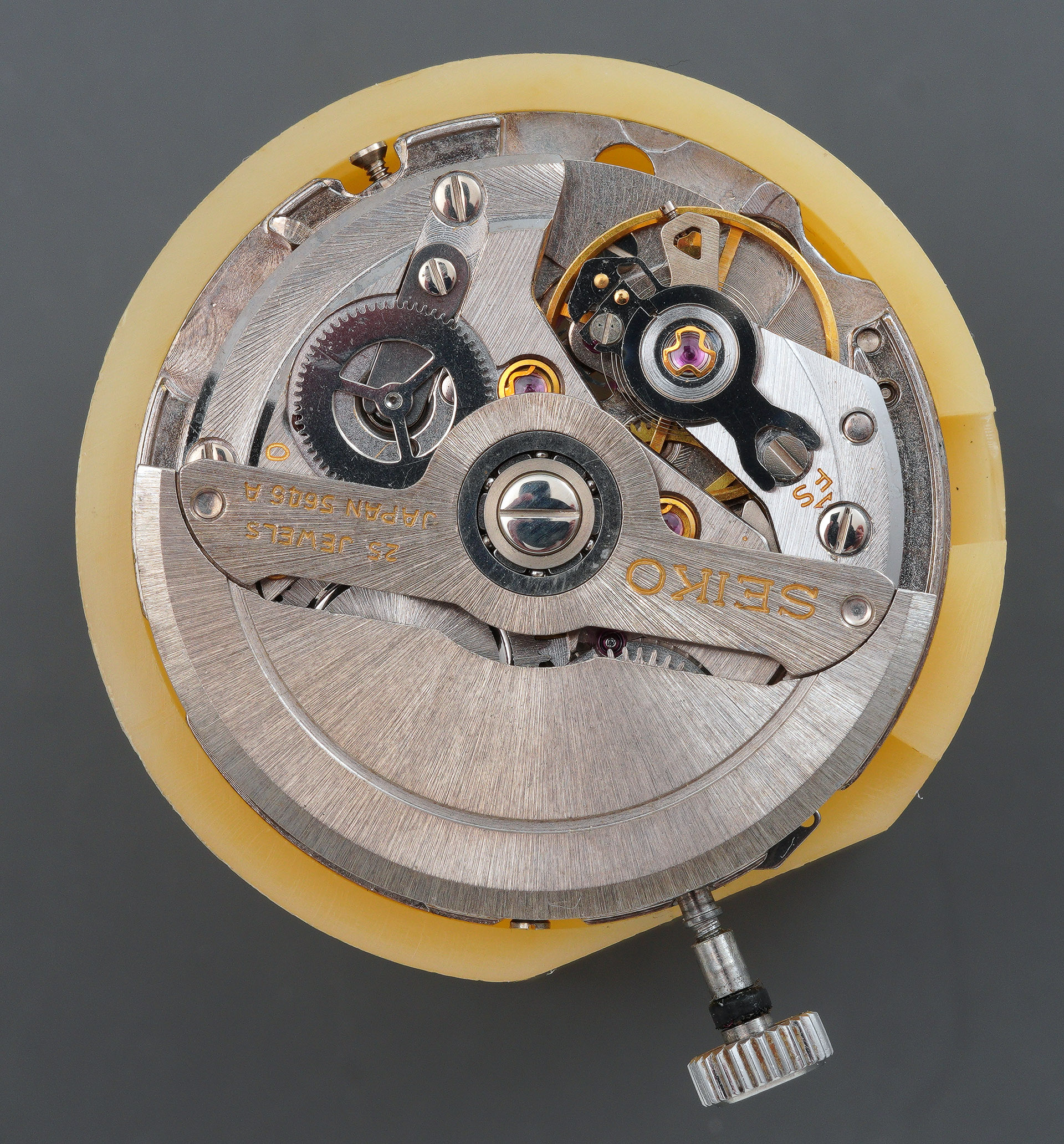
This all looks very familiar but it’s when we remove the rotor that we see what distinguishes this movement from the B variant of the KS 5626.
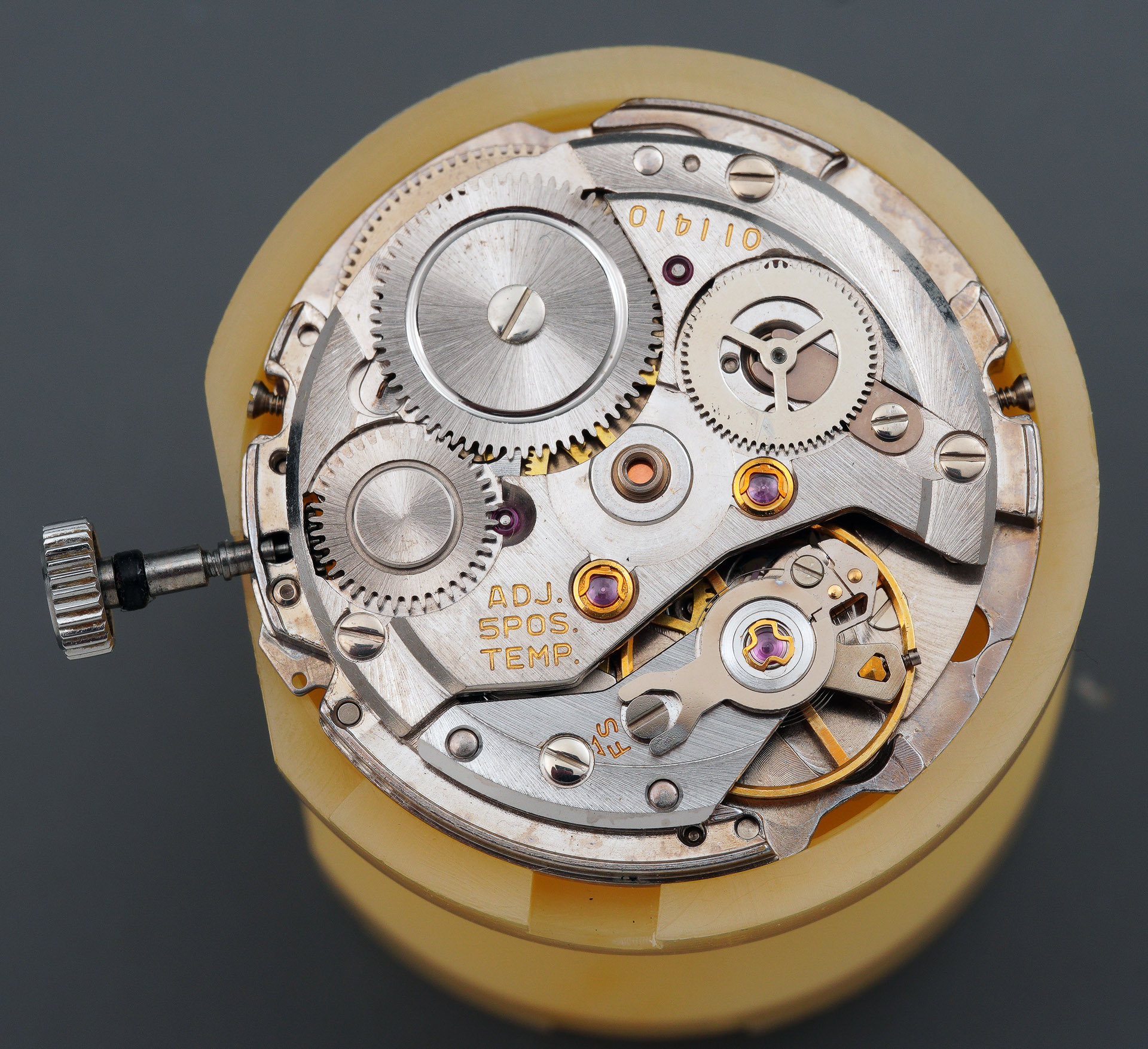
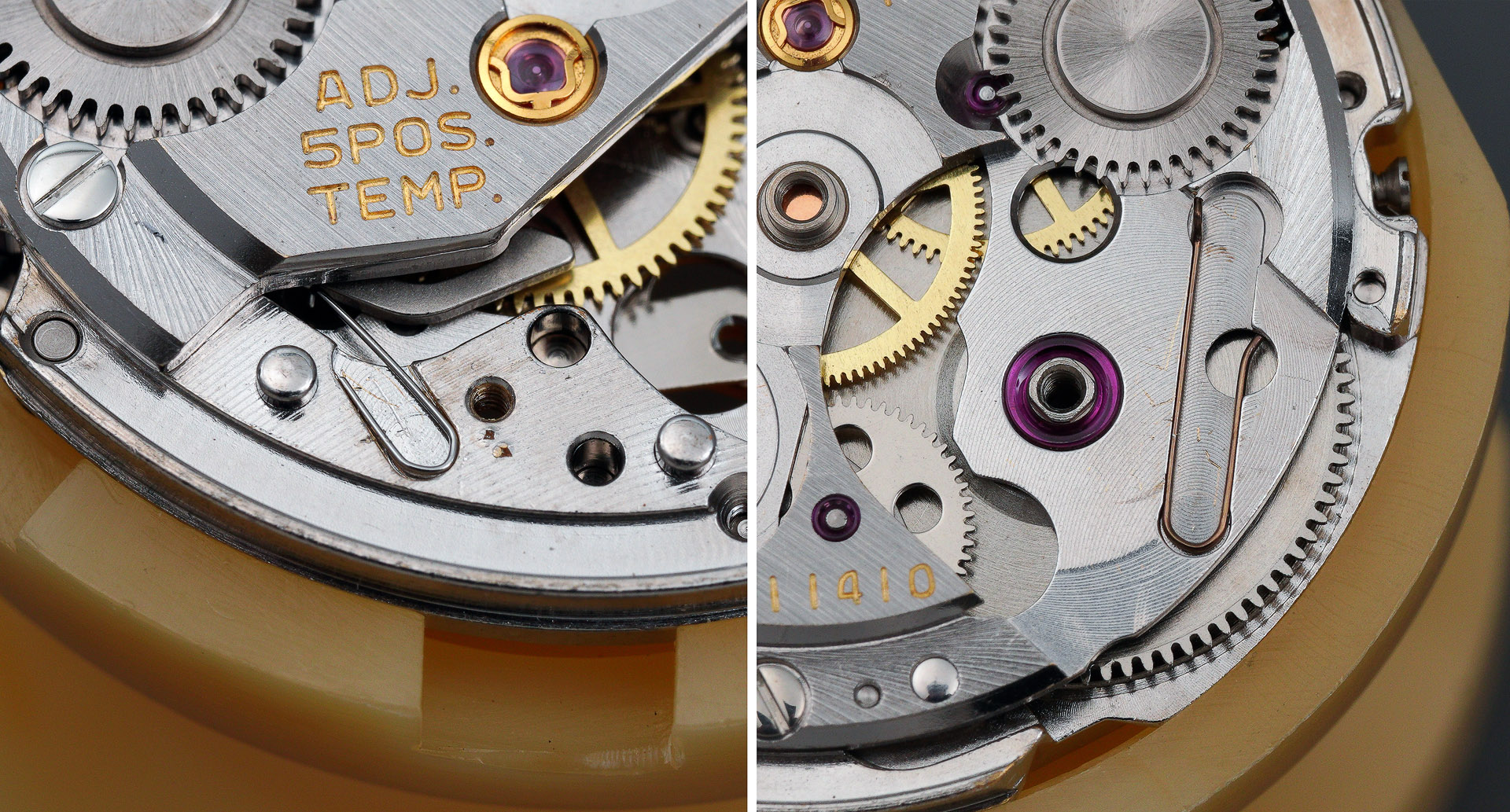
Nothing is manifestly different other than the appearance of the words ADJ. 5POS. TEMP. on the train wheel bridge indicating that the movement has been adjusted to five positions and to ensure that the temperature-dependence of the rate conforms to the Grand Seiko standard. The only part numbers of any significance that differ between the 5626B fitted to later and chronometer-specified King Seikos and the 5646 movements fitted to this family of Grand Seikos are the winding weight, the barrel and train wheel bridge and the ratchet wheel. Parts that might have a tangible effect on performance such as mainspring or balance wheel are the same.
While we have the opportunity, let’s remove the two Diafix cap jewels as well as the balance Diashock.
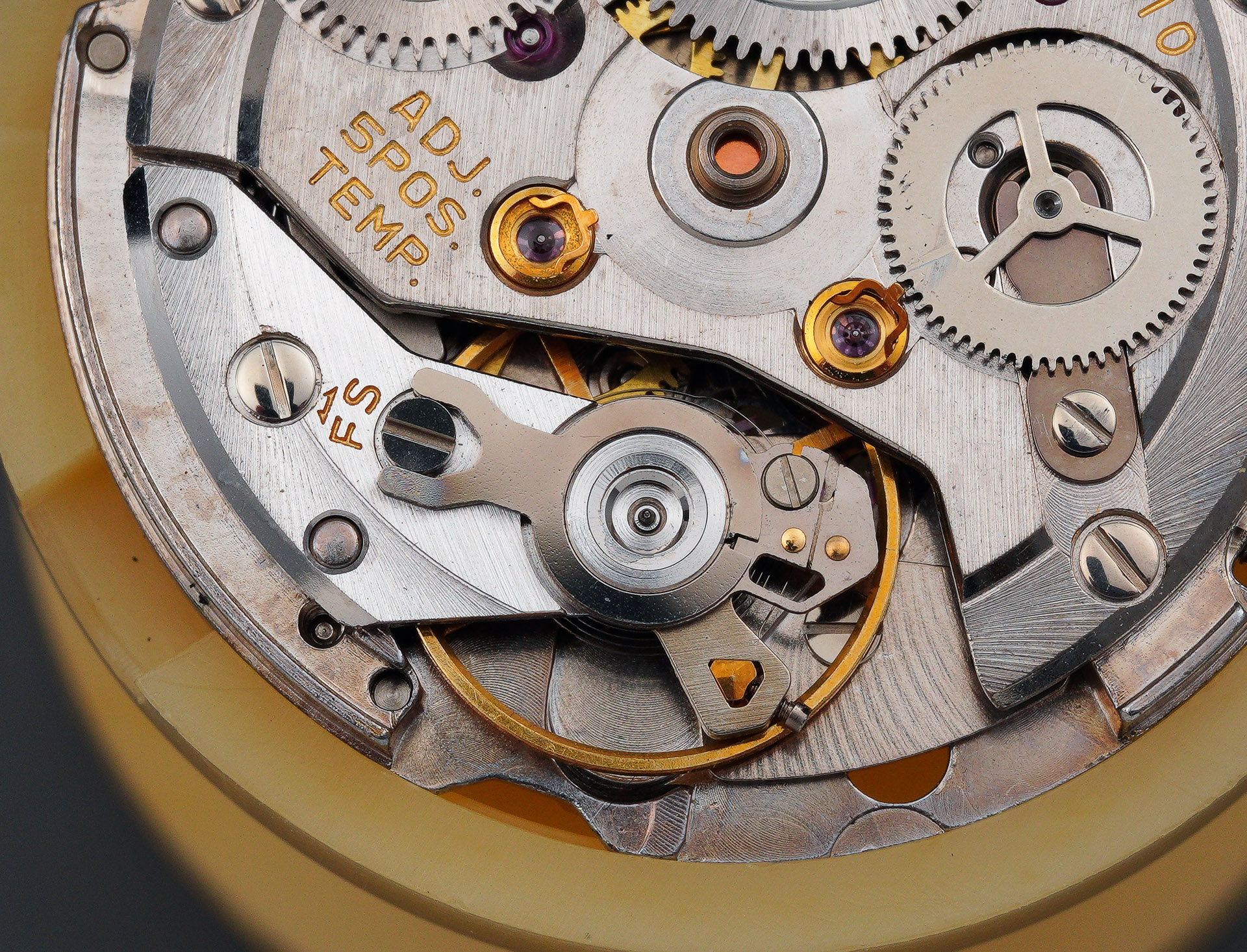
Removing the balance allows us to inspect the hairspring which looks nice and crisp and even.

With the balance out of the way, we can remove the pallet bridge and pallet fork and it is at this point that I encounter an unanticipated issue.
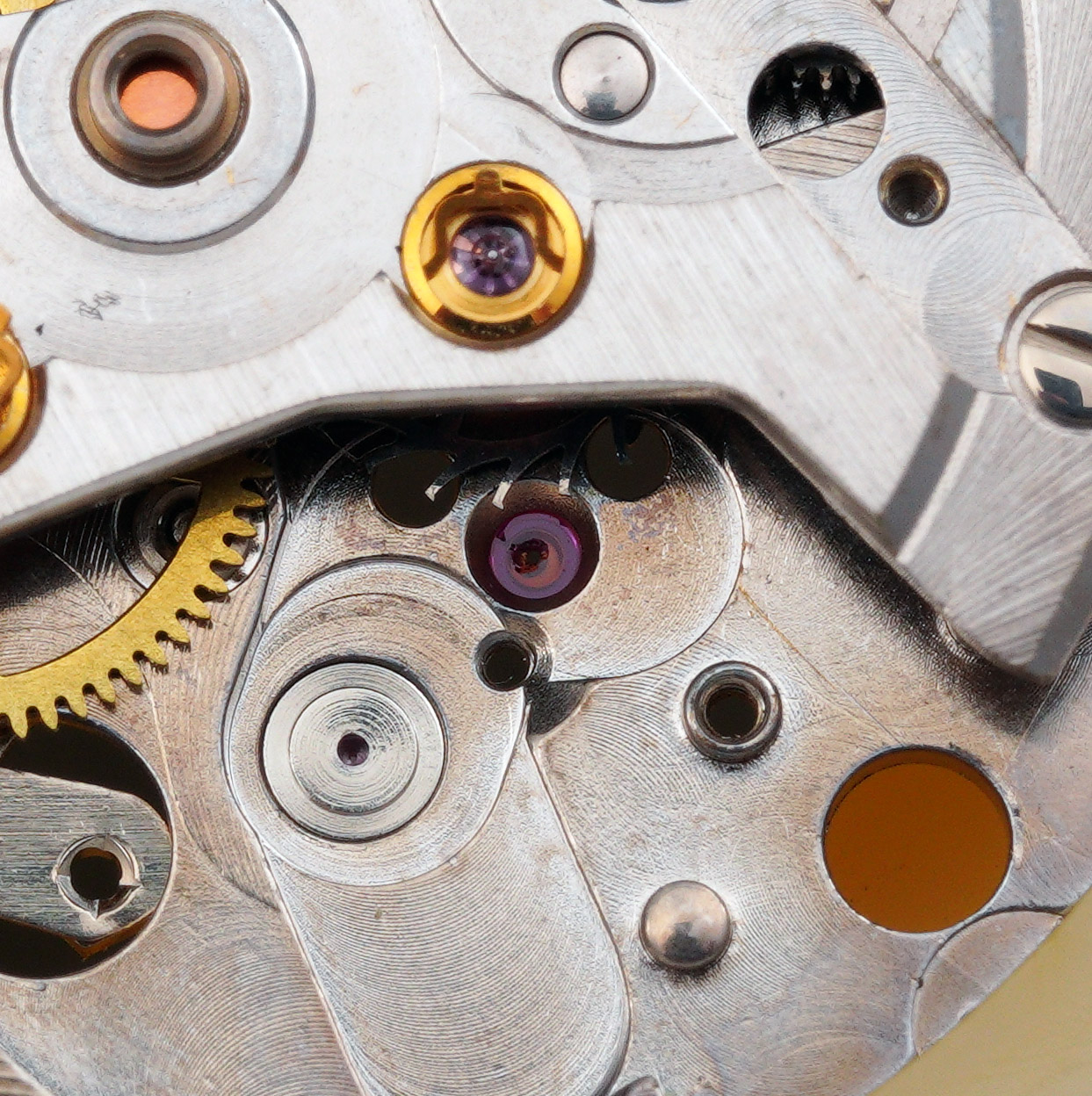
Initially, I took the shadow at the centre of the pallet fork jewel to be a splodge of dried oil but a closer inspection reveals it to be a chip out of the jewel. We shall get a clearer view shortly with the train bridge out of the way. But first, let’s proceed with the correct order of play and remove the second setting lever spring.
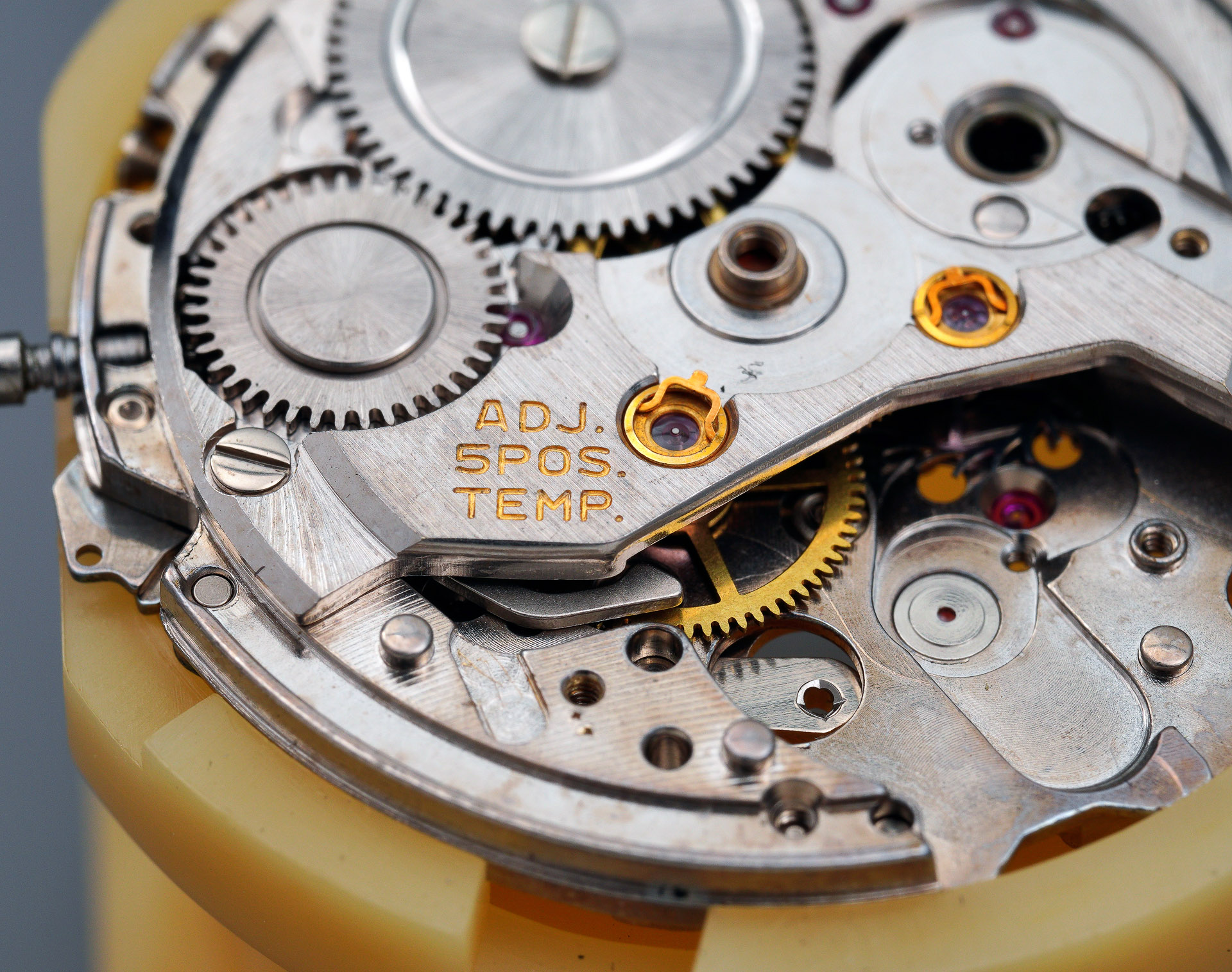
Deconstruction of the train wheel side is routine from this point, following the path described a number of times in other posts on this family of movements.
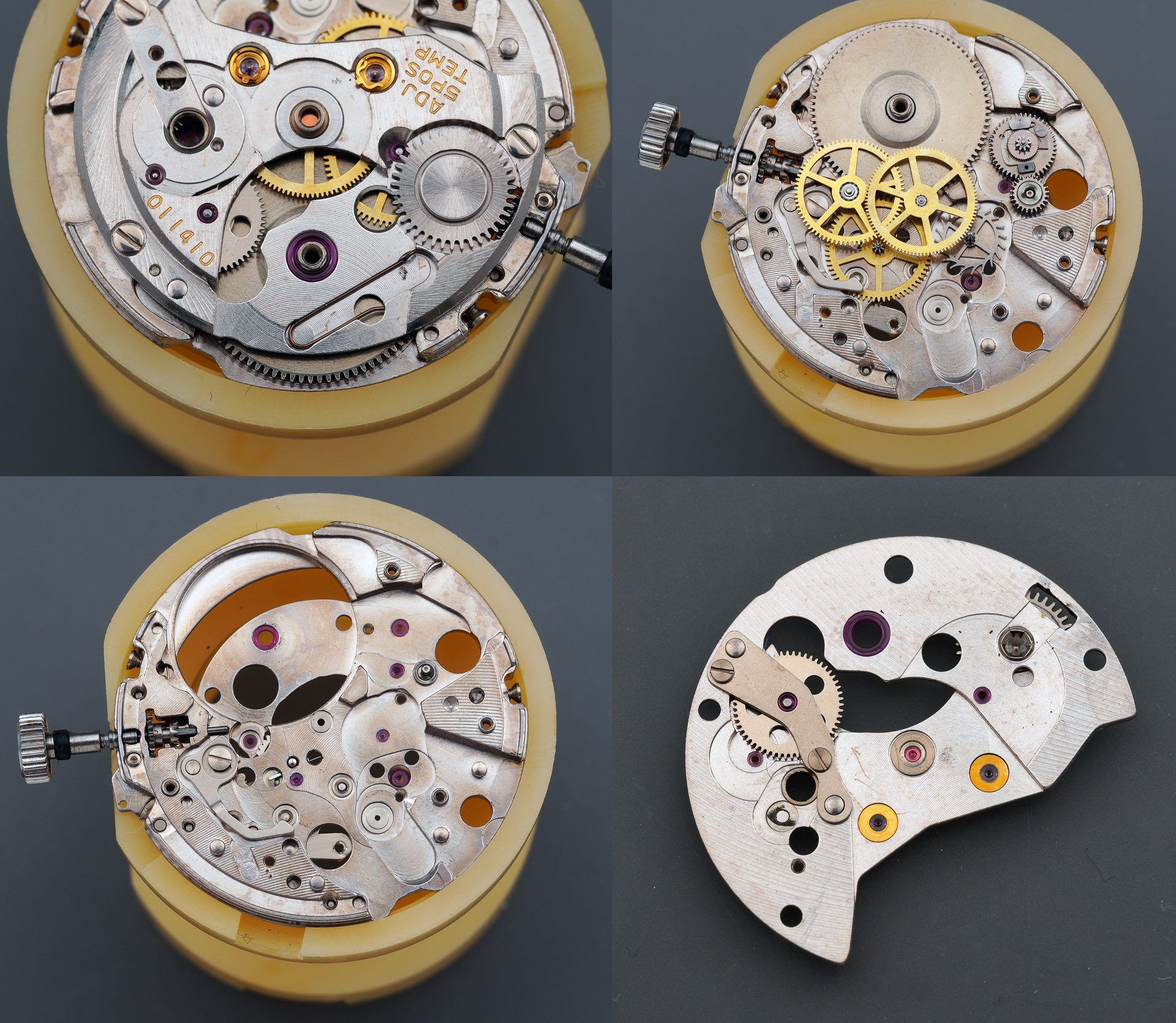
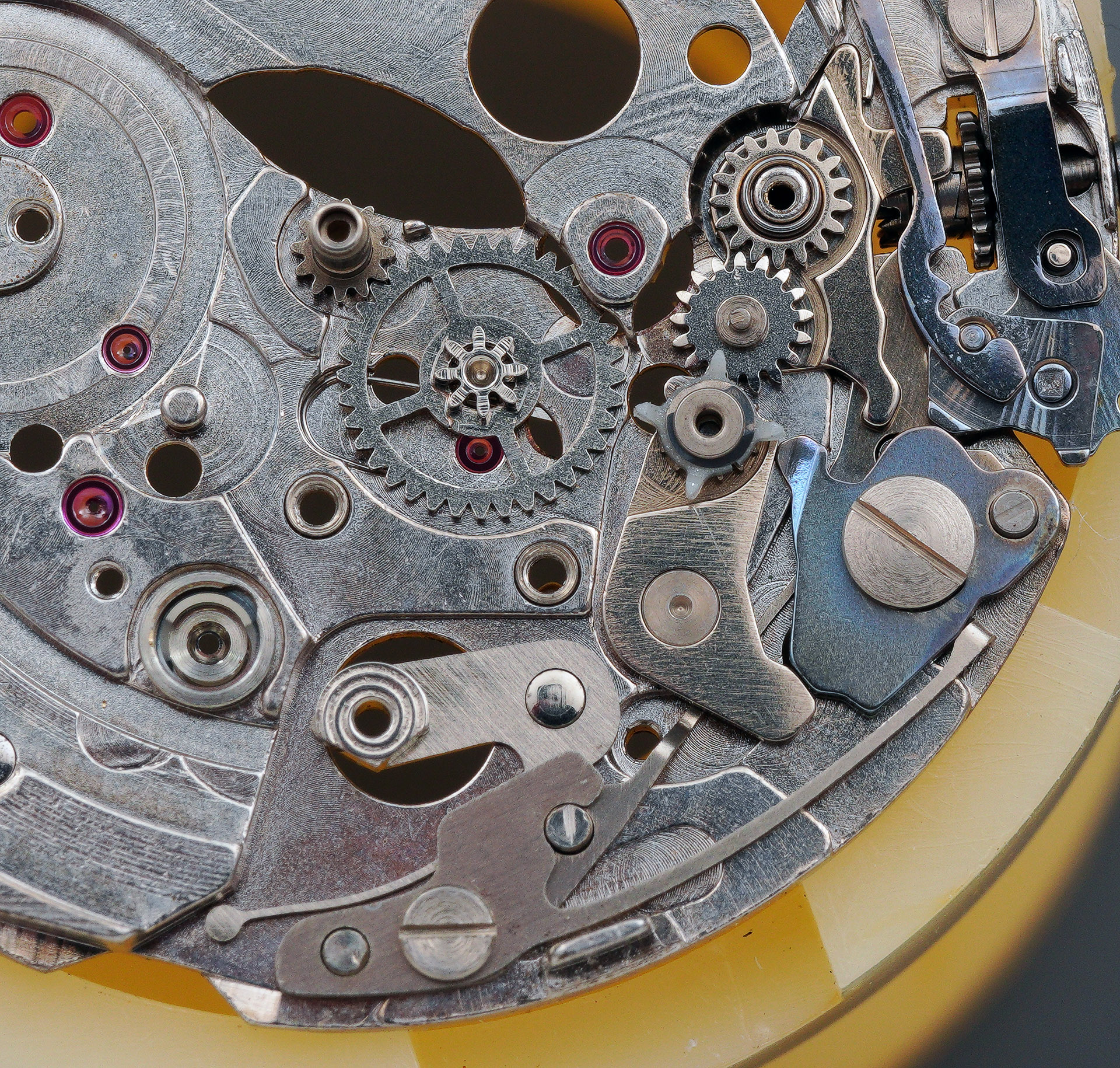
The patination visible on the main plate suggests some considerable time has passed since its last service. Indeed, there is not a lot to suggest so far that this movement has ever been serviced until now. Before completing the deal, lets pause to take a gander at the setting parts on the dial side, noting the considerable complexity compared to either of the 62 or 61 series movements.
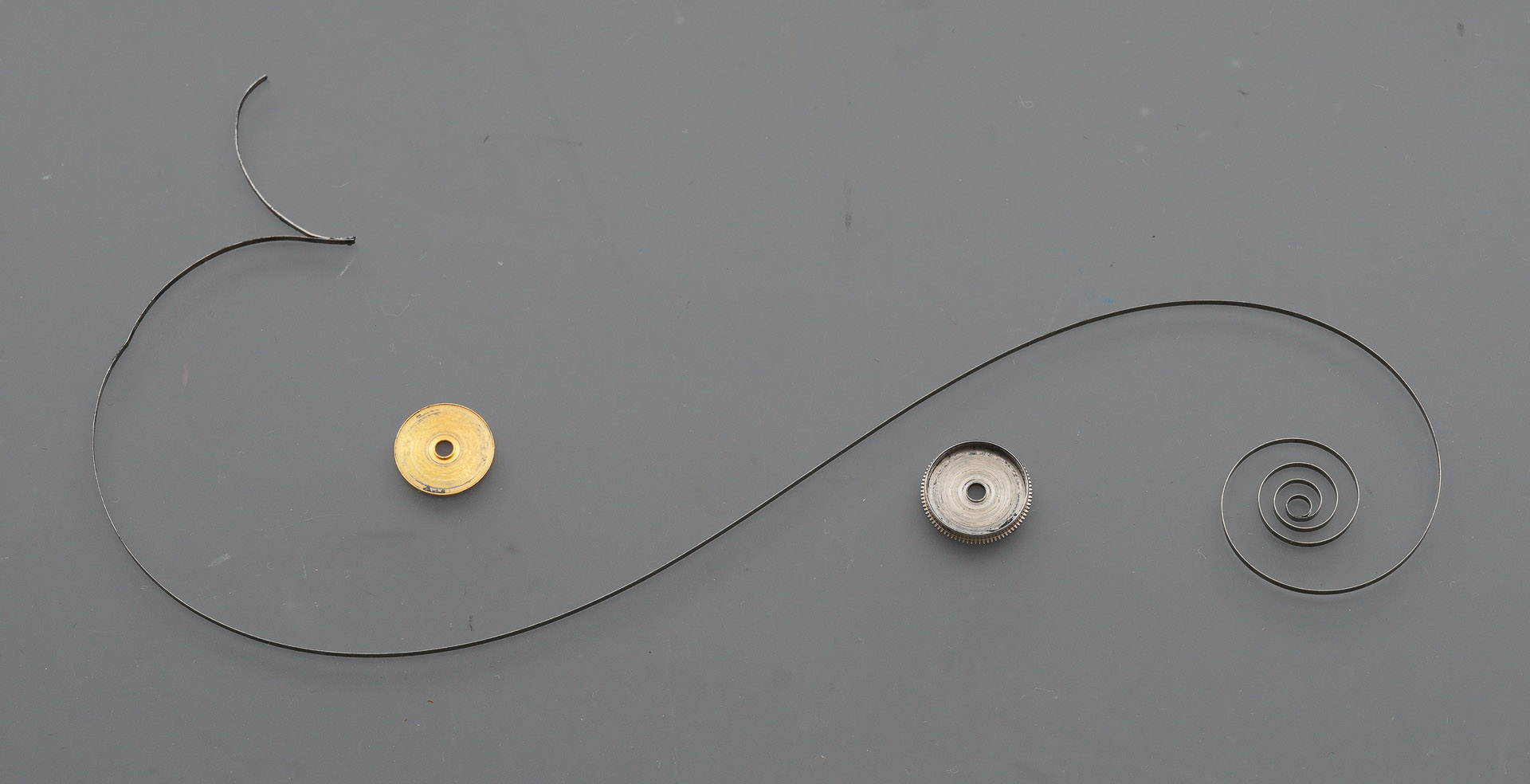
Unravelling the mainspring would normally be the last task before cleaning.
However, I wanted to investigate further the state of the pallet jewel and potentially remedy that before moving on. A close-up view of the jewel confirms the diagnosis.

A sizeable chunk is missing. I wonder where it ended up?
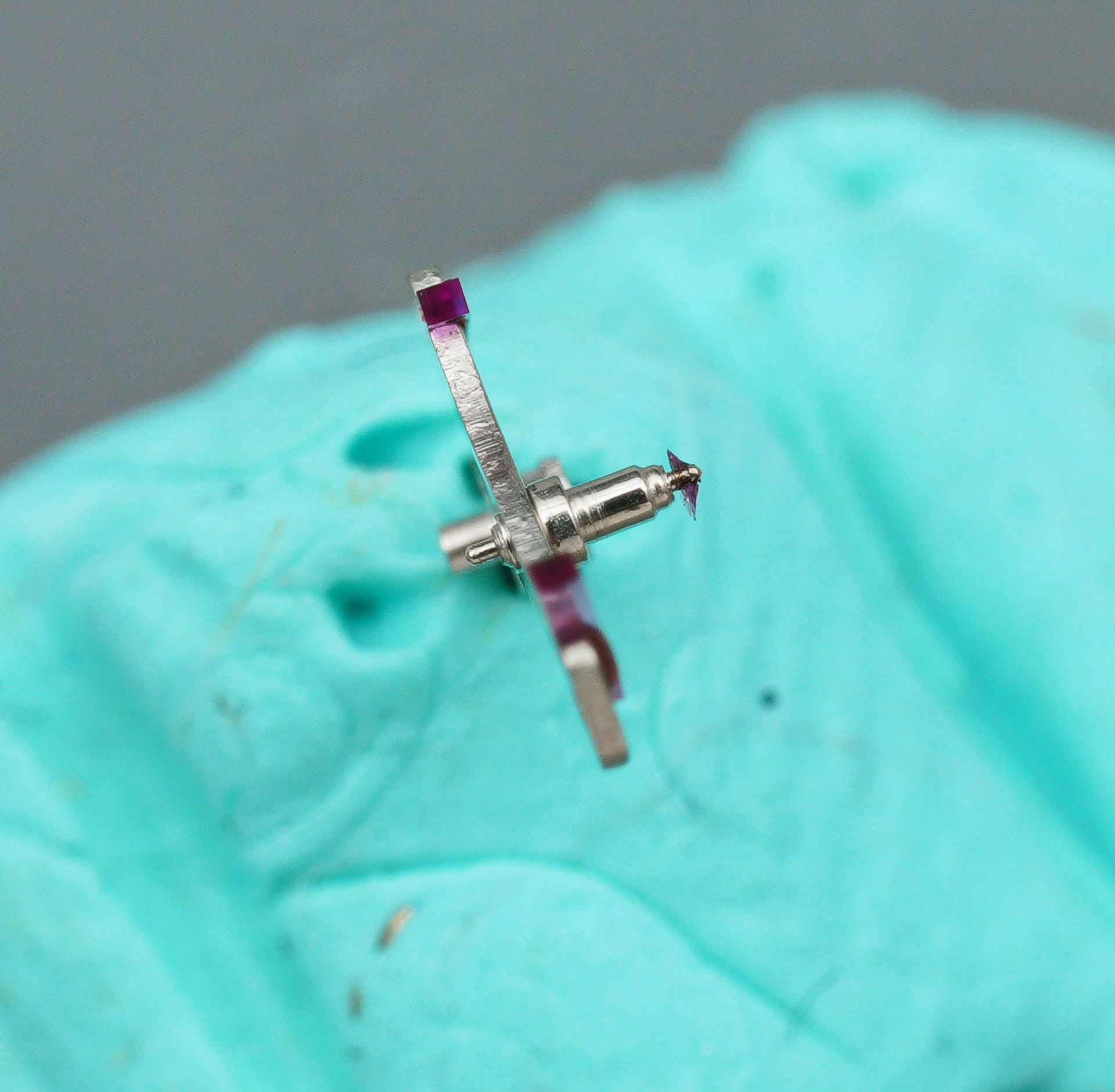
I find it somewhat surprising that the watch was able to run in this state but I assume that with the pallet secured into position, the pivot was still able to, err, pivot sufficiently freely to allow a flow of energy between the mainspring and the balance. Nevertheless, clearly the jewel needs replacing. A suitable candidate is secured from a spare 5606.

With the replacement jewel removed from the donor, I press it into the vacancy in the 5646 mainplate.
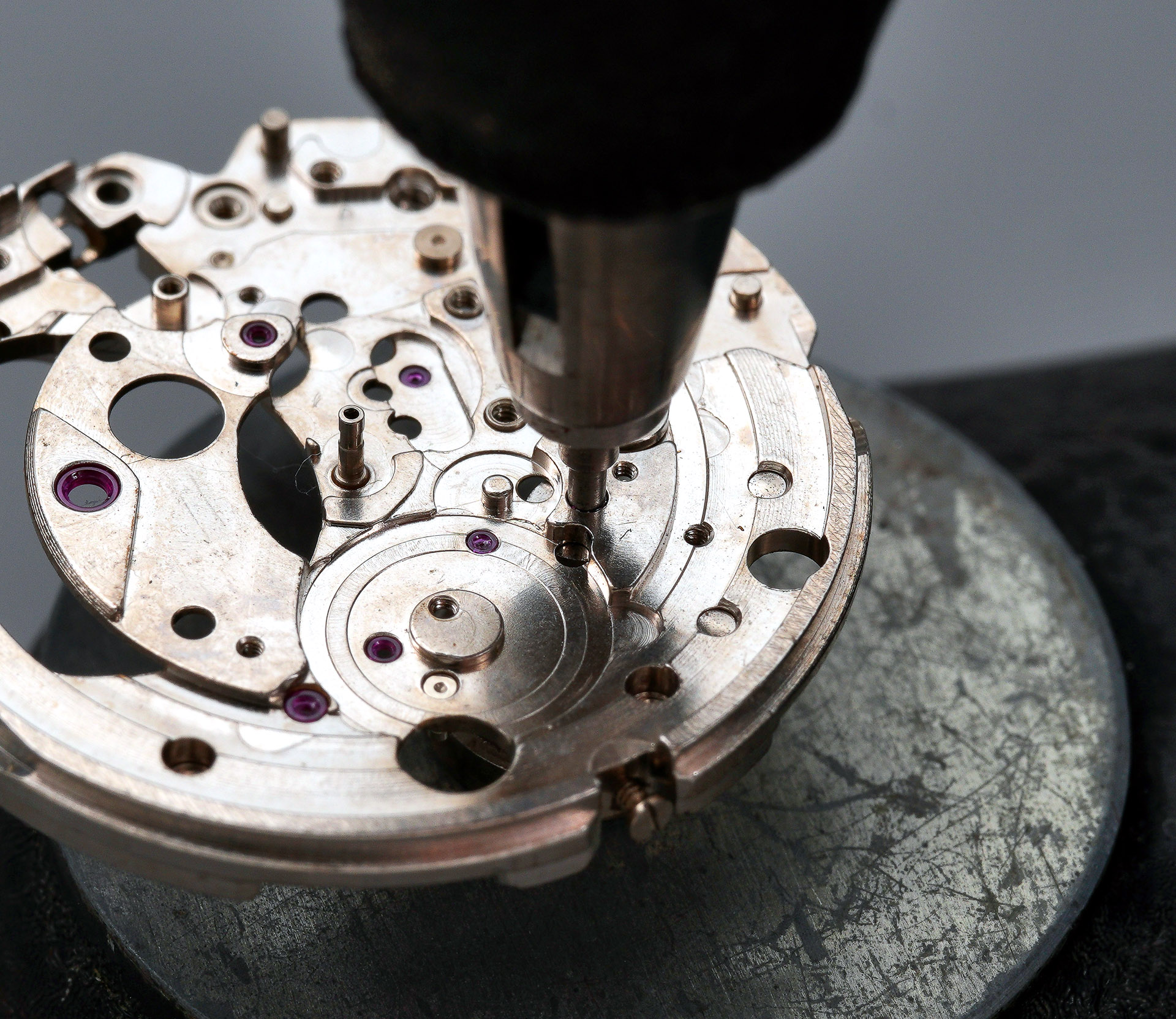
At this stage it is important to check for end-shake and so I temporarily refit the pallet fork and its bridge and do just that.
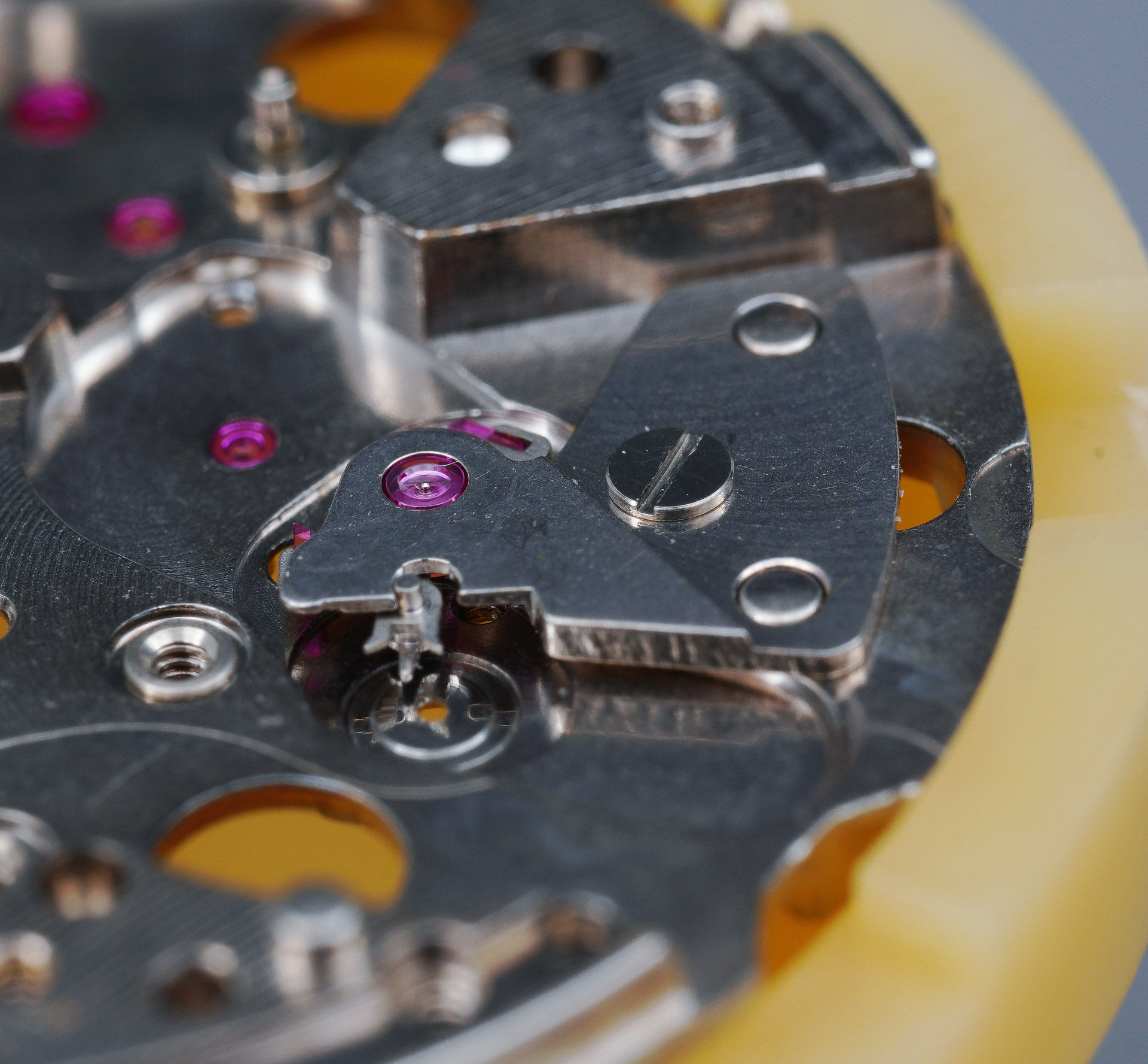
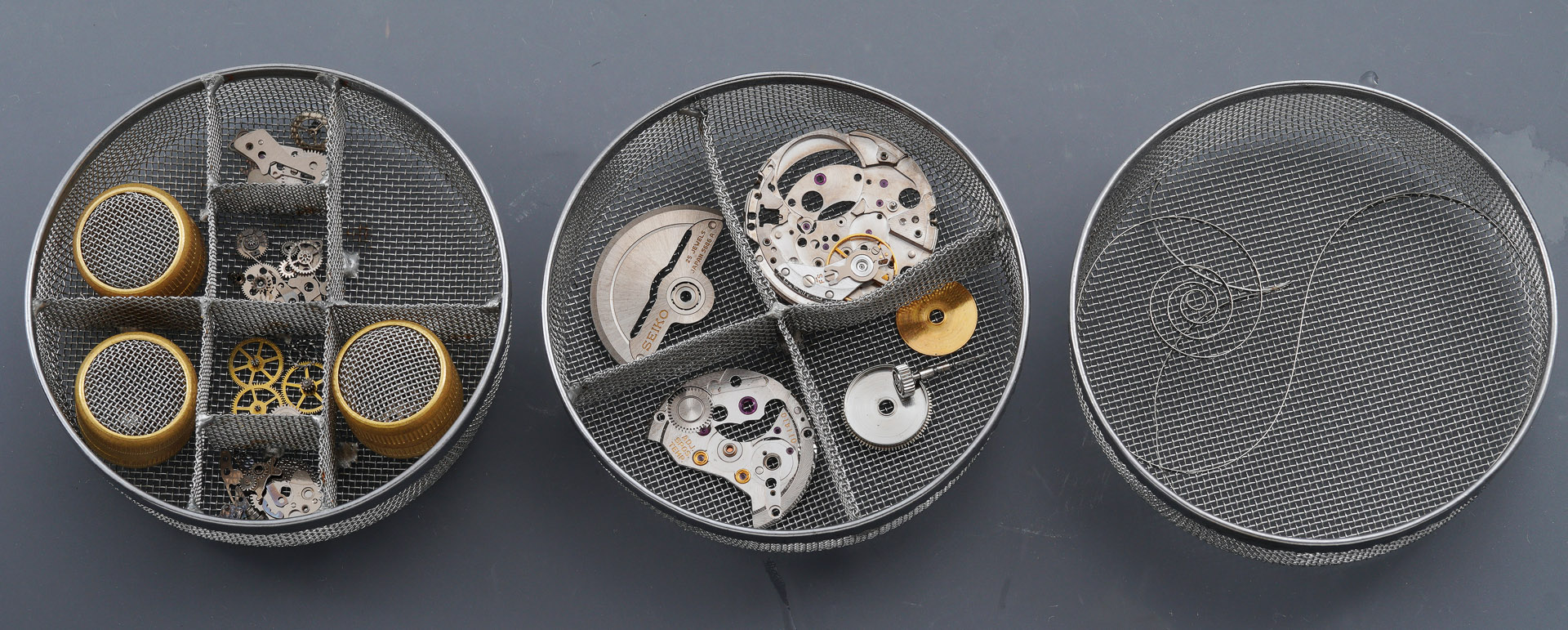
A small further adjustment was required and with that done, the whole movement can be distributed between the mesh baskets before the cleaning process begins.
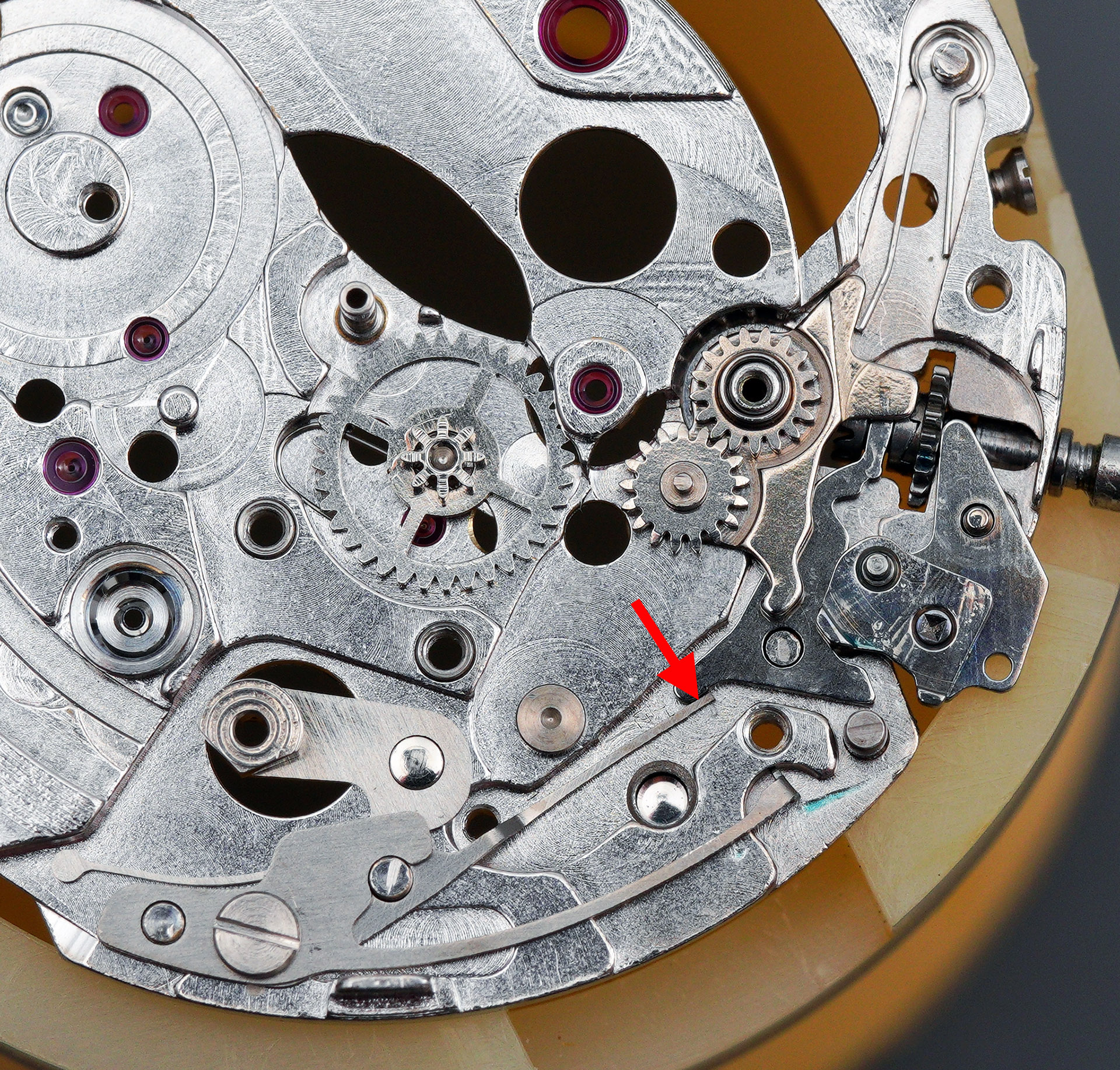
The reassembly begins with the rather complicated arrangement of setting parts. I have jumped straight to the point just prior to refitting a replacement day/date corrector wheel. Notice the correct positioning of the yoke spring against the yoke (indicated in red, below). It is all too easy to miss this.
I have sourced a replacement day/date corrector lever from a 5606 Lord Matic donor, this one benefitting from a metal wheel rather than the vulnerable plastic (you might wonder why I have not opted to repair the lever as was my initial approach in the chronometer King Seiko project described here). In the image below the replacement lever is secured in place with the minute wheel bridge, the minute wheel having been eased into its position against its U-shaped minute wheel spring.

Two procedures next require a degree of manual dexterity: first up, refitting the mainspring.

And second, the fitting and lubrication of the train bridge Diafix cap jewels:
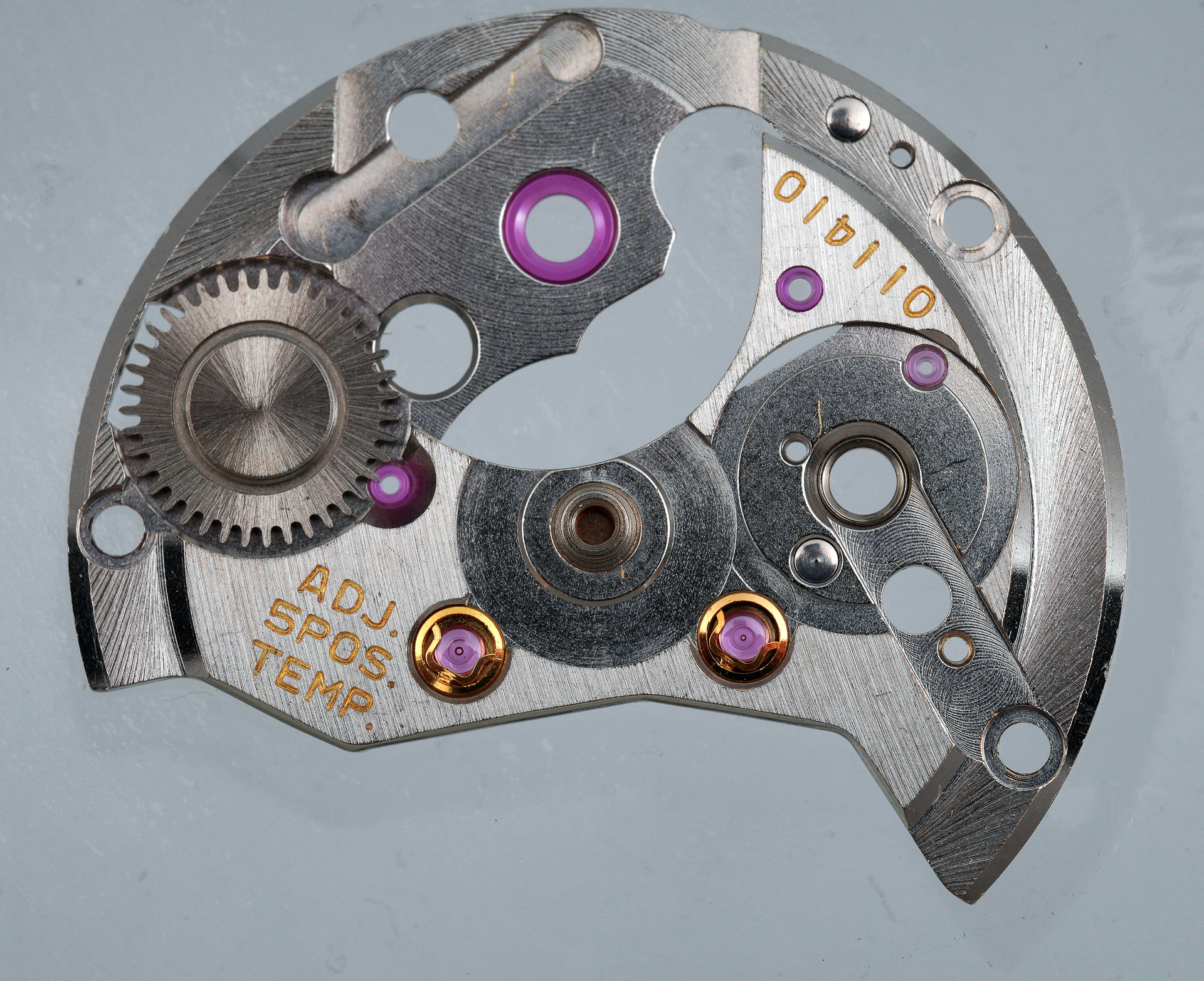
While we are attending to the train wheel bridge, let’s refit the transmission wheel and its bridge to the reverse side.
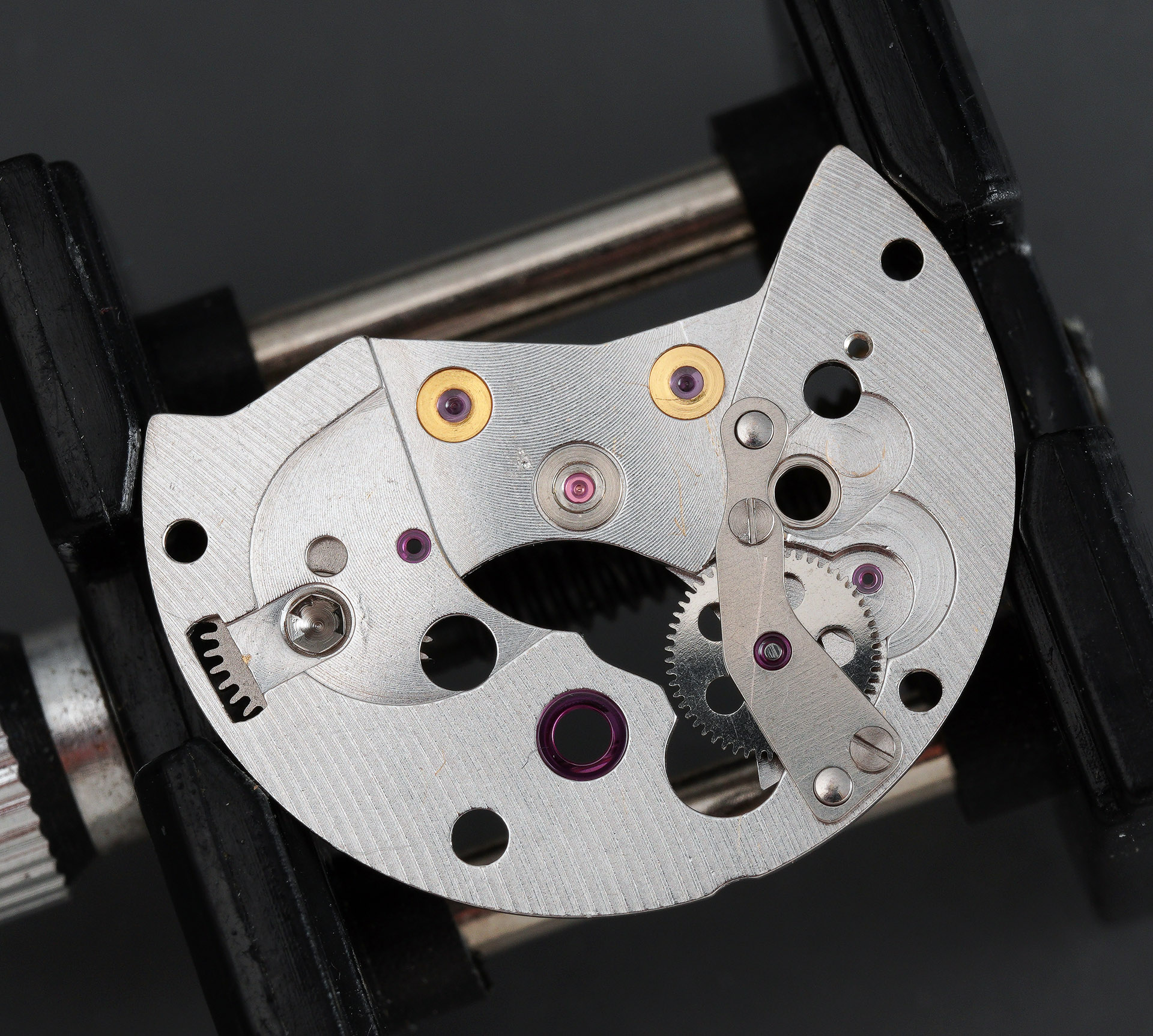
The first act on the balance-side of the movement is to fit the stop seconds lever.
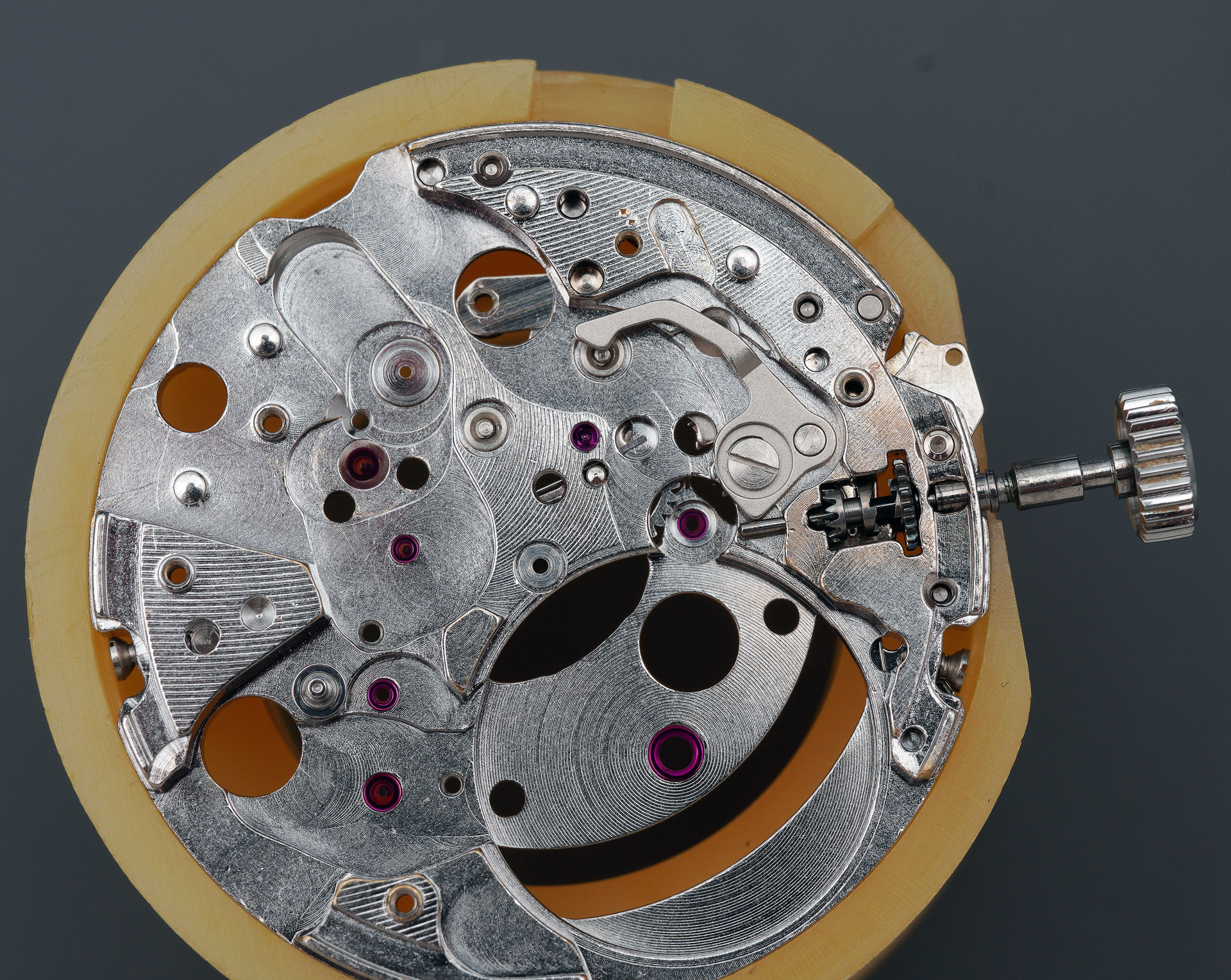
Having done that, we are ready to refit the going train which in this movement comprises the barrel, large driving wheel and pinion, third wheel, sweep second wheel and the escape wheel.
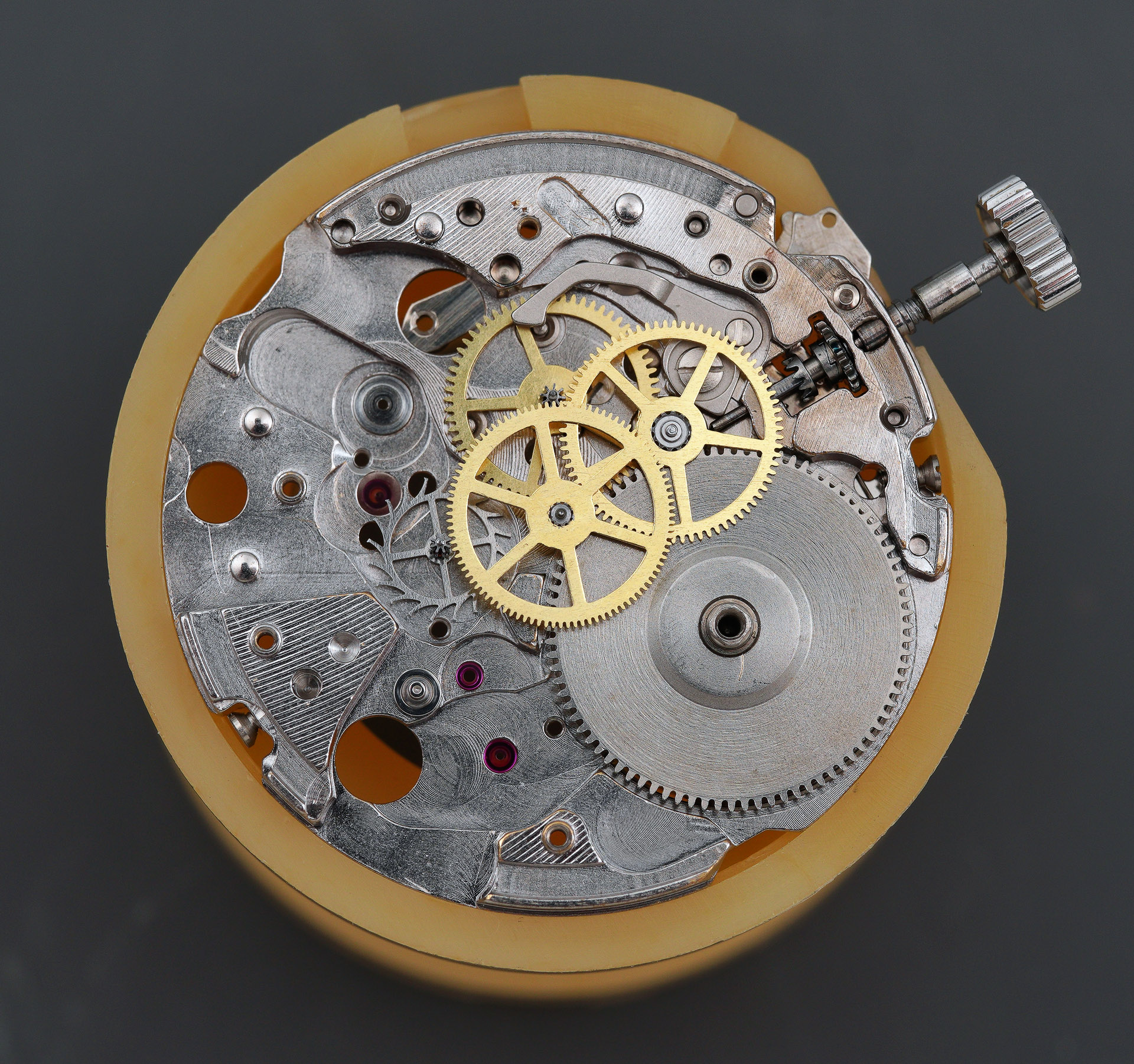
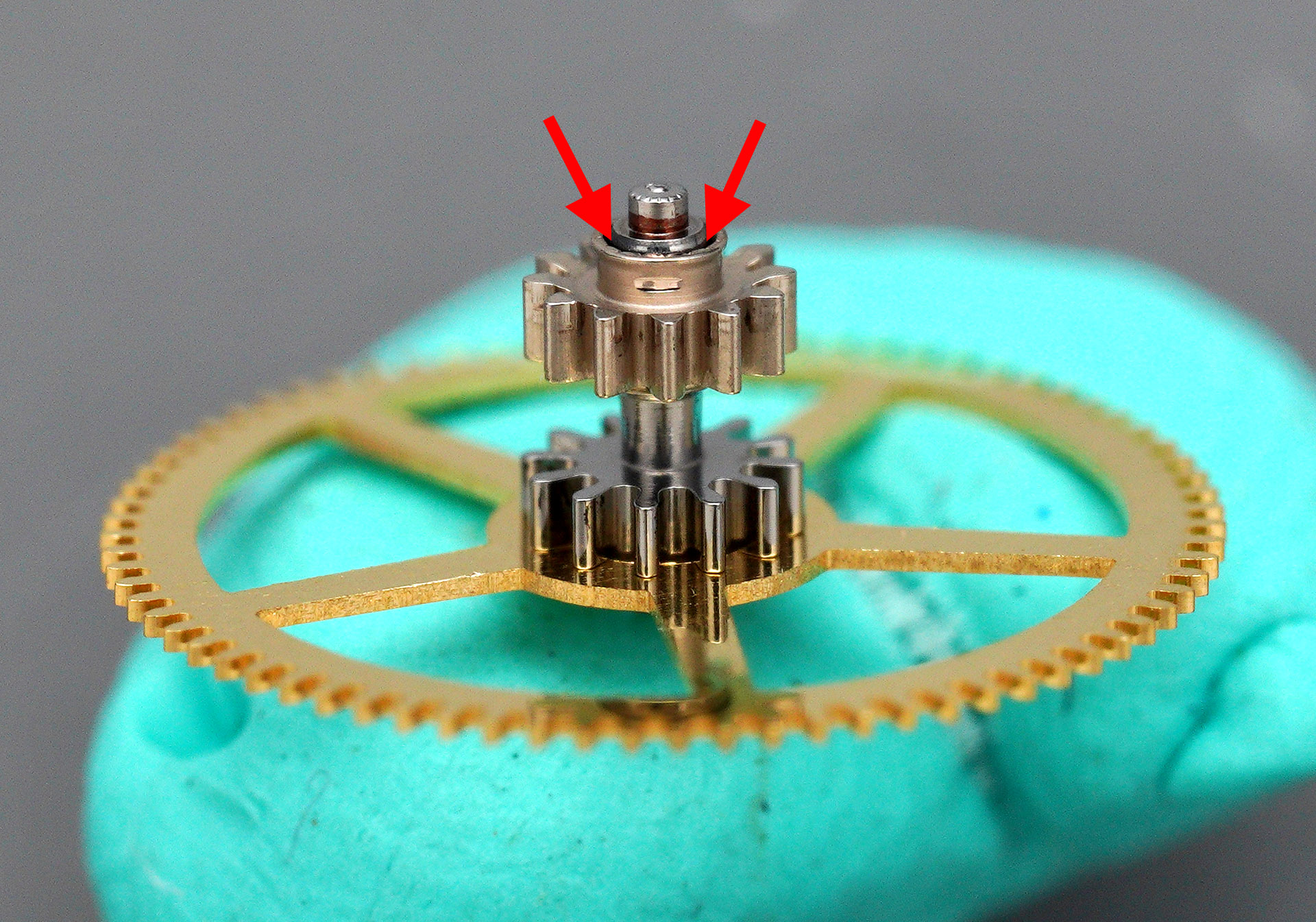
There is no centre wheel in this design, its role being performed by the off-centre large driving wheel and pinion. The technical manual treats this wheel and pinion as a single part, although it is straightforward to remove the upper-most pinion (effectively a cannon pinion). Lubrication requires a couple of drops of oil to be administered to the gap indicated in the photograph below:
The differential and second reverser idler wheels are positioned next, there to perform their respective roles in the operation of the autowinding mechanism. Note that in constrast to the piggy-backed separate autowinding module used in the earlier 62 and 61-series movements, the operational componentry of the autowinding mechanism sits at the same level as the going train in the 56-series.

The barrel and train bridge can be positioned and gently jiggled to facilitate the location of the six pivots plus barrel arbor. This is achieved surprisingly easily at which point the securing screws can be located and tightened down.
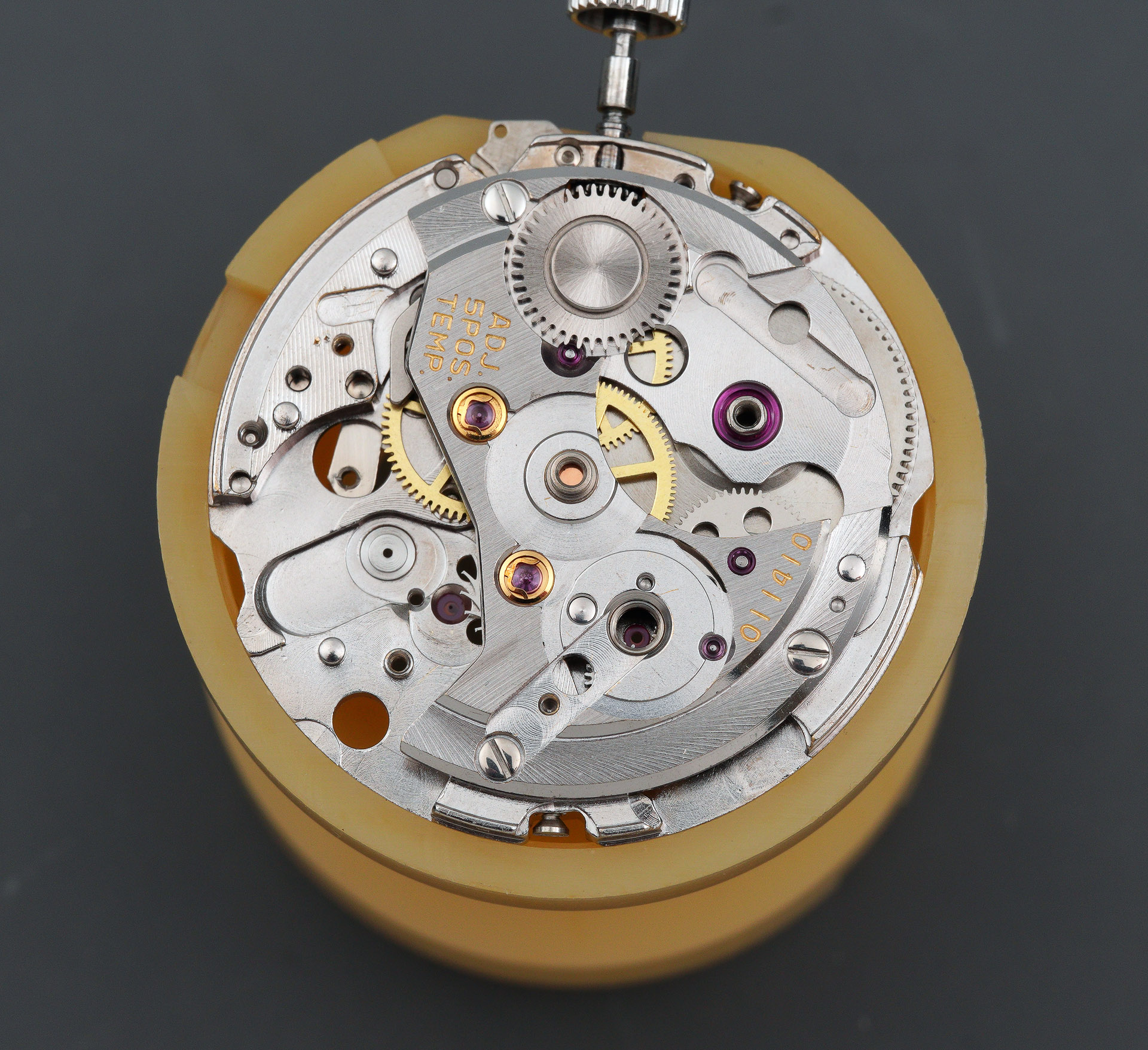
Lubricate the unlubricated pivots on this and the dial side and we can move on to fitting the stop seconds lever spring and then the click spring. The first of these will be in a state of some potential jeopardy until the balance bridge is fitted.
We can edge our way closer to being able to fire up the engine via the following sequence of steps: fit the ratchet wheel; fit the pallet fork and its bridge and lubricate the exit stone; lubricate and fit the dial side Diashock setting; fit the balance followed by its Diashock, and in principle we are ready to wind in some power and make an initial assessment.
I let the movement run for an hour or so, performed a preliminary regulation and all seems well.
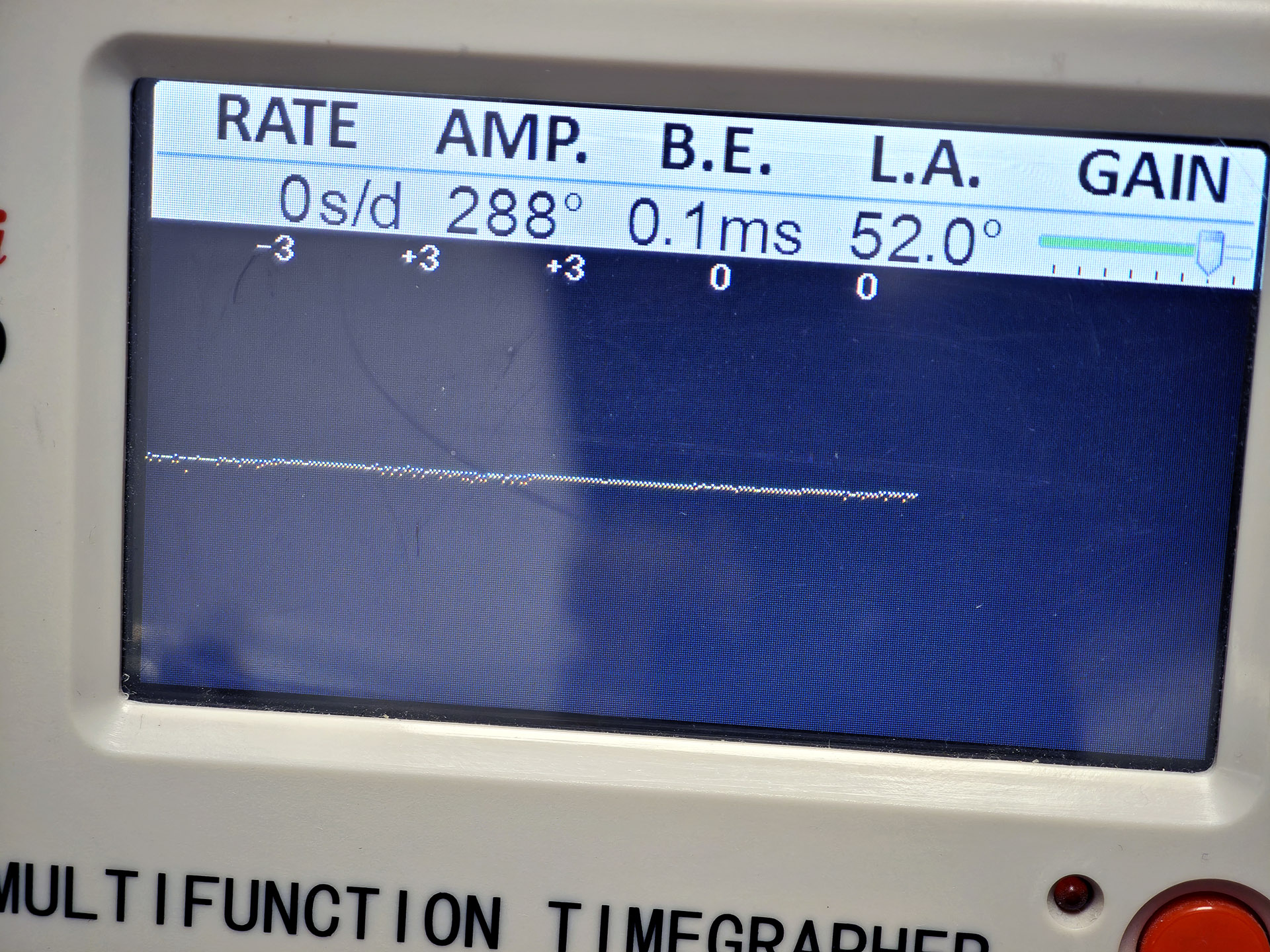
One point to note for future reference in the image above: the timegrapher is set to its default lift angle of 52 degrees. The 56-series are widely listed as having a lift angle of 56 degrees. However, I know of one watchmaker who reckons that is incorrect and that the true value is closer to the default of 52 degrees. I have made my own measurements on the 5606, 5626 and 5645 and will probably make a post about that at some point soon (spoiler alert: the documented value is not correct).
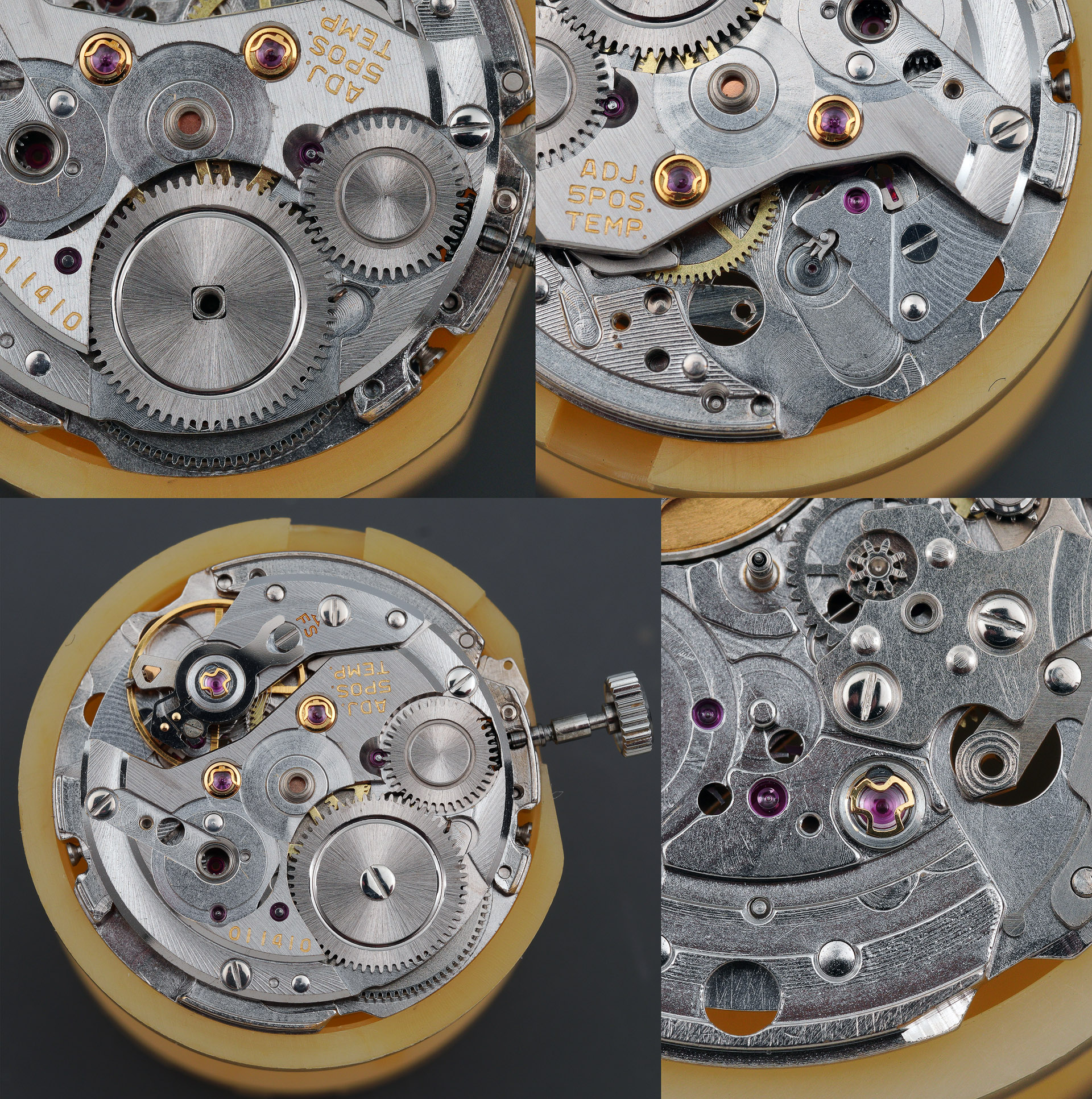
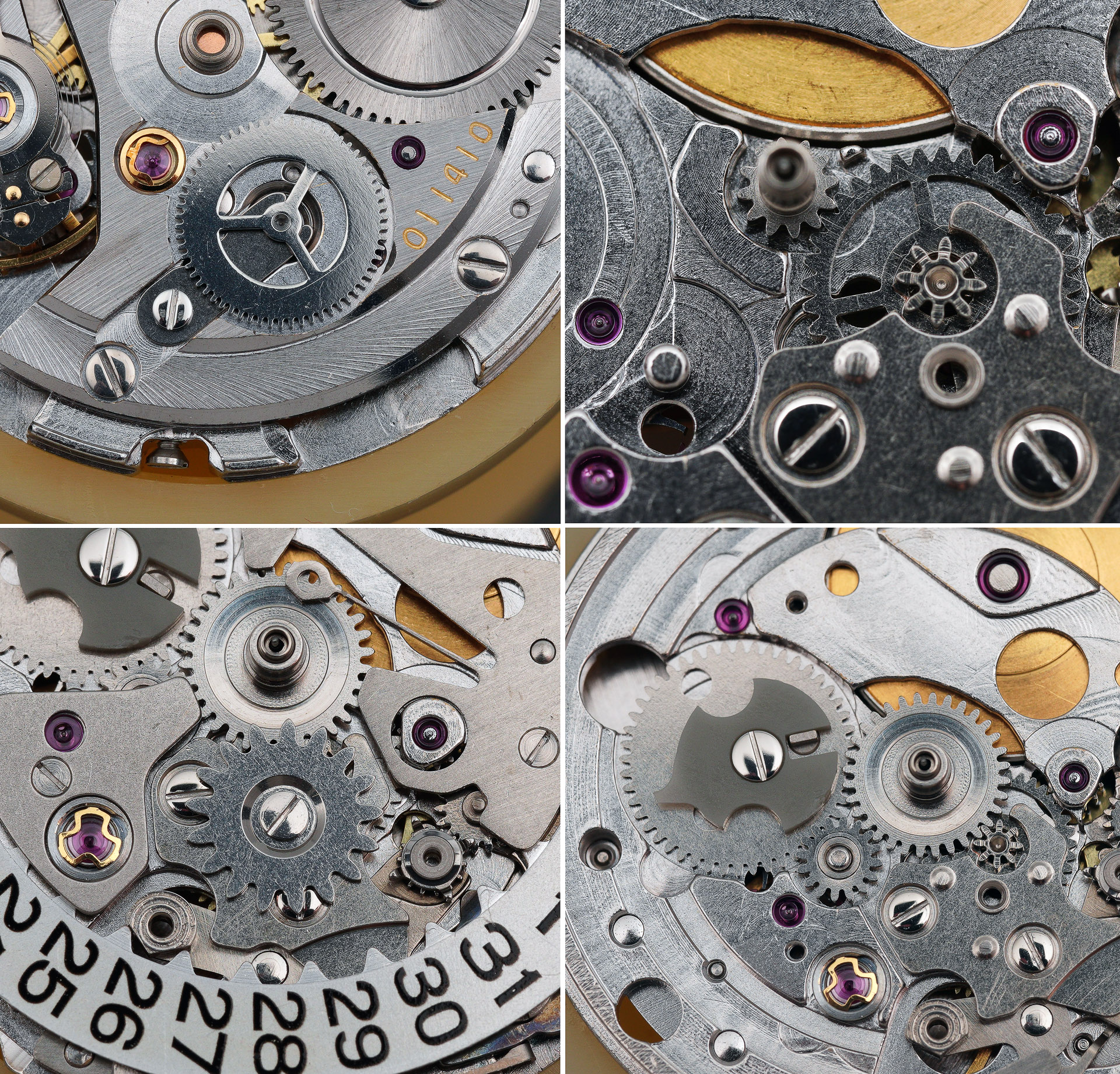
Four more steps take us close to being able to wrap up the movement work – clockwise from top left, below: install the autowinding mechanism first reverser idler and its bolt; fit the cannon pinion by easing the minute wheel downward against its spring; install the day/date driving wheel, intermediate wheel and hour wheel; and finally, fit the intermediate wheel for day correction.
We are ready to fit the bilingual day disk.
Fitting the dial requires us first to fit the dial ring but the original ring is cracked.
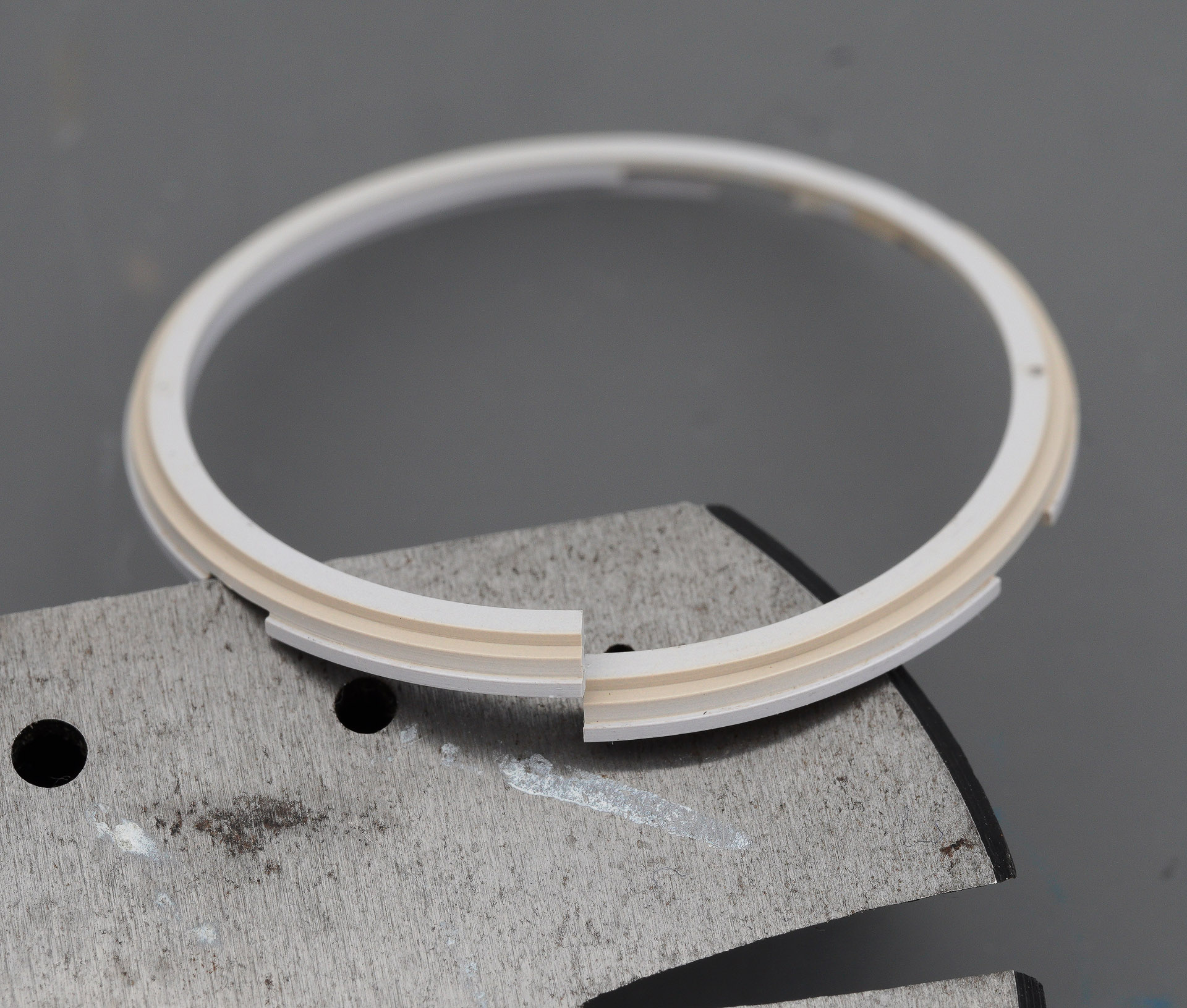
I went through the motions of repairing the break but as I had a whole replacement from a donor watch, I elected to use this.
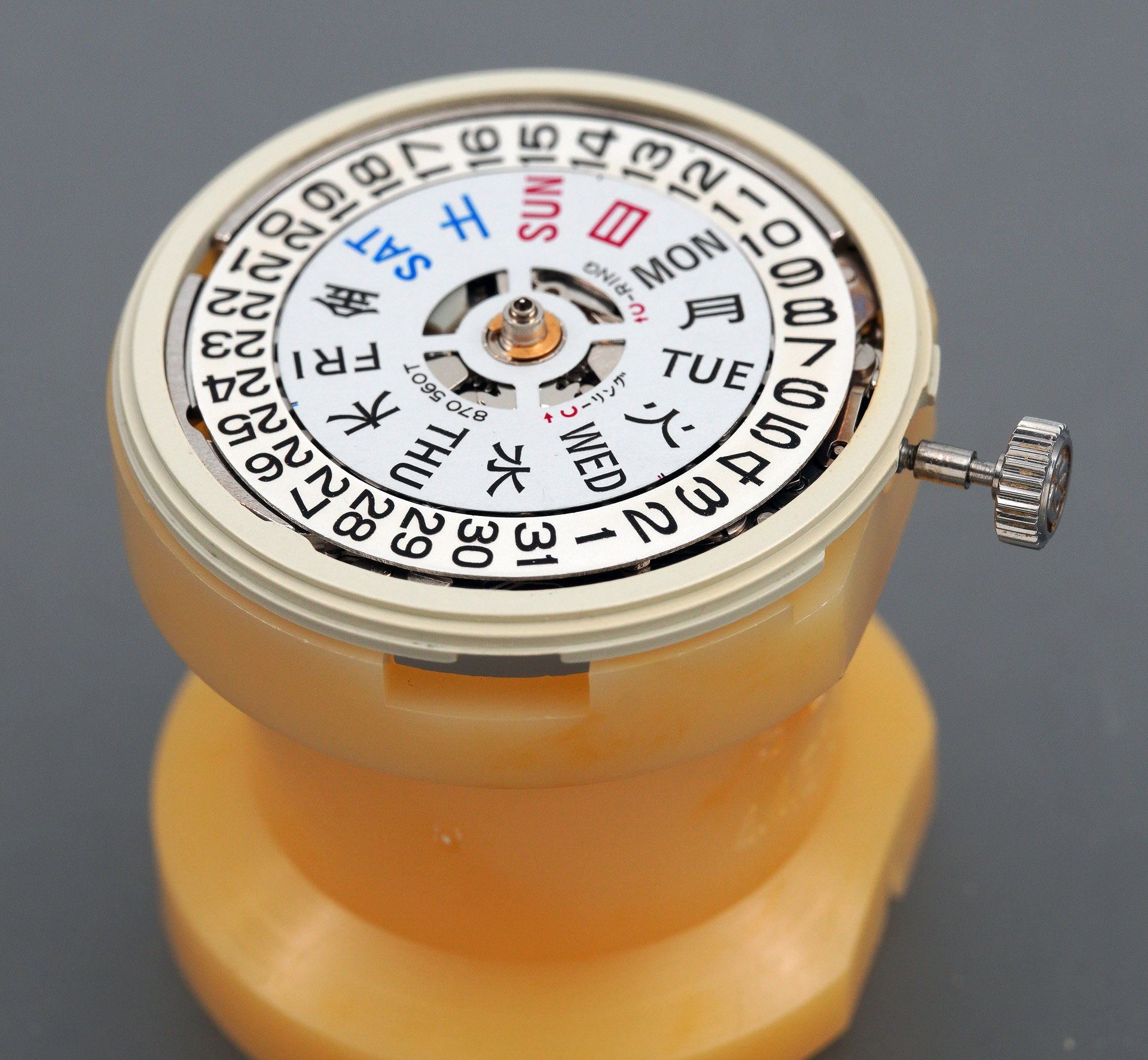
At which point, we can fit the dial and hands.

The photo above provides a clearer view of the mild damage around the periphery of the dial. This is all but invisible to the naked eye and there is no obvious degradation to the lacquer. It just appears that there has been a slight reaction to the dial finish beneath the lacquer, in particular between 11 and 3.
It is time turn our attention to the case. At its introduction, I noted that the case is in near mint condition, and that might suggest that there is little to do but provide it with a wash and brush up. That is certainly the case but to do that properly, we really need to dismantle the case completely.
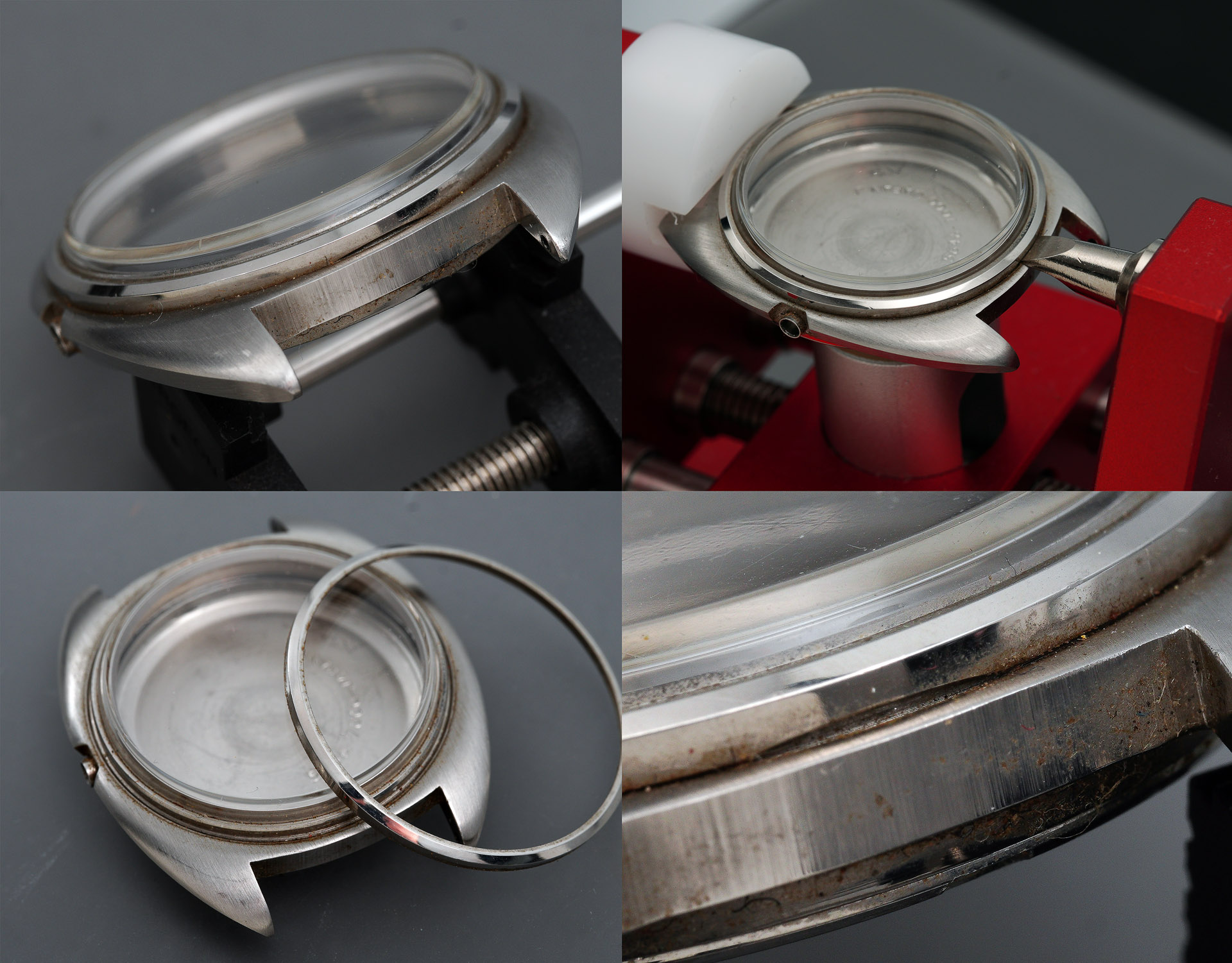
The crystal was in good enough condition to be reused, following a light polish with some Polywatch. The casing parts were cleaned in the ultrasonic bath and then given a good scrub with a toothbrush under warm running water.
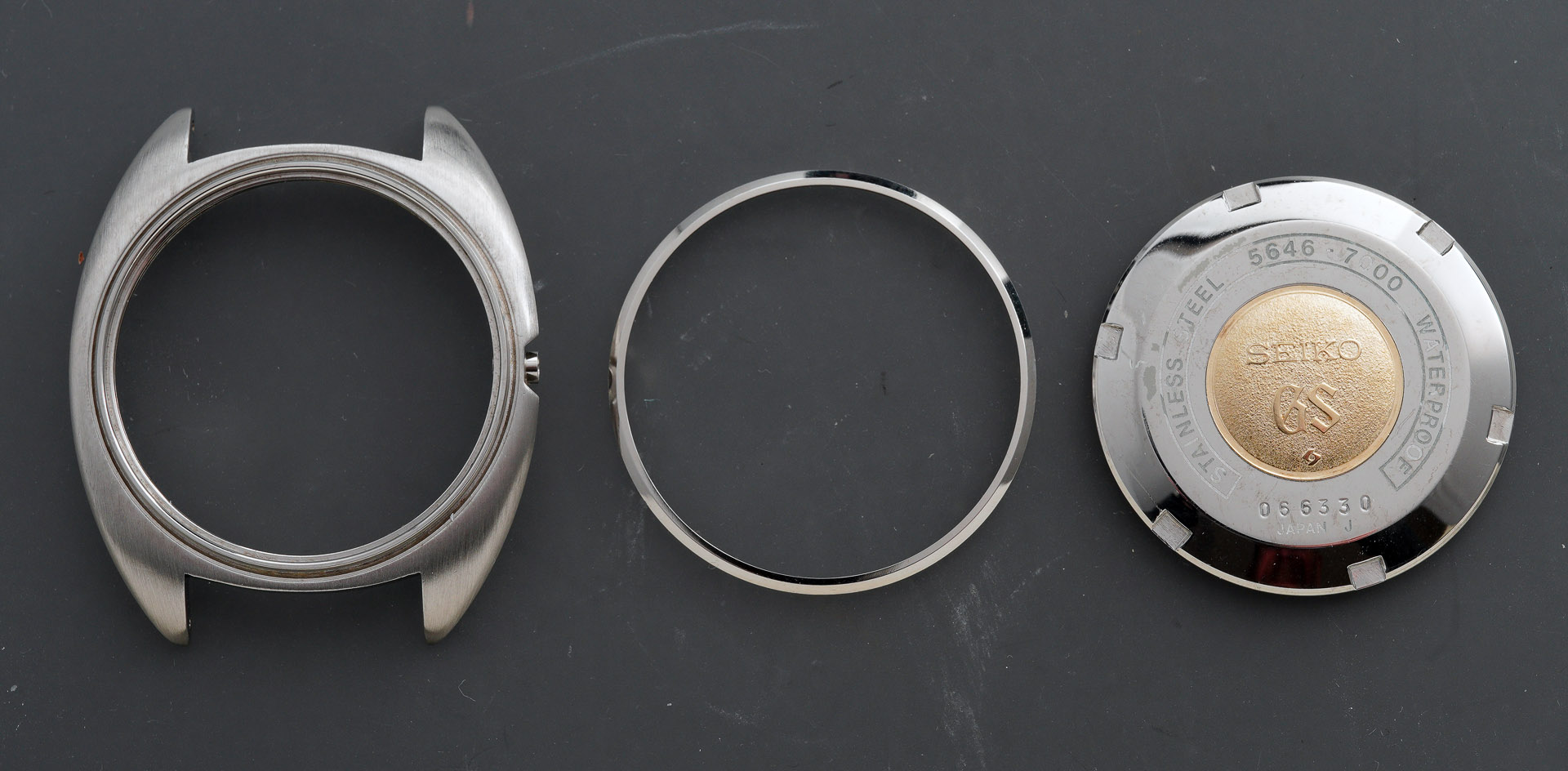
The crystal is pressed back into place, its armored tension ring providing a waterproof seal to the outside environment.
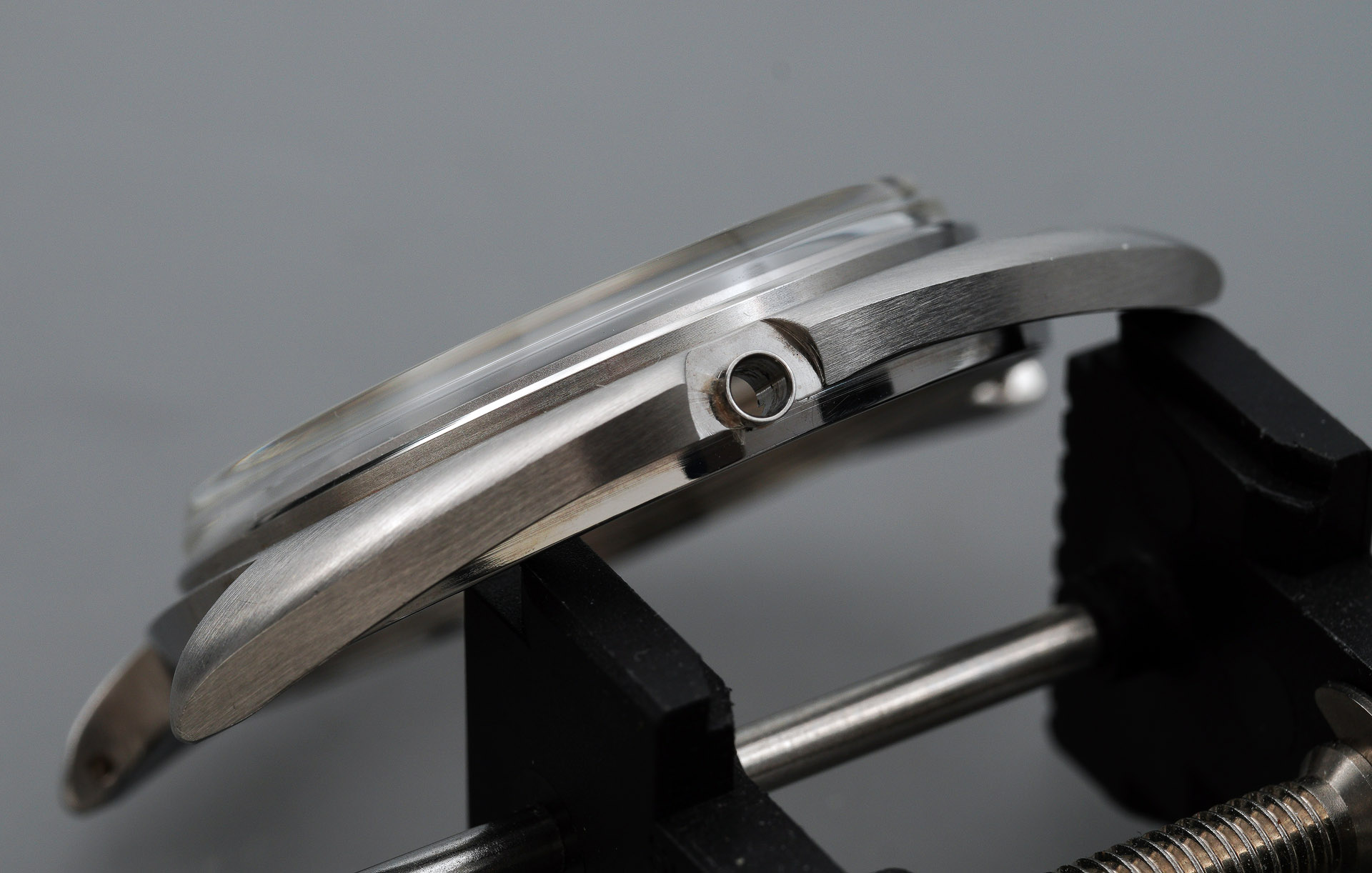
The case work is completed by refitting the bezel and we are ready to reunite the case with the movement.
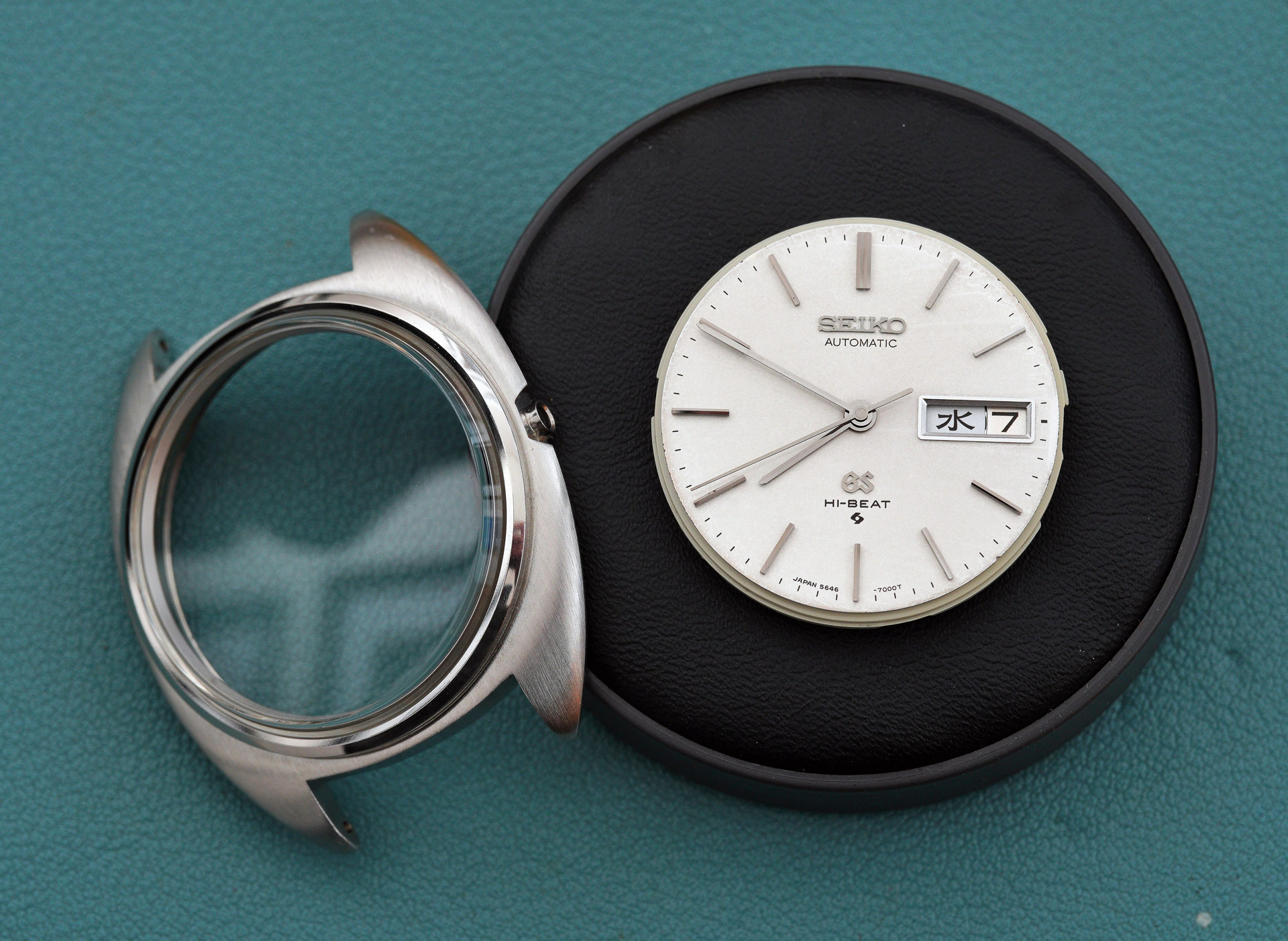
With the movement sitting comfortably back in the case, the final piece of the jigsaw to fit is the winding weight.

The watch is completed by refitting the caseback and my last task is to select a suitable strap.
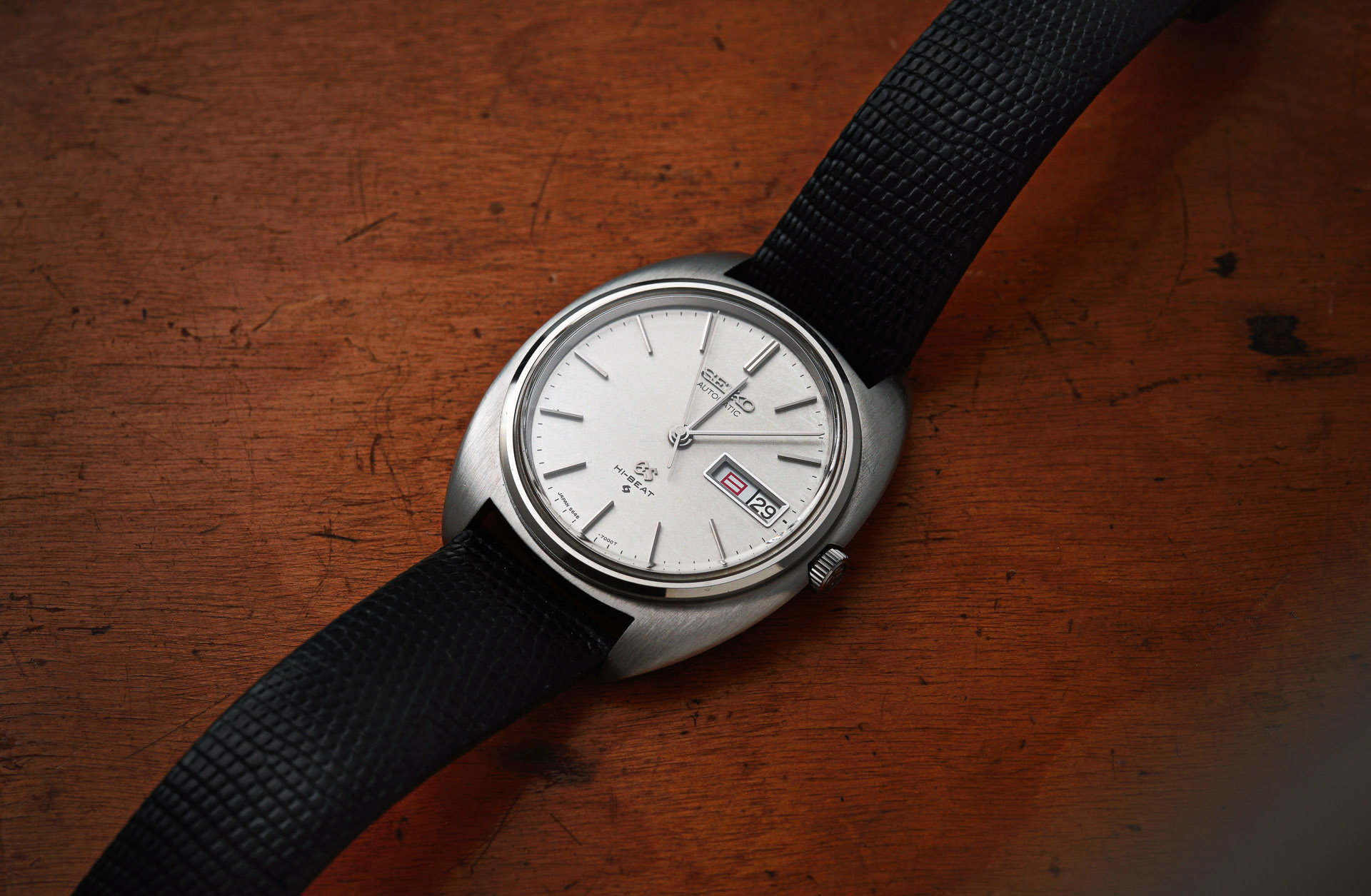
A consequence of the compact dimensions of the 5646, thanks to its integrated autowinder and smaller diameter, is that the watches that it was paired with, as the decade ticked over from ’69 to ’70, were smaller, more elegant, perhaps a little less overt in their expression of their elevated status.

But they are also very beautiful objects of desire, whose appeal can be appreciated from almost any angle.
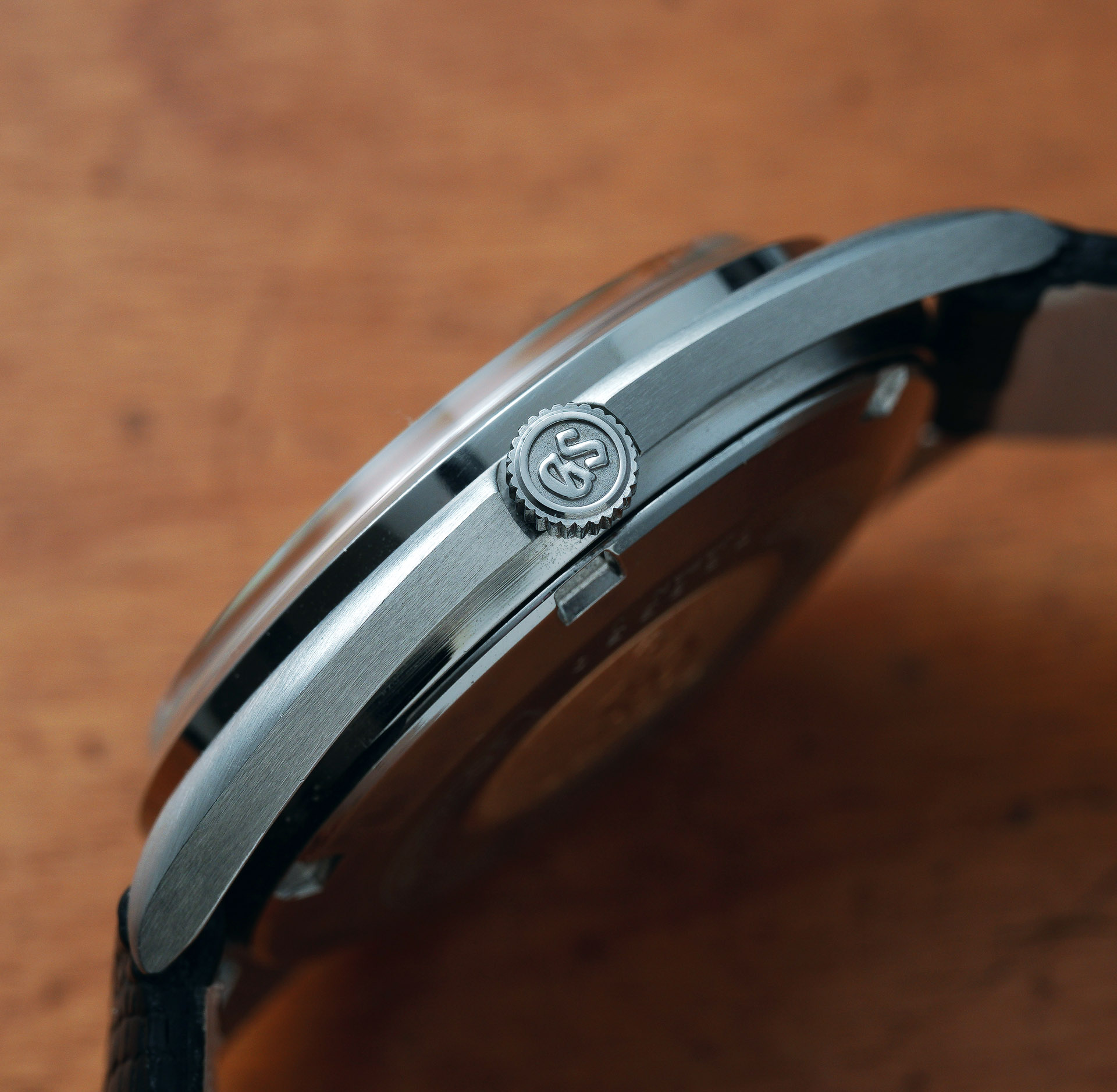
They sit so easily, slipping under a cuff but ready to dazzle at the flick of the wrist. Were it not for that fatal flaw in the design of the movement, their reputation could have been the equal of any of the other Grand Seiko output from this first golden era of the brand.

That flaw though is rectifiable and these lovely watches can live on as a reminder of the glorious closing of the first Grand Seiko chapter.
 Adventures in Amateur Watch Fettling
Great job with this restoration.You mention removing the pinion from the ‘effective cannon pinion’ – what is the best way of going about this, and do you think that a loose cannon pinion can be corrected this way, as it can be with a center wheel cannon pinion? I’ve heard that a doner part is needed.
You can use a box cutter blade to act as a support to lever off the pinion. In principle, I see no reason why you could not tighten the pinion using a jewelling tool in the same way that you might tighten a regular cannon pinion but I have not yet tried this. It’s on the list of things I want to look at in the next few weeks.
Happy New Year Martin! Really love your work and please keep it up!
All the best!
Thank you Philip! I appreciate the support!
What a gripping read to start the new year.I have had a just spent the most enjoyable half hour reading and then re-visiting the journey so kindly shared, thank you.
The end result is a watch I would have initially looked past as a model but would be proud to wear after such an investment of time and skill.
Thank you Raymond. I really appreciate the kind words.
Hi Martin,
I’m glad to see you’re still posting in 2025.
Best wishes and many new projects for this new year!
Hi Marcos,
Thanks! Yes, plenty more to come, hopefully.
Perhaps it’s a measure of how much I need to get a life, but I’ve been on tenterhooks for months now waiting for an update on the 56xx series lift angle.. 🙂 I now never know whether to set my timegrapher to 56, 52 or something in-between!
Hi Neil, I’ve not had time to perform a forensic measurement but I reckon 52 degrees is close enough to the correct value. It’s probably not worth sweating over plus or minus 0.5 or 1 degrees from that ballpark value.
Thank you! Yes, I don’t think it makes a huge difference but it’s nice to be correct.. 🙂
thank you so much for the piece on this watch. I inherited the 56GA a number of years ago and have just recently started wearing it. It has a spiedel bracelet that is a little small. I would love any advice on a suitable replacement band. Cheers
Hi Martin,
Originally these watches would have been fitted with a black crocodile strap and to my mind this would be the ideal choice now. In the post on the blog you will see perhaps that I fitted a nice black lizard strap to mine and I am really happy with how that looks and wears. There are lots of options for how you might go depending on how much money you want to spend. Genuine lizard straps are much cheaper than genuine crocodile but you could opt for a plainer or embossed leather to keep the cost down. I would recommend finding a strap without edge stitching. I hope that helps.
All the best
Martin
thank you
I have just started enjoying the watch. I just spent $475 for a service and repair of the quick set. Parts came from Australia to California. My watch maker said my model was collectible and worth over $5,000. I am not sure where he got that number since my searches don’t show that. The hands and number marks are silver rather than black but I don’t see any other differences. Thanks for any insight
Martin in Sacramento
Hi Martin,
Your watch is certainly collectable but if it is the steel-cased version then it may be worth somewhere between 15 and 25% of what your watchmaker valued it at, depending on condition. The solid gold cased versions are worth a lot more but even those would be nowhere near $5000.
All the best
Martin